HOMELANDS
Restoration. Sovereignty. Recognition.
Restoration. Sovereignty. Recognition.
HOMELANDS
Visibility Through Art 2019
By its third year, Visibility Through Art had grown beyond its beginnings as a supplement to Nisenan Heritage Day, emerging as a distinct community program rooted in artistic collaboration, Cultural revitalization, and Nisenan visibility.
Building upon the trust and partnerships established during its first two years, the 2019 exhibition reflected an important evolution in the program. While local artists continued to collaborate in support of CHIRP (now HUṠWEJ’s) mission, an increasing number of Nisenan Tribal members shared their own artwork and creative voices, marking a meaningful shift toward a more Tribal-forward expression of Visibility Through Art. Together, these works invited visitors to engage with the enduring presence of the Nisenan People through themes of Homeland, identity, memory, and Cultural continuity.
Looking back, the 2019 exhibition represents an important turning point in the development of the Visibility Through Art initiative. The relationship cultivated during these formative years laid the foundation for the program’s continued growth – from an annual opening art reception for Nisenan Heritage Day, to the opening of ‘UBA SEO: Nisenan Arts & Culture in 2021, and today, to a broader ecosystem of Nisenan Tribal arts programming and Cultural enrichment that continues to grow through the gallery and the Homeland Return of Yulića.
Visibility Through Art & Cultural-Sensitivity
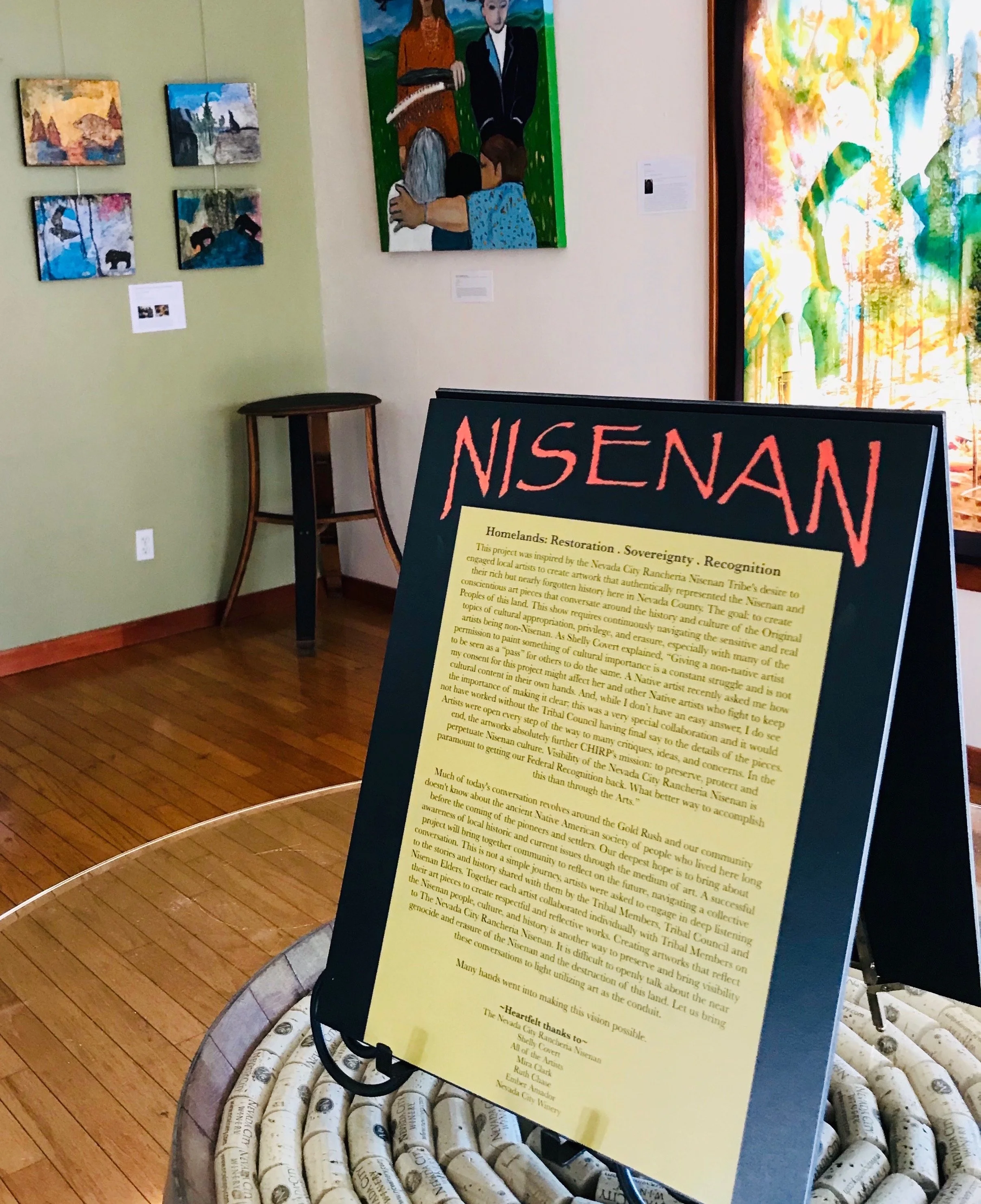
This show required continuously navigating the sensitive and real topics of cultural appropriation, privilege, and erasure, especially with many of the artists being non-Nisenan.
As Shelly Covert explained,
“Giving a non-native artist permission to paint something of cultural importance is a constant struggle and is not to be seen as a “pass” for others to do the same. A Native artist recently asked me how my consent for this project might affect her and other Native artists who fight to keep cultural content in their own hands. And, while I don’t have an easy answer, I do see the importance of making it clear; this was a very special collaboration and it would not have worked without the Tribal Council having final say to the details of the pieces. Artists were open every step of the way to many critiques, ideas, and concerns.
In the end, the artworks absolutely further CHIRP’s mission: to preserve, protect and perpetuate Nisenan culture. Visibility of the Nevada City Rancheria Nisenan is paramount to getting our Federal Recognition back. What better way to accomplish this than through the Arts.”
Much of today's conversation revolves around the Gold Rush and our community doesn't know about the ancient Native American society of people who lived here long before the coming of the pioneers and settlers. Our deepest hope is to bring about awareness of local historic and current issues through the medium of art. A successful project will bring together community to reflect on the future, navigating a collective conversation.
This is not a simple journey, artists were asked to engage in deep listening to the stories and history shared with them by the Tribal Members, Tribal Council and Nisenan Elders.
Together each artist collaborated individually with Tribal Members on their art pieces to create respectful and reflective works. Creating artworks that reflect the Nisenan people, Culture, and history is another way to preserve and bring visibility to The Nevada City Rancheria Nisenan.
It is difficult to openly talk about the near genocide and erasure of the Nisenan and the destruction of this land. Let us bring these conversations to light utilizing art as the conduit.
Many hands went into making this vision possible.
EXHIBITING
Consulting Nevada City Rancheria Nisenan Tribal Members: Ginger Covert, Lorena Davis, Sarah Thomas, Saxon Thomas, Cassandra Johnson, Shelly Covert, Karen McCluskey, and Richard Johnson. IN SPIRIT, Dutch Rose, Carmel, Jackson Rose, Alberta “Birdie” Gallez, and Maryann Start.
Participating Artists: Ron Kenedi, Chloe Young, Jarod Kane, Mira Clark, Alyssa Walz, Jennifer Rugge, Bishop Randall, Bo Blain, Rama Cryer, Teighlor Renee Anderson, Jenny Hale, Jessa Hurst, Lori Lachman, Andy Cerrona, Miles Toland, Indigo Donaldson, Leilani Webb
I Heard Their Stories
by Lorena Rose Davis
Nevada City Rancheria Tribal Member
It began with vague thoughts and whispers
entering my dreams at night,
telling me to go back, to our ancestral site.
I went into the mountains to see if I could find
my once forgotten heritage, I'd gladly left behind.
They say it's in our memories of the one's so long ago
handed down from generations, to those who choose to know.
With much fasting and prayer as I sat there
not knowing what to expect,
when all of a sudden, the ground began to shake.
They came around midnight, a ghostly eerie sight to see
singing songs and chanting,
dancing around the campfire and me.
Their eyes were like fire, faces chiseled from stone
then I heard their stories told in a ghastly moan.
The things they endured for so many years.
I heard their stories sounds of screaming in my ears.
These faces so strong were now streaming with tears.
My mind was racing, heart beating fast
looking into the faces I knew were from my past.
I came away from that mountain with a heart full of pride
even though I'd tried to hide.
My family and ancestors, had never denied me.
Gallery of Artworks
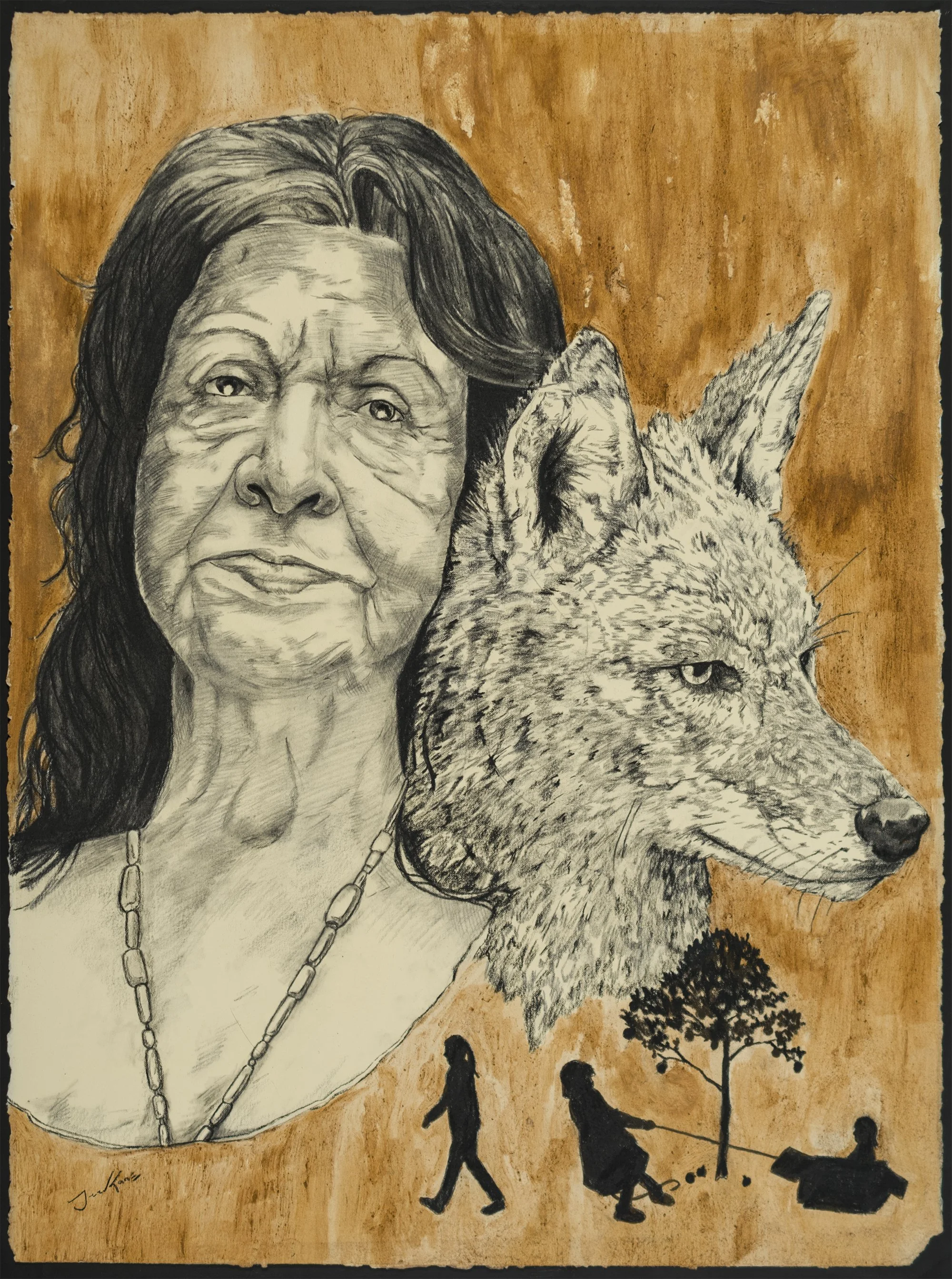
Birdie by Jarod Kane, ellugallery.com/jarod-kane Charcoal and clay Featuring Alberta “Birdie” Rose Gallez ____________________________________________ It has always been the primary function of myth to provide the right symbols to carry the human spirit forward, to contradict those constant fantasies that would hold us back. Through the stories of Coyote we learn of a trickster or of someone who meddles. Coyote can do what we shouldn’t do or say what shouldn’t be said. Through the stories of Coyote we learn life lessons and perhaps some fun.
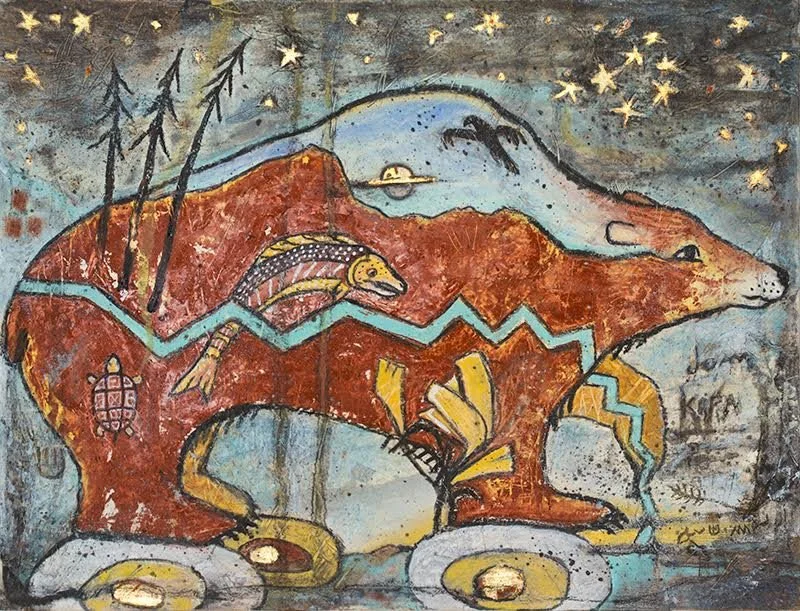
Kapa (Bear) By Jennifer Rugge Mixed media, papers, mineral paints, gold leaf, charcoal and cold wax. Collaboration with Nevada City Rancheria Spokesperson and Tribal Council Member Shelly Covert ___________________________________________ In the painting, kapa holds and protects sacred Nisenan beings and the Sacred Mountain, 'estom yanim is etched along his back. If you look closely, other important Nisenan symbology can be found as-well-as great animal beings who are completely gone or in danger of disappearing. We are grateful to artist Jennifer Rugge for creating this image exclusively for our 10th Anniversary Nisenan Heritage Day poster and merchandise. The Mountain Lion, pekun, watches and protects. It is a symbol of leadership, the balance of power, intention, physical strength, and grace or as the balance of body, mind and spirit. Here the shoulders and back of pekun reflect the ridge of the sacred mountain, ‘estom yanim.
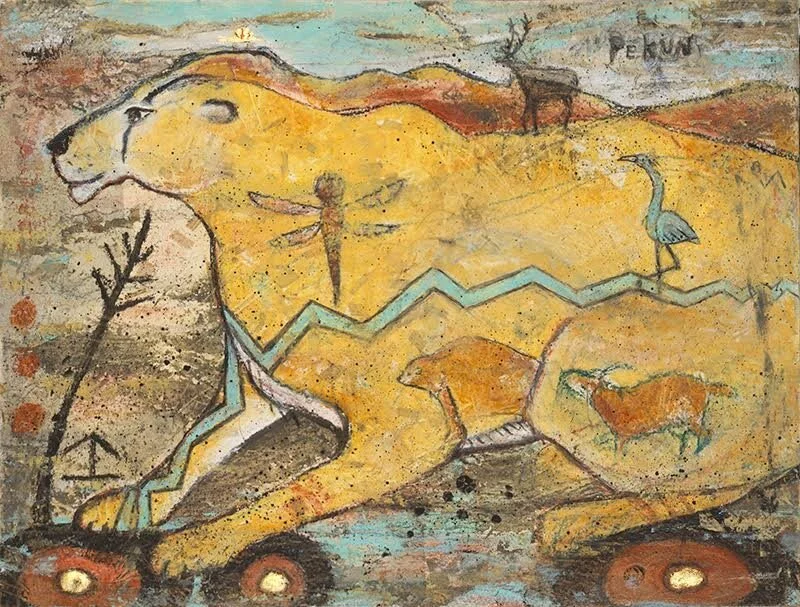
Pekun (Mountain Lion) By Jennifer Rugge Mixed media, papers, mineral paints, gold leaf, charcoal and cold wax. Collaboration with Nevada City Rancheria Spokesperson and Tribal Council Member Shelly Covert ___________________________________________ In the painting, kapa holds and protects sacred Nisenan beings and the Sacred Mountain, 'estom yanim is etched along his back. If you look closely, other important Nisenan symbology can be found as-well-as great animal beings who are completely gone or in danger of disappearing. We are grateful to artist Jennifer Rugge for creating this image exclusively for our 10th Anniversary Nisenan Heritage Day poster and merchandise. The Mountain Lion, pekun, watches and protects. It is a symbol of leadership, the balance of power, intention, physical strength, and grace or as the balance of body, mind and spirit. Here the shoulders and back of pekun reflect the ridge of the sacred mountain, ‘estom yanim.
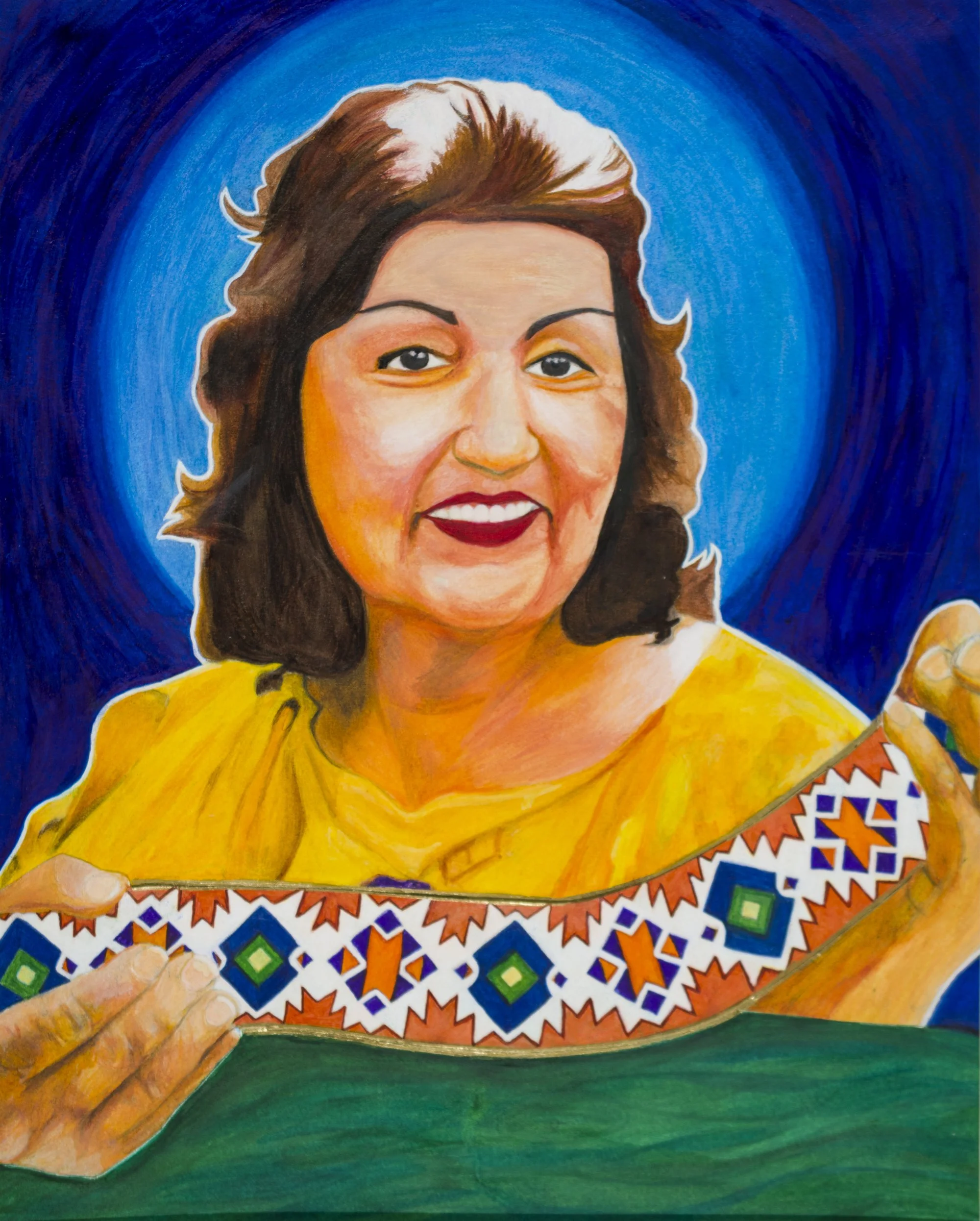
Carmel Rose Jackson, Restored. Alyssa Walz Pencil, Colored pencil, Ink ___________________________________________ Featured in this image is Matriarch Carmel Rose Jackson b. 1921, photographed with a traditional Nisenan dancing belt wrapped around her head. During the photoshoot the Non-Nisenan photographer asked Carmel to tie her dancer’s belt around her head—even though it did not belong there. She did not want to embarrass the photographer so she posed that way. This is a classic example of how culture can become misrepresented by outsiders which further contributes to erasure. This art piece reclaims the true purpose and tradition of the Nisenan dancing belt. This art piece is intended to allow Carmel’s portrait to be viewed as it should have been originally, without her dancer's belt on her head.
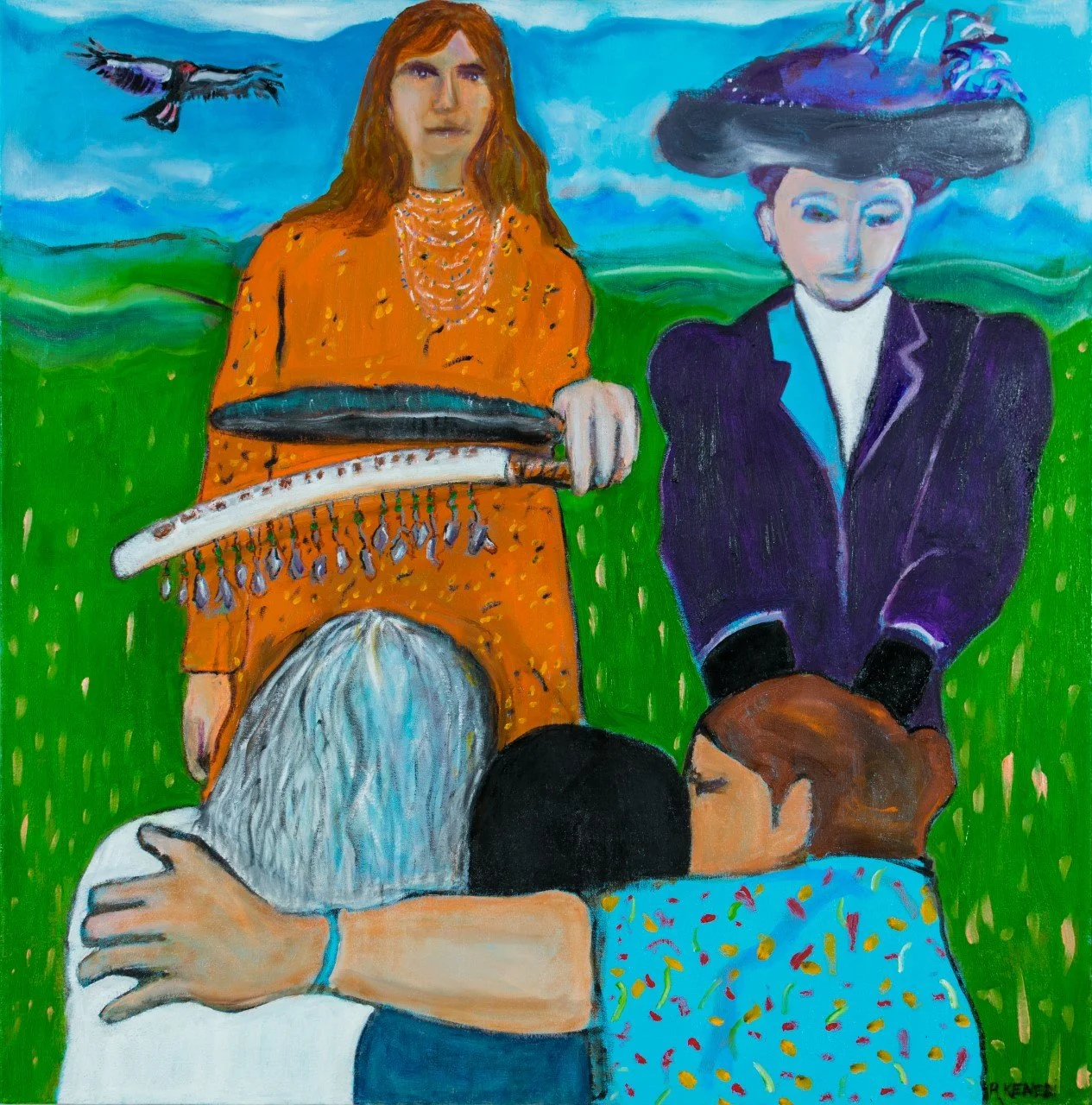
Action Caused by Love, by Ron Kenedi. Oil on canvas ___________________________________________ The painting depicts two important advocates for the Nevada City Rancheria, Belle Douglas and Shelly Covert...though separated by a century both provide support and action for the betterment of the Nisenan people. Images of Tribe members, California condor, and the foothills are also represented. The work is meant to elicit a feeling of safety among the people, animals, and homeland while paying well deserved homage to advocates.
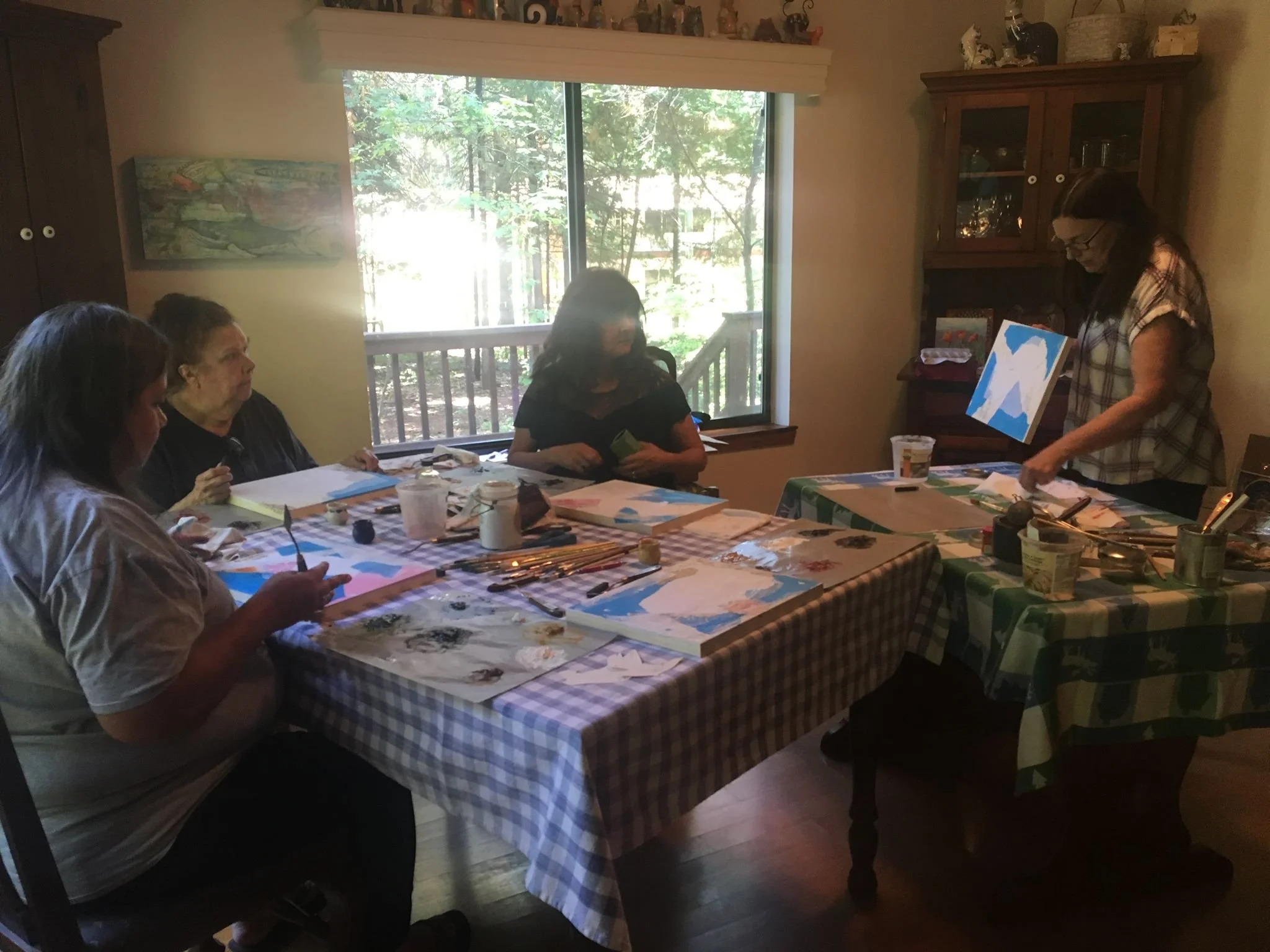
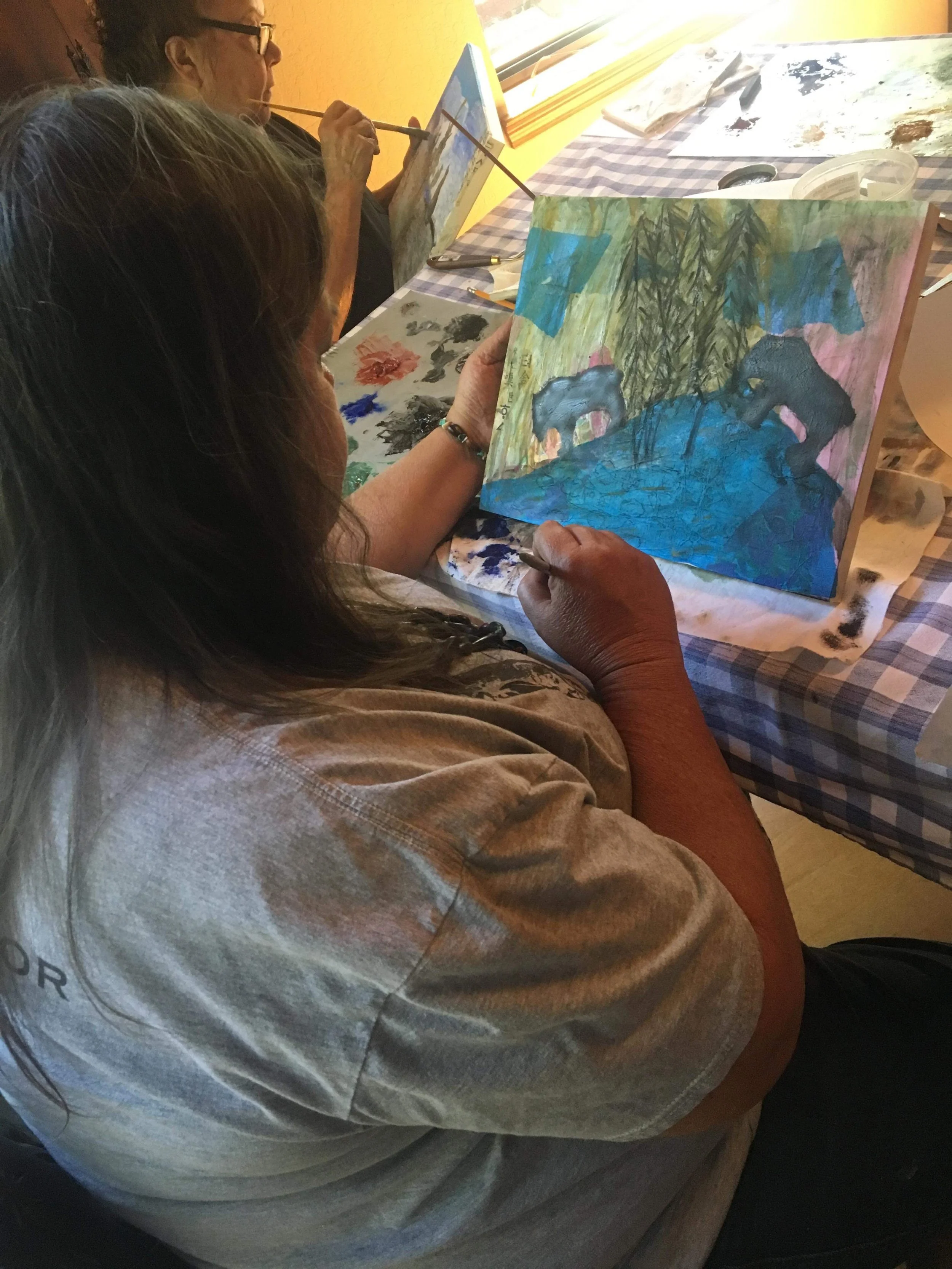
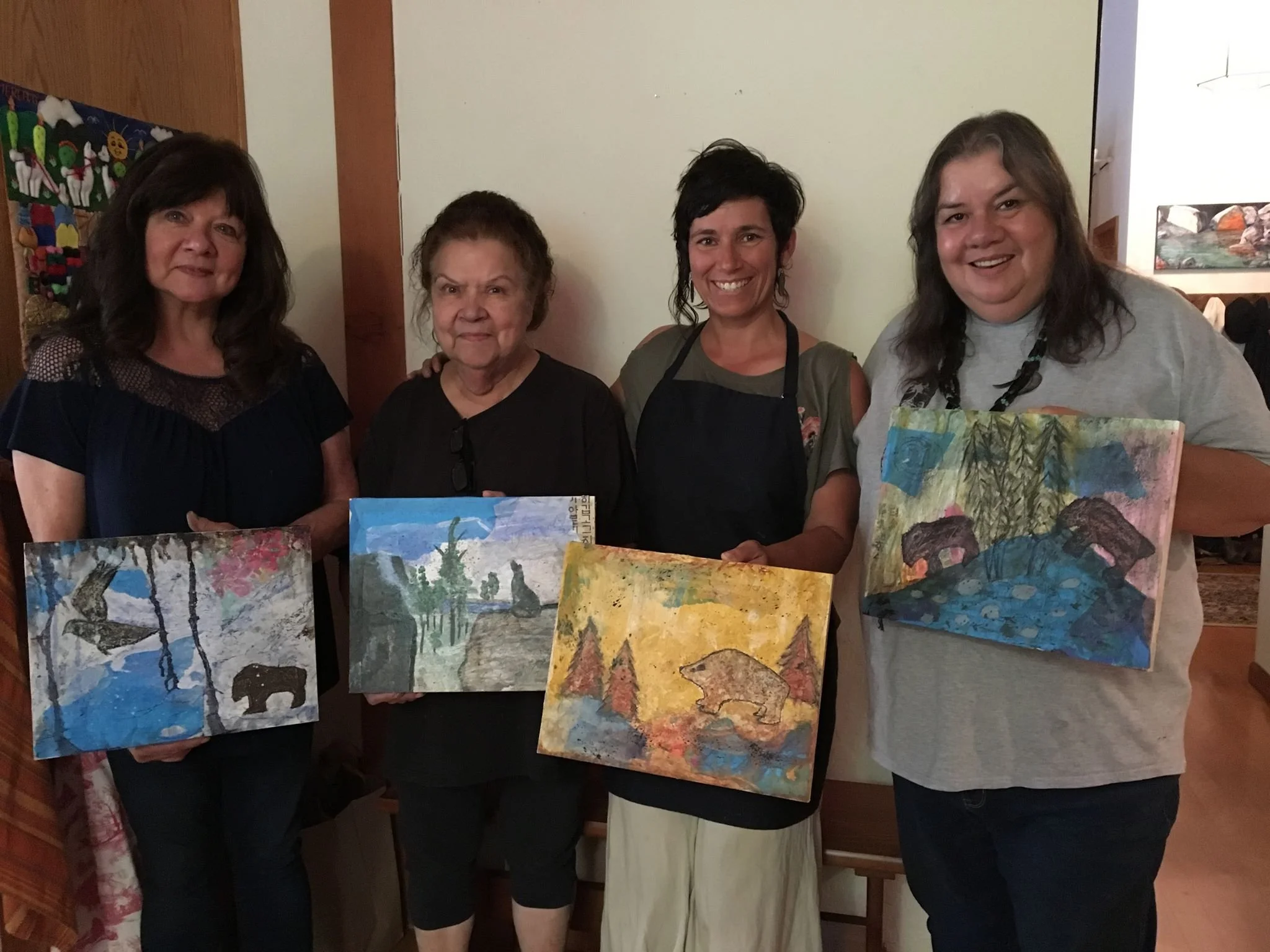
Earth Minerals in Painting, a Workshop with Tribal Members. Artwork by NCR Nisenan Tribal Member: Ginger Covert. Mixed media using papers, charcoal, and mineral paints ___________________________________________ With Earth Artist, Jennifer Rugge, Tribal members learned the skill of mixing natural mineral pigments into paints and their application to create organic works of Art on wood panels. Members worked individually mixing paints with oil and beeswax, designing and finishing their art pieces. At the conclusion of the workshop, it was realized that each painting represented a Season.
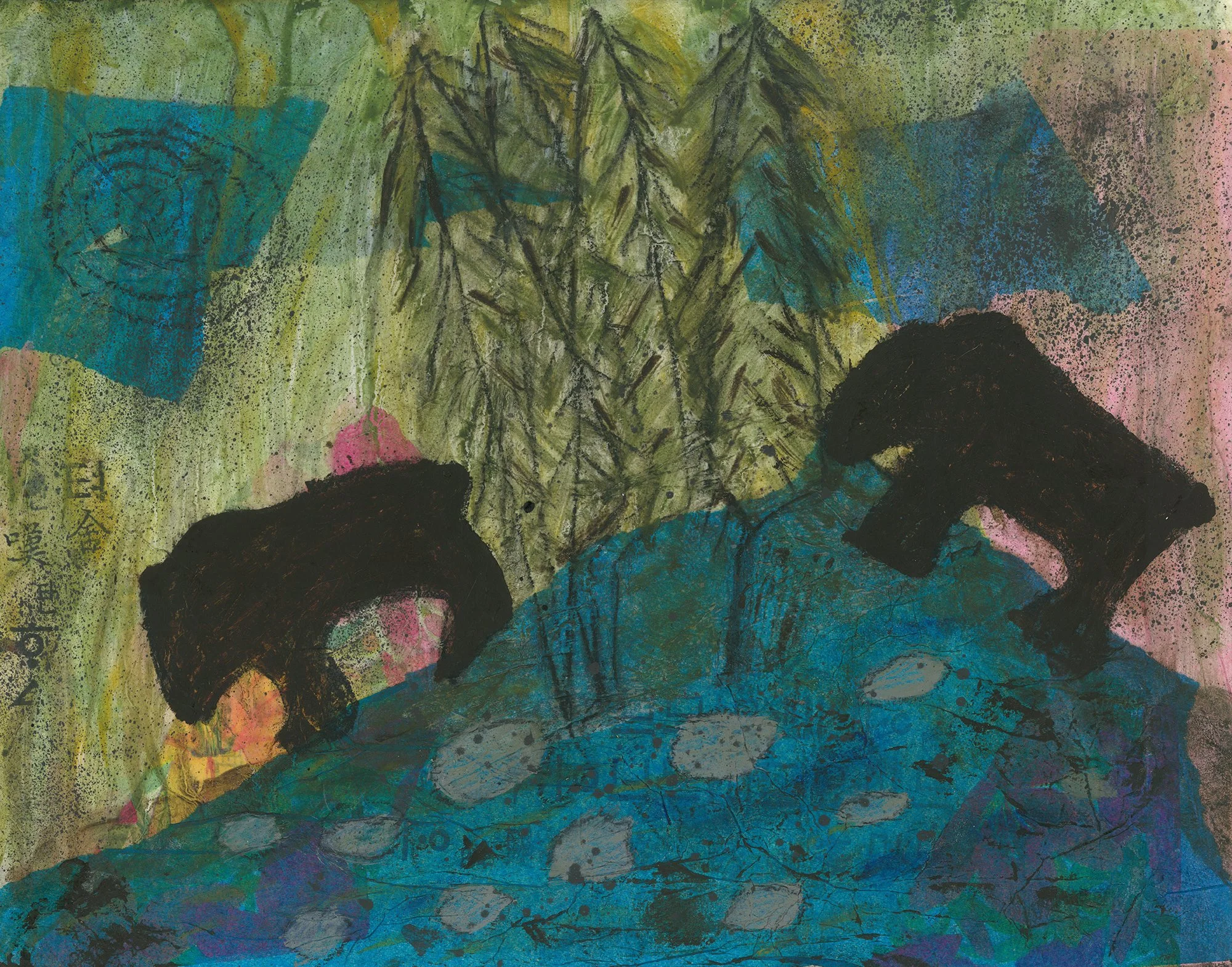
Earth Minerals in Painting, a Workshop with Tribal Members. Artwork by NCR Nisenan Tribal Member Sarah Thomas. Mixed media using papers, charcoal, and mineral paints ___________________________________________ With Earth Artist, Jennifer Rugge, Tribal members learned the skill of mixing natural mineral pigments into paints and their application to create organic works of Art on wood panels. Members worked individually mixing paints with oil and beeswax, designing and finishing their art pieces. At the conclusion of the workshop, it was realized that each painting represented a Season.
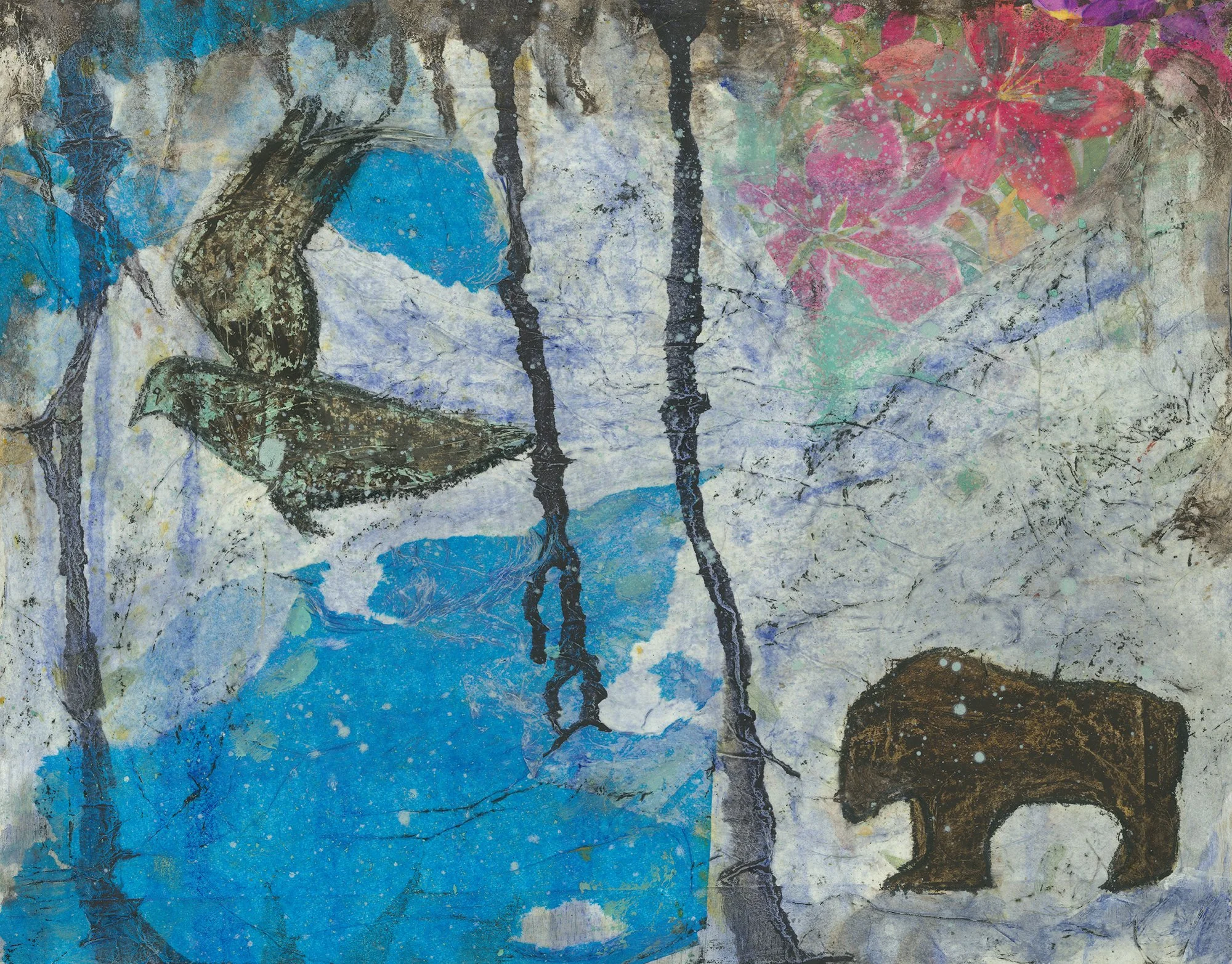
Earth Minerals in Painting, a Workshop with Tribal Members. Artwork by NCR Nisenan Tribal Member Lorena Davis. Mixed media using papers, charcoal, and mineral paints ___________________________________________ With Earth Artist, Jennifer Rugge, Tribal members learned the skill of mixing natural mineral pigments into paints and their application to create organic works of Art on wood panels. Members worked individually mixing paints with oil and beeswax, designing and finishing their art pieces. At the conclusion of the workshop, it was realized that each painting represented a Season.
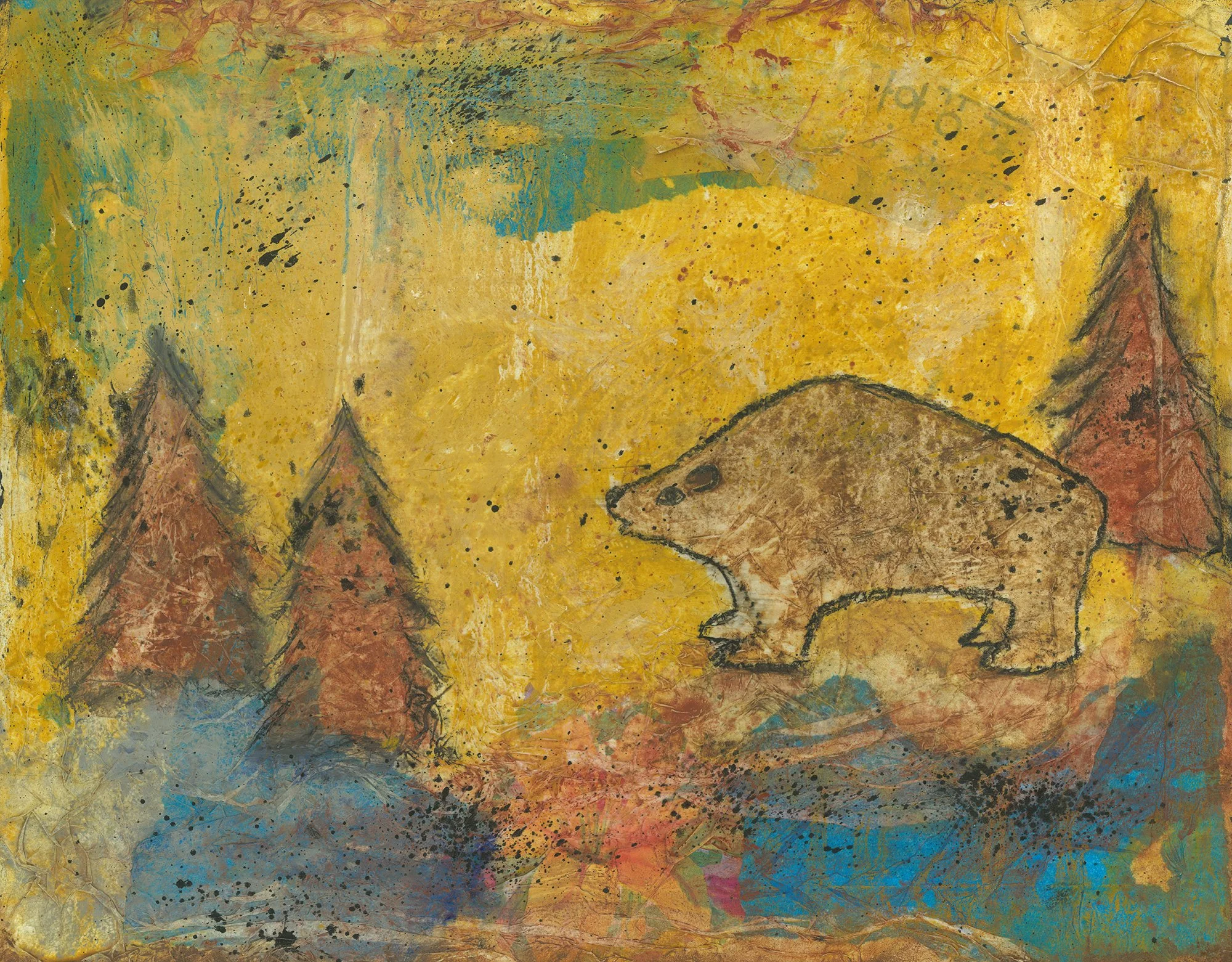
Earth Minerals in Painting, a Workshop with Tribal Members. Artwork by Ember Amador (not a Tribal Member). Mixed media using papers, charcoal, and mineral paints ___________________________________________ With Earth Artist, Jennifer Rugge, Tribal members learned the skill of mixing natural mineral pigments into paints and their application to create organic works of Art on wood panels. Members worked individually mixing paints with oil and beeswax, designing and finishing their art pieces. At the conclusion of the workshop, it was realized that each painting represented a Season.
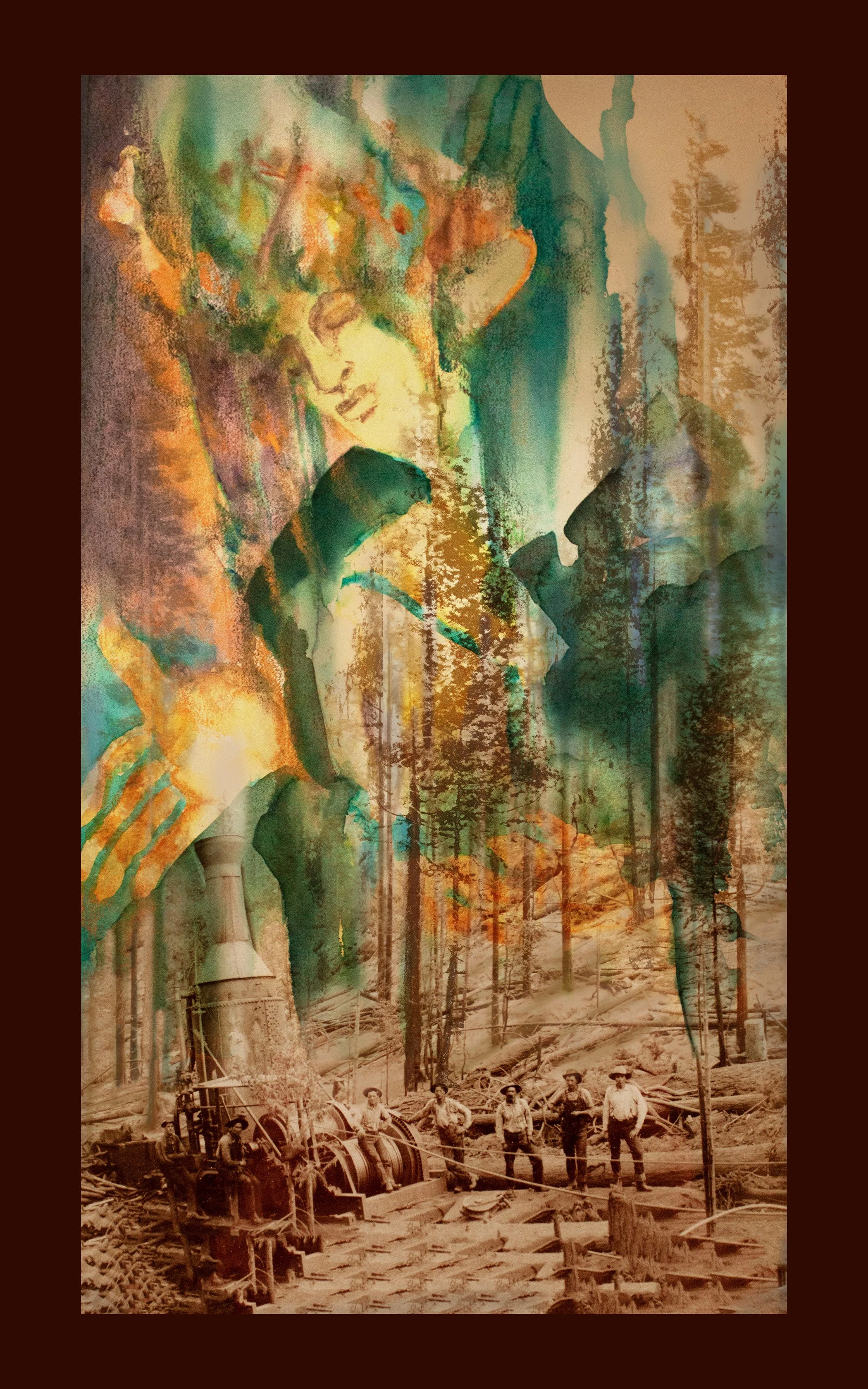
Earth Abides, by Jenny Hale jennyhaledesign.com. Watercolor, digital collage, LED lights Collaboration with Nevada City Rancheria Tribal Vice Chairperson Ginger Rose Covert ___________________________________________ Virginia Rose Covert, known as Ginger, holds the position of Vice Chairperson on the Tribal Council of the Nevada City Rancheria and represents her family in an unbroken leadership line of descendancy. She has been connected to the foothills of the Western Sierra Nevada all her life and is a link to the knowledge and history of the Tribe. While Father Henry “Dutch” Rose was logging in coastal redwood forests, the family lived in the woods. They hunted and gathered and lived off the land. Ginger grew up knowing the plants and creatures of the forest. She knows deer, possum, skunk, bear, frog and snake and they know her. Ginger describes Homeland as something in your body – a spiritual and physical feeling of home. In this artwork – the spirit of the forest watches while 1890’s loggers cut and clear the web of life that supported the Nisenan for thousands of years. Though trees may be felled, rivers rerouted and land washed away - the spirit of the forest will never be destroyed.
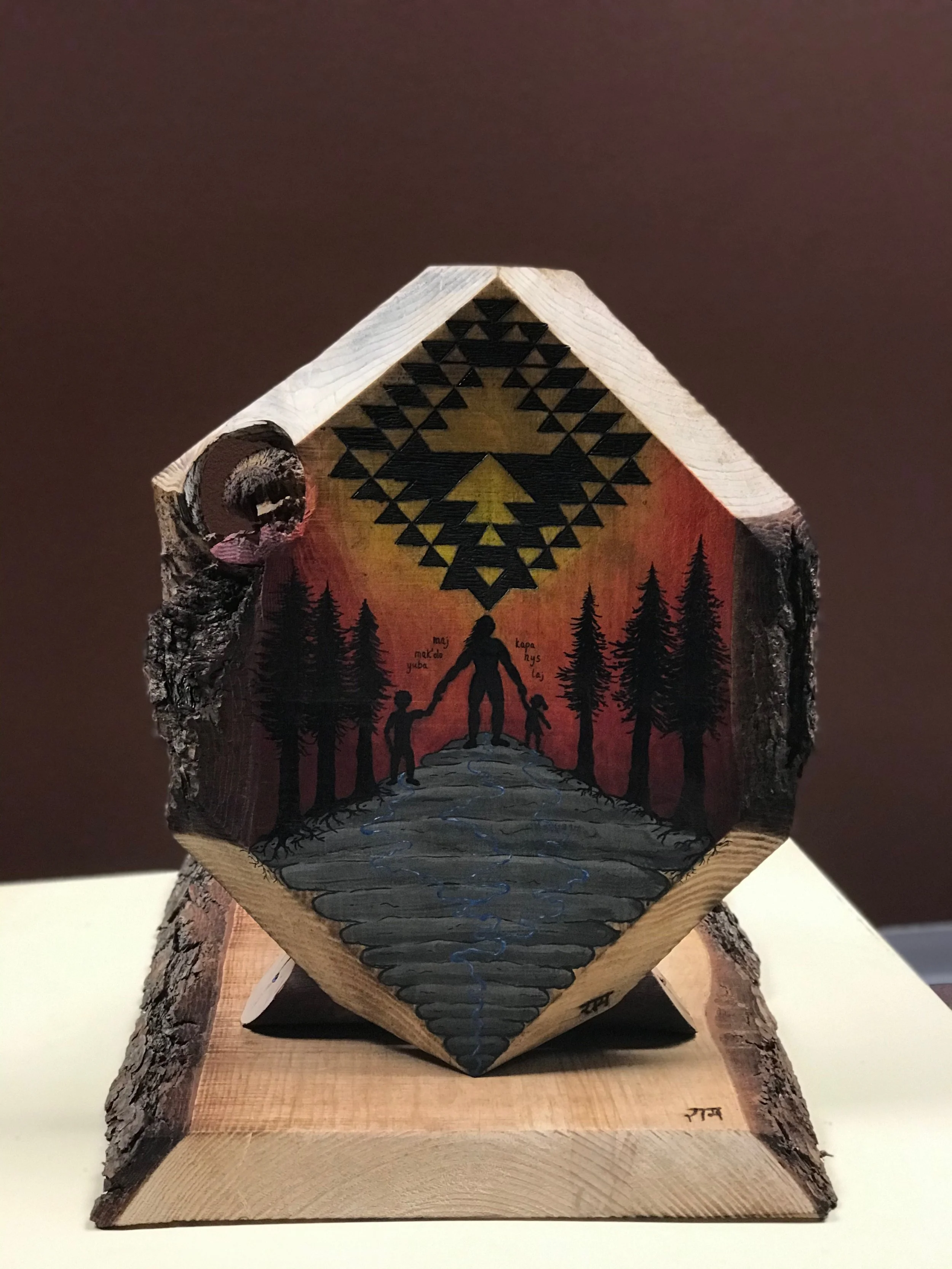
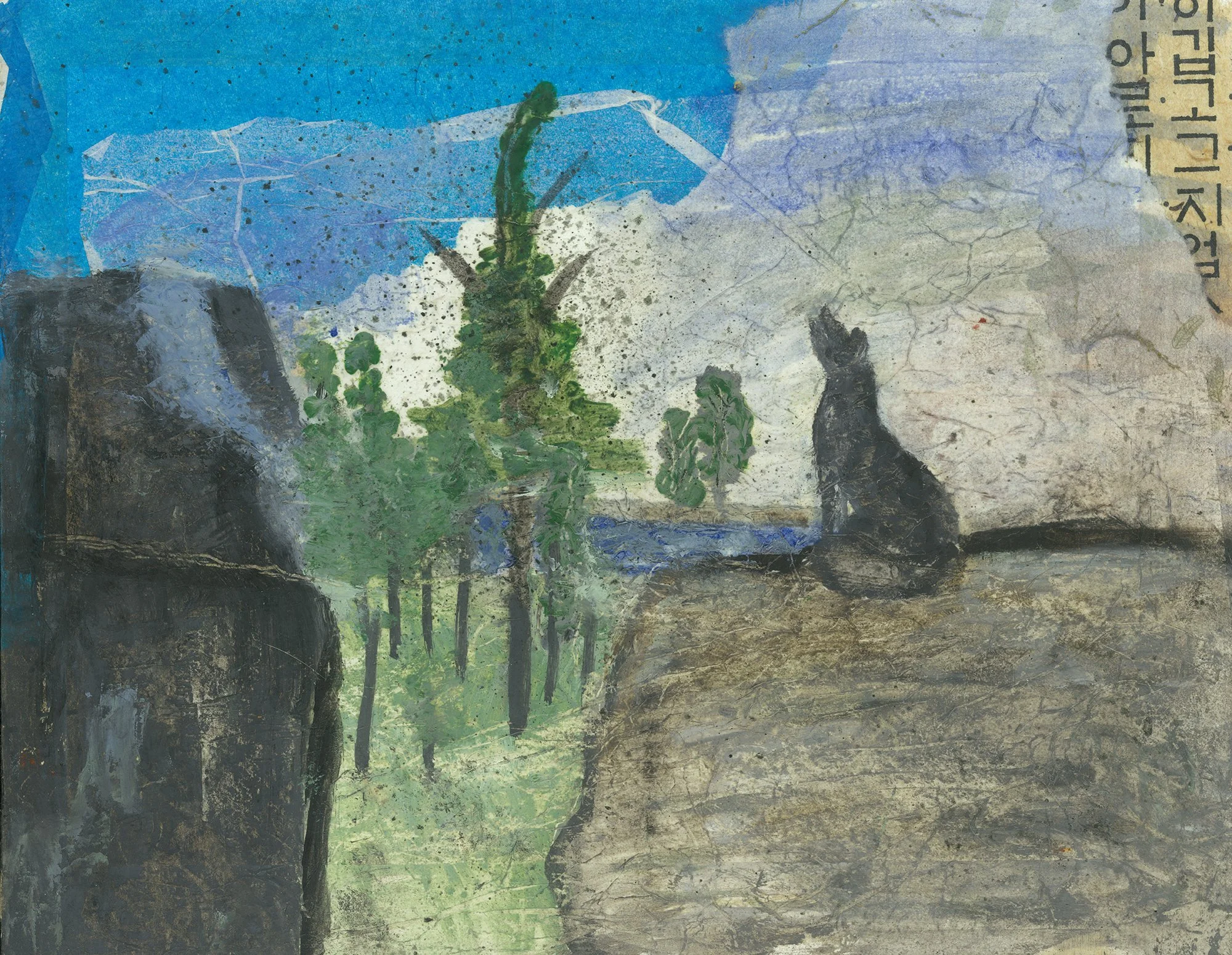
Family Roots by Rama Cryer. Wood burning, acrylic, pen and ink. Collaboration with Nevada City Rancheria Nisenan Tribal Member Cassandra Johnson ___________________________________________ My piece is representative of Cassandra and her kids, the family she loves and will pass on her Nisenan roots too. Atop a granite mountain, she stands silhouetted, removing her from any stereotypes that might question her Indigenous bloodline. Below her flows the three forks of the Yuba river, and above burned into the sky resides traditional patterns found in basket weaving, and words of the language of her people, her legacy soaking into her children.
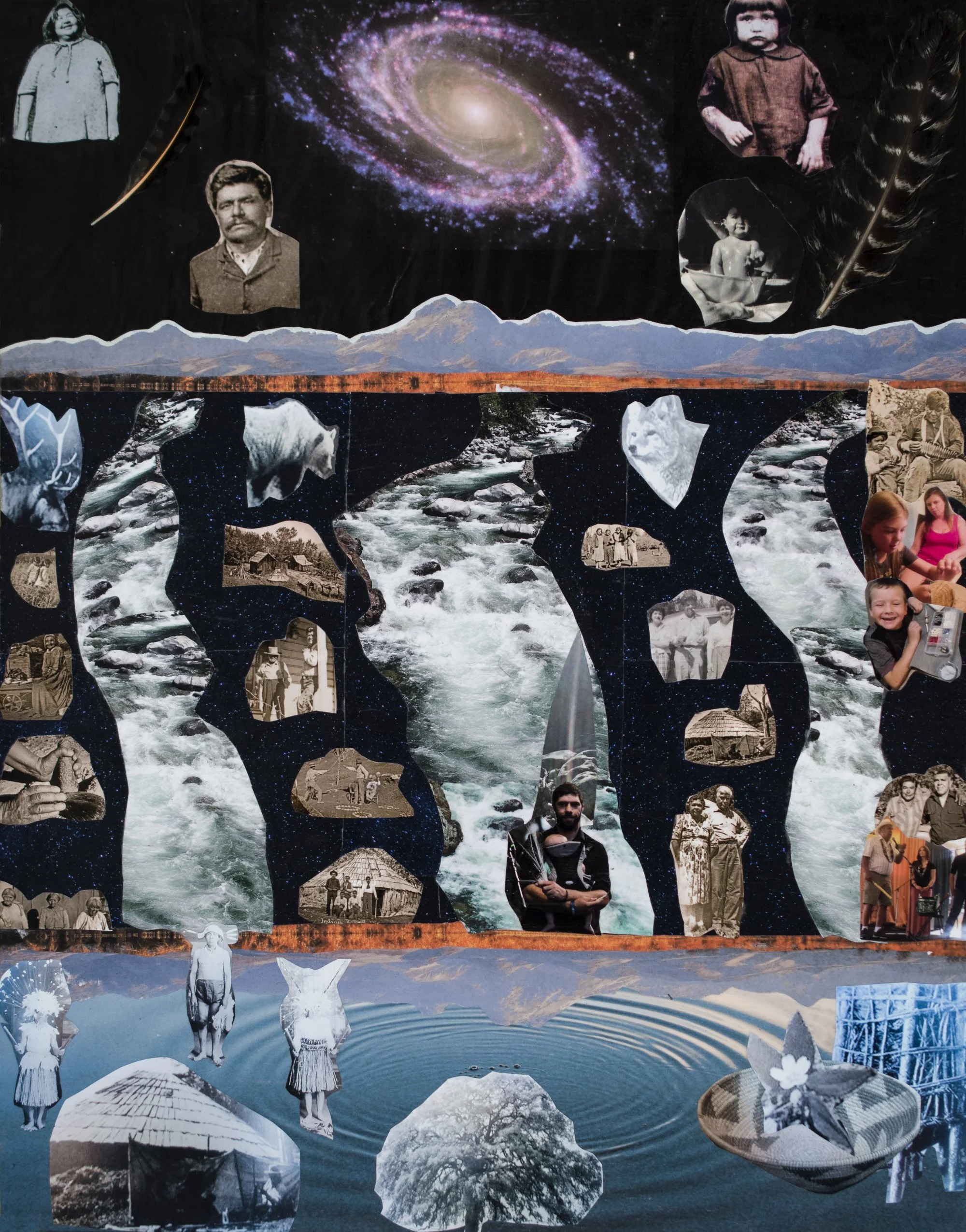
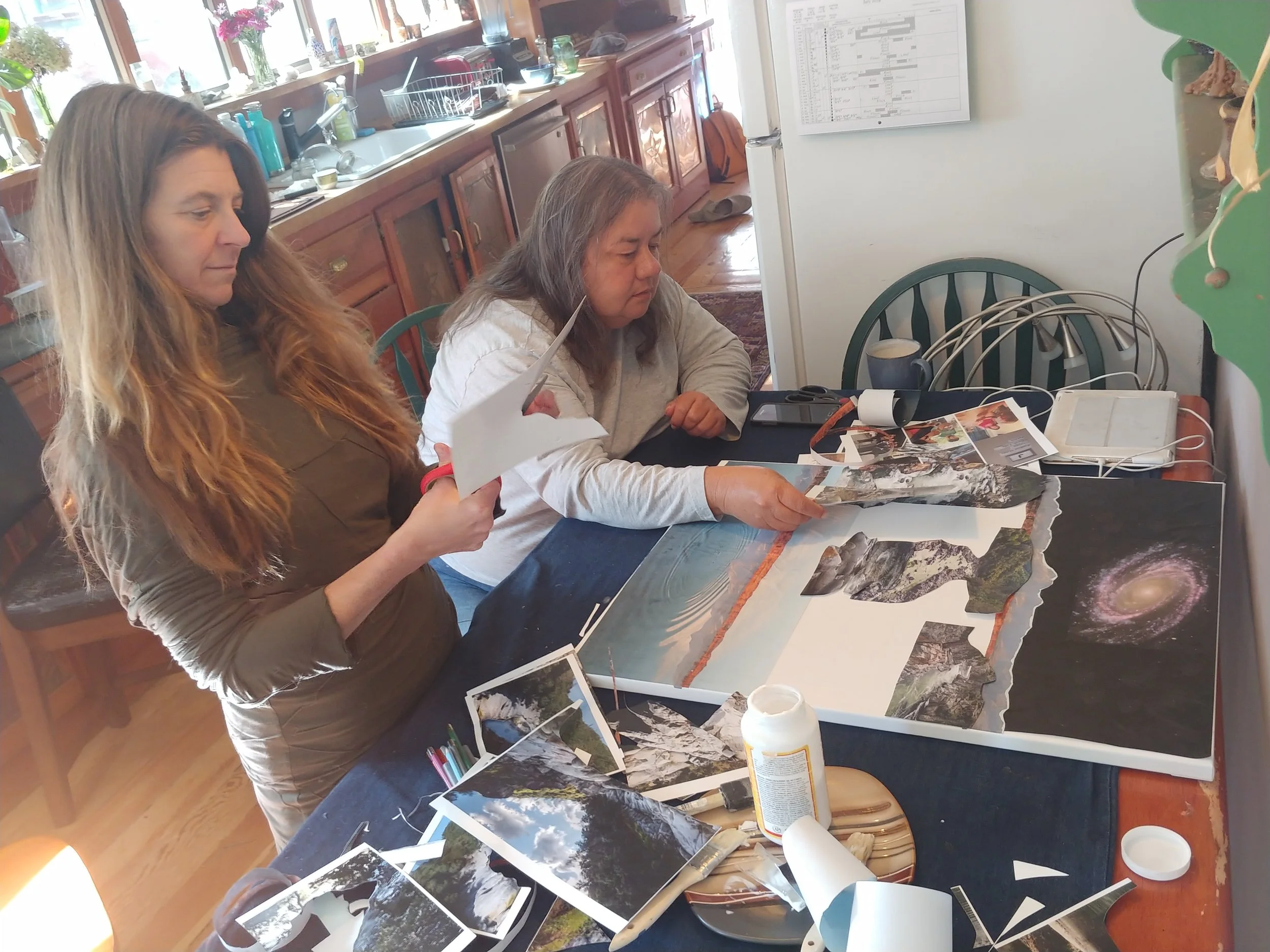
Finding Our Way Back Home by Indigo Donaldson. Collage mixed medium. Collaboration with Nevada City Rancheria Tribal Council Member Sarah Thomas ___________________________________________ The message we would like to convey in this piece is the reassurance to our Ancestors that everything they went through was for us and the fruits of their work are ripening now. That the seed they planted has always been there, gestating, ready to sprout and grow and now the conditions are right for that to happen. Our children and grandchildren are starting to learn the culture and live in some of the ways, to respect our Ancestors, their knowledge, teachings and wisdom. In this piece the three forks of the river represent our past, present, and future. The ‘estom yanim (Sutter Buttes) are where we come from and where we go when we die, then finding our way up to the Milky Way where we start our journey. The lake represents the place where we all come back together and meet again. The Ancestors are always right here guiding us and watching over the grandchildren. We are heading towards a positive future through the path of recognition and finding our way back HOME. “The process of creating this piece together has been an incredibly positive and healing experience for both of us. It really has helped me to open up and share and put some feelings into words and feel comfortable in sharing with you, the artist. Creativity and ease of ideas and visions for this piece has just flowed with intention and inspiration. Putting emotions and thoughts into words then to art on a canvas is sometimes not an easy thing to do, but this process has been surprisingly easy and fulfilling.” - Sarah Thomas
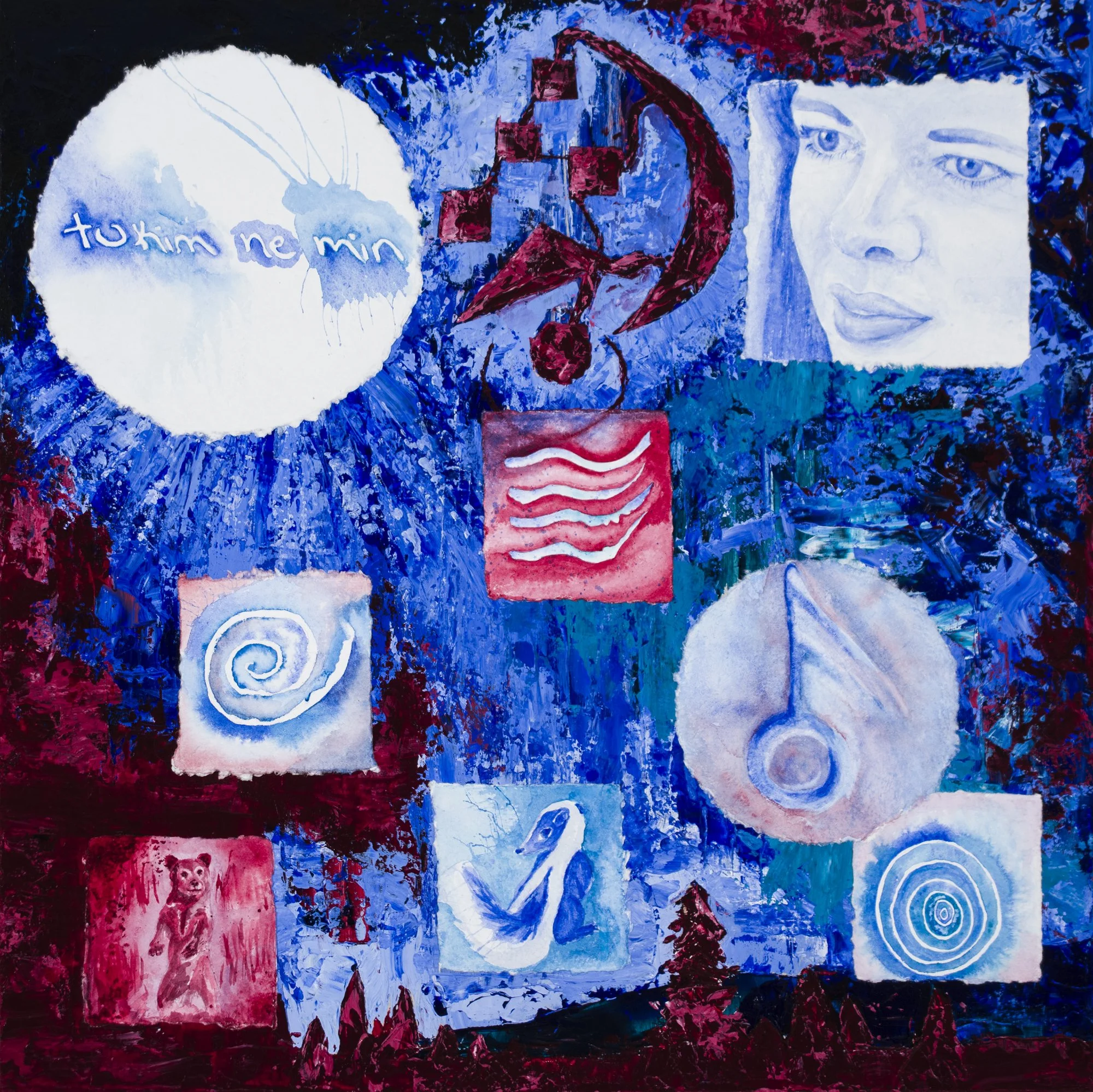
Putting Together the Pieces by Leilani Webb. Acrylic and watercolor on wood. Collaboration with Nevada City Rancheria Tribal Member Karen McCluskey – descendent of the Rose-Potts family line. ___________________________________________ Karen has been “Putting Together the Pieces,” to learn her story and heritage. “tukim ne min,” means I love you in Nisenan. She attends classes with her children to learn the language of her Ancestors and help preserve the legacy of her people. When I asked her what she wants others to know about the Nisenan her simple reply spoke volumes, “We’re still here.” She is still here.
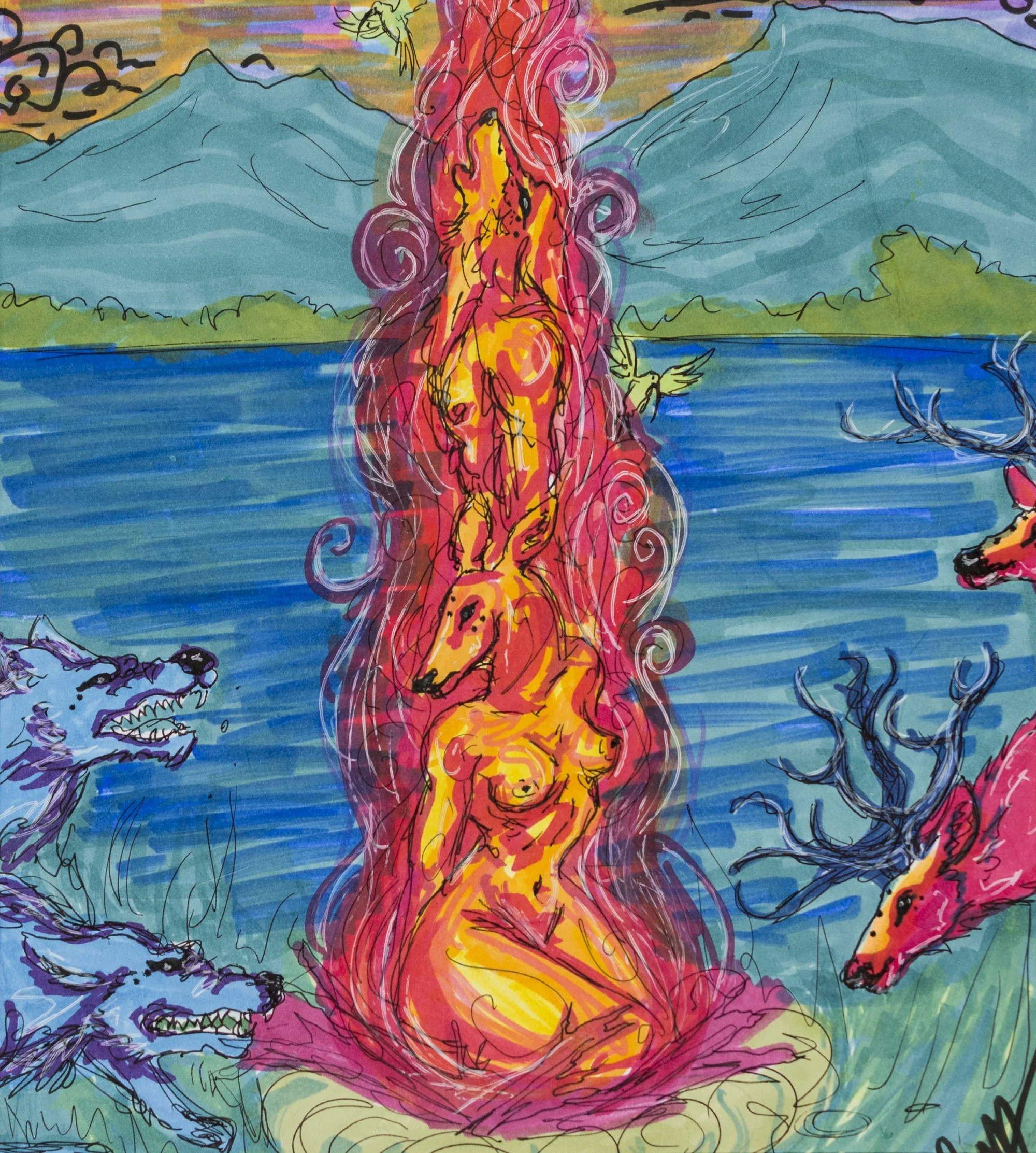
Loud Silence by Chloe Young. Acrylic. Collaboration with Nevada City Rancheria Nisenan Tribal Council Member Saxon Thomas ___________________________________________ This piece is of the ‘estom yanim (Sutter Buttes) with a big fire pit creating dancing smoke that floats up to the sky with the spirit of the wolf and some other forest animals.
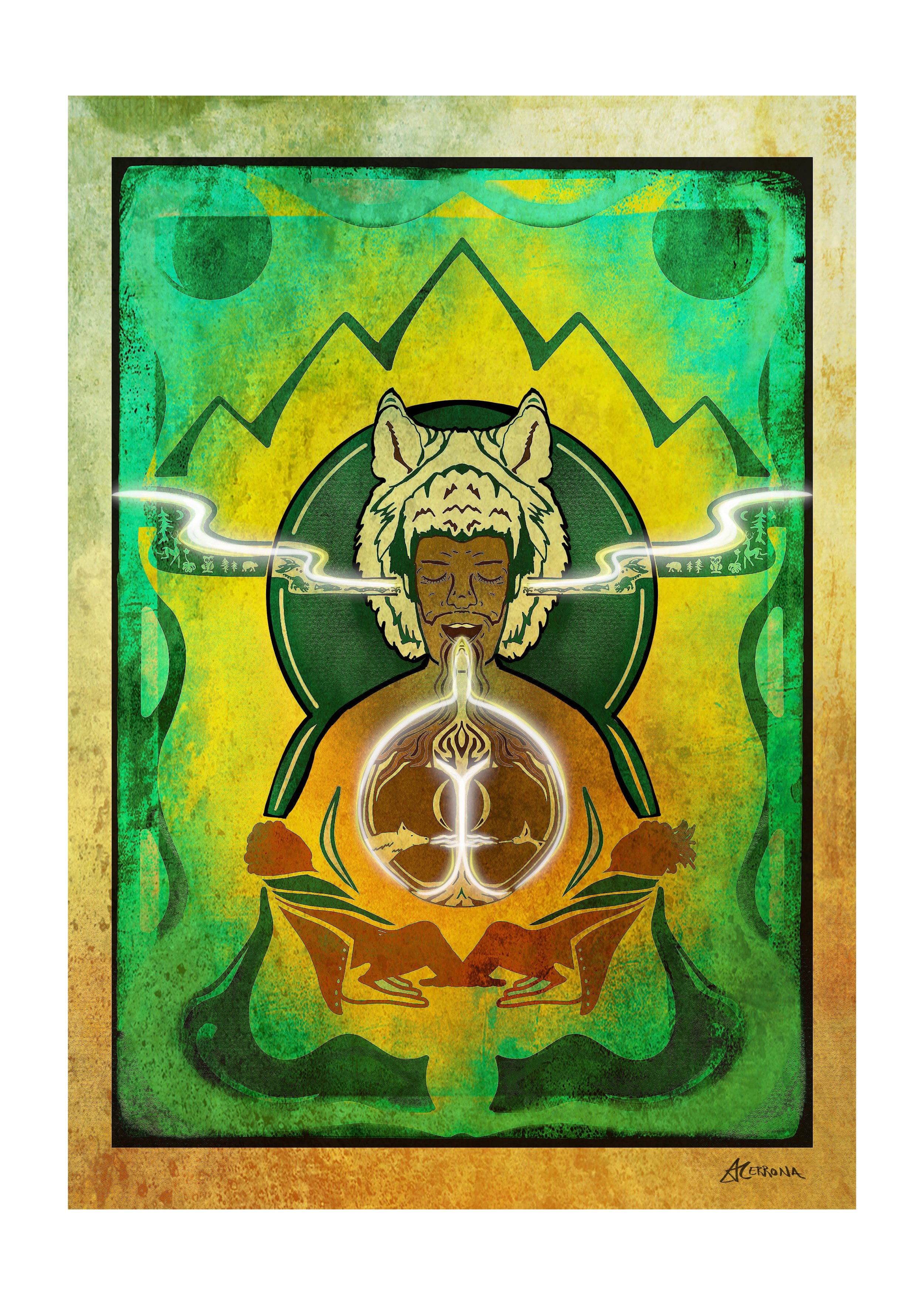
Transmission by Andy Cerrona www.cerrona.com . Digital print on paper Collaboration with Nevada City Rancheria Nisenan Tribal Council Member Saxon Thomas ___________________________________________ This art piece shows Saxon Thomas sharing the gift of native language with his children. The Nisenan language is currently being reclaimed and revitalized by the Nevada City Rancheria Nisenan and their Non-Profit CHIRP. Saxon Thomas
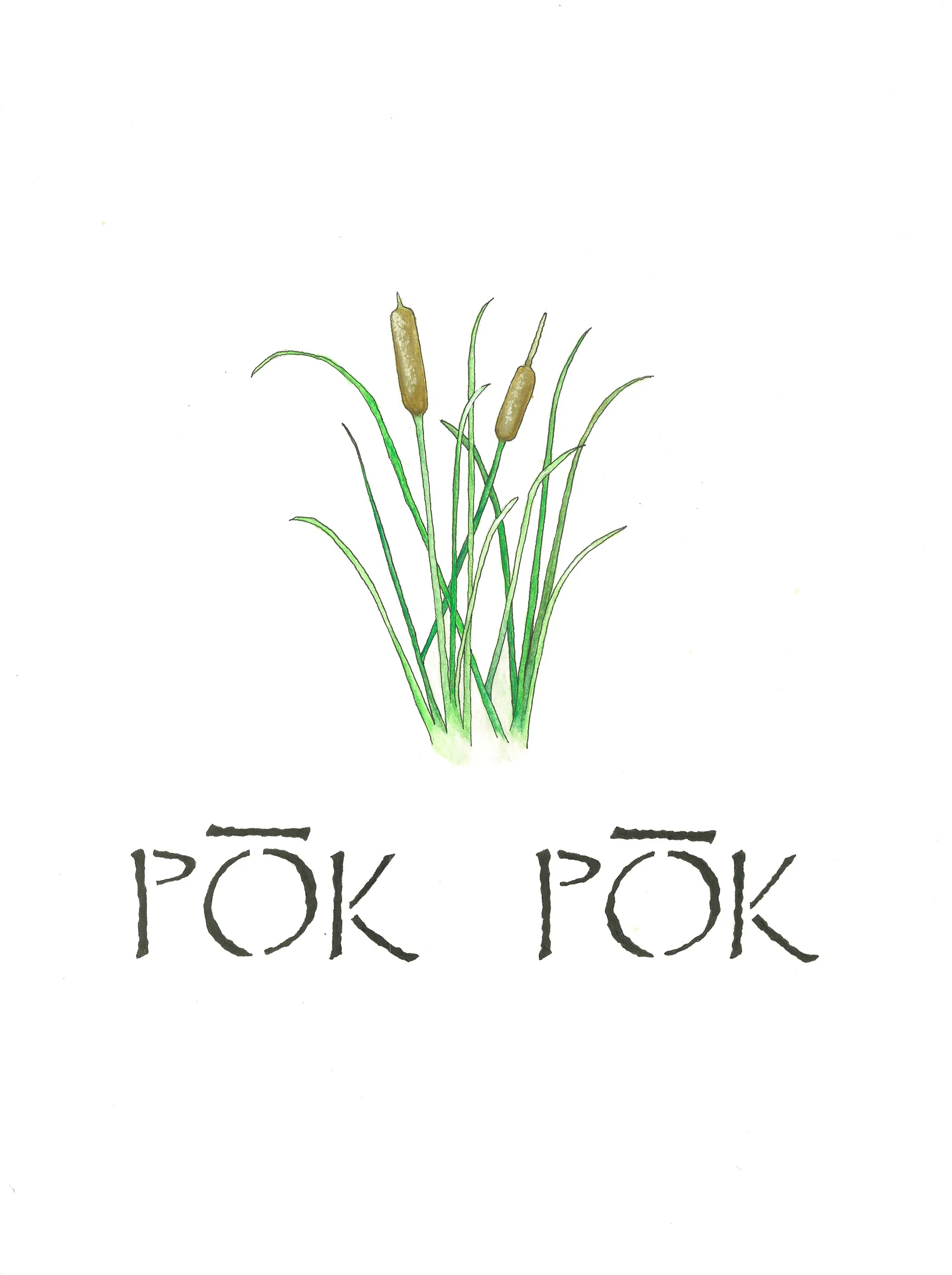
Look Around Series by Teighlor Renee Anderson. Watercolor, Ink ___________________________________________ In history books native people are often referred to in past-tense, though they are still here. Look around. Notice the impact of colonization. Notice the people, plants and animals around you. The Nisenan lived amongst many beings that endured the hardships that came during the Gold Rush, and they themselves did as well. The local language was nearly lost, though here you see plants and animals that persevered, as the resilient Nisenan people of nisem k'auwak' did, with the name they’ve known long before settlers walked this land.
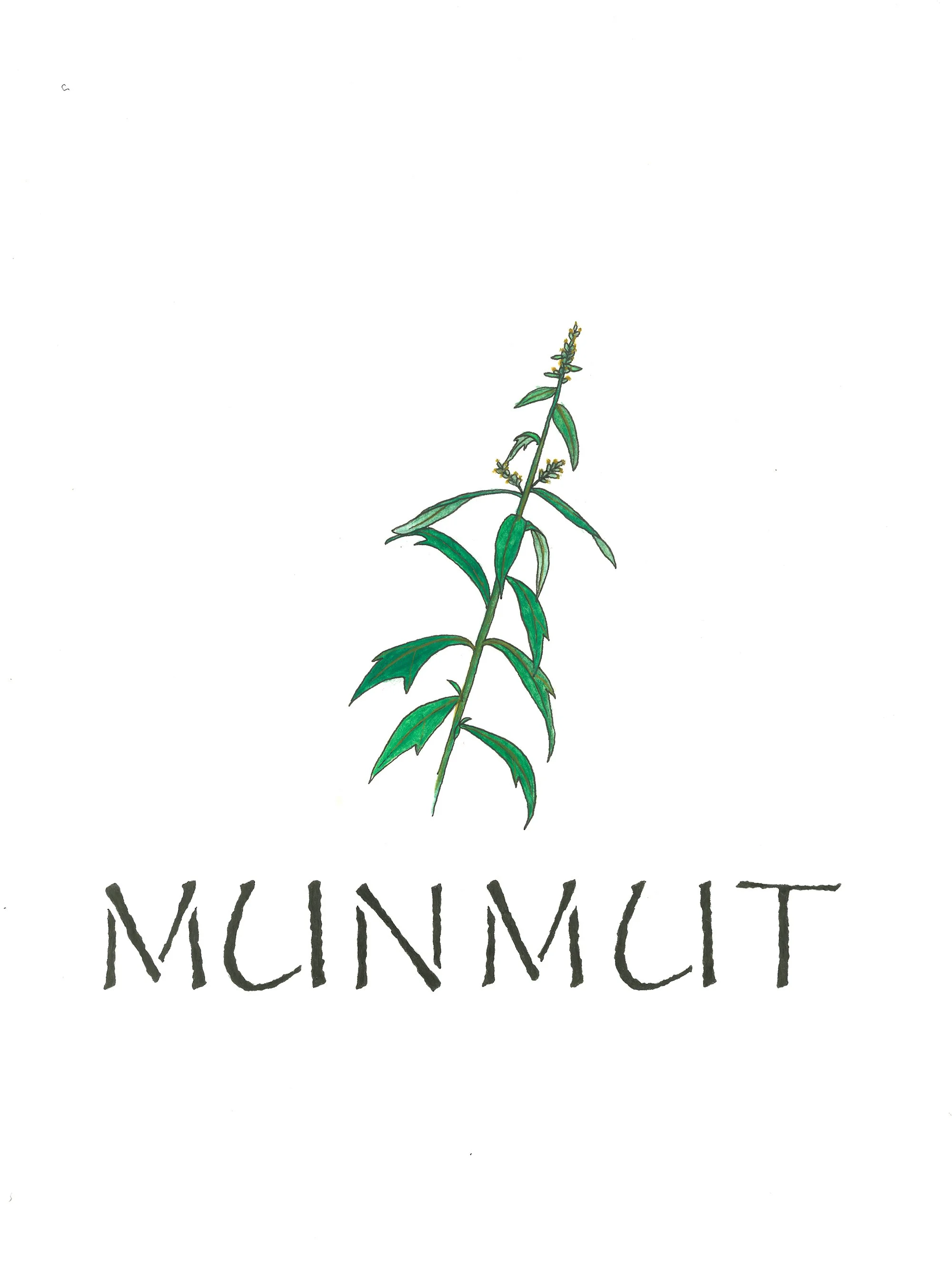
Look Around Series by Teighlor Renee Anderson. Watercolor, Ink ___________________________________________ In history books native people are often referred to in past-tense, though they are still here. Look around. Notice the impact of colonization. Notice the people, plants and animals around you. The Nisenan lived amongst many beings that endured the hardships that came during the Gold Rush, and they themselves did as well. The local language was nearly lost, though here you see plants and animals that persevered, as the resilient Nisenan people of nisem k'auwak' did, with the name they’ve known long before settlers walked this land.
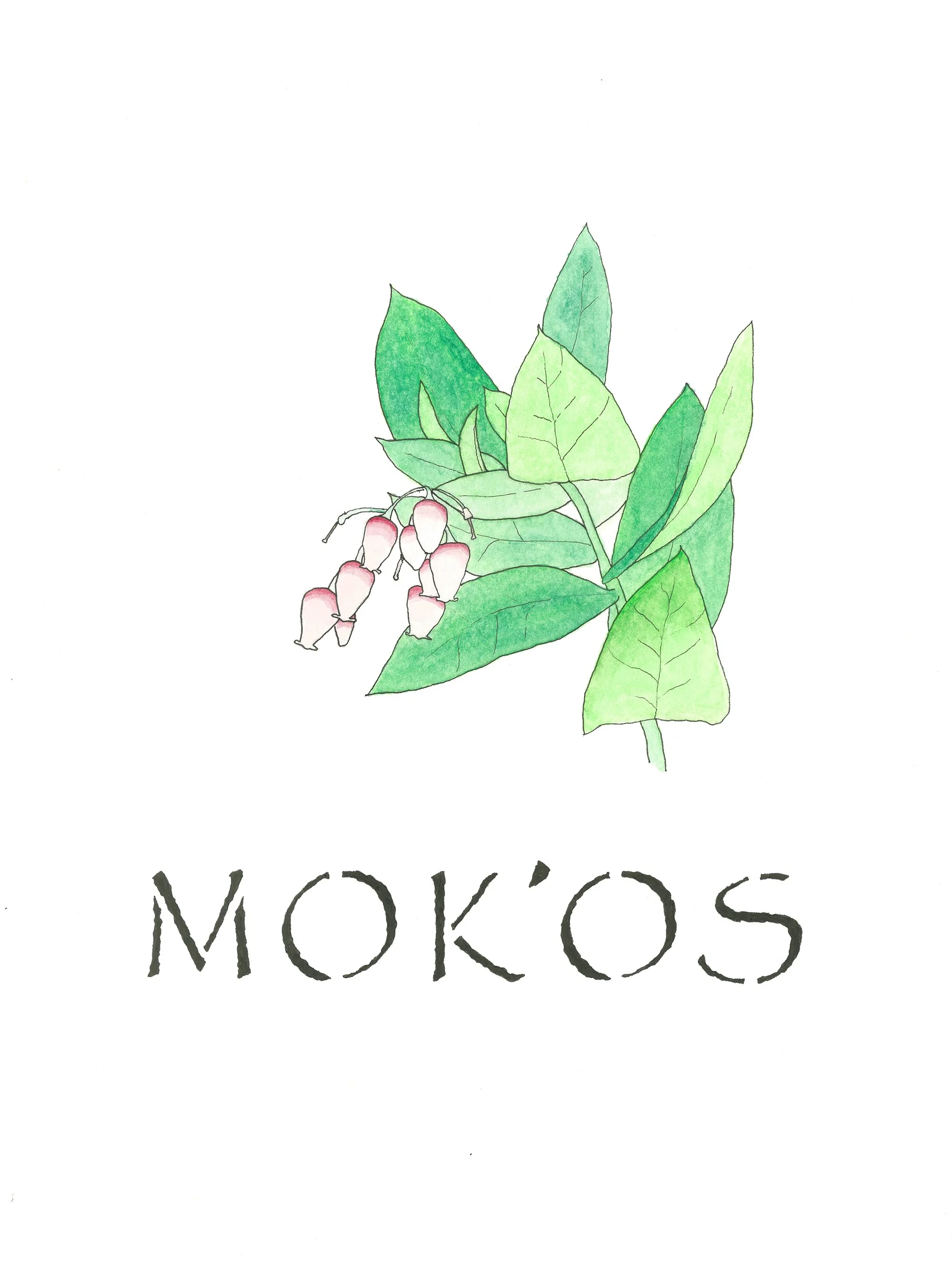
Look Around Series by Teighlor Renee Anderson. Watercolor, Ink ___________________________________________ In history books native people are often referred to in past-tense, though they are still here. Look around. Notice the impact of colonization. Notice the people, plants and animals around you. The Nisenan lived amongst many beings that endured the hardships that came during the Gold Rush, and they themselves did as well. The local language was nearly lost, though here you see plants and animals that persevered, as the resilient Nisenan people of nisem k'auwak' did, with the name they’ve known long before settlers walked this land.
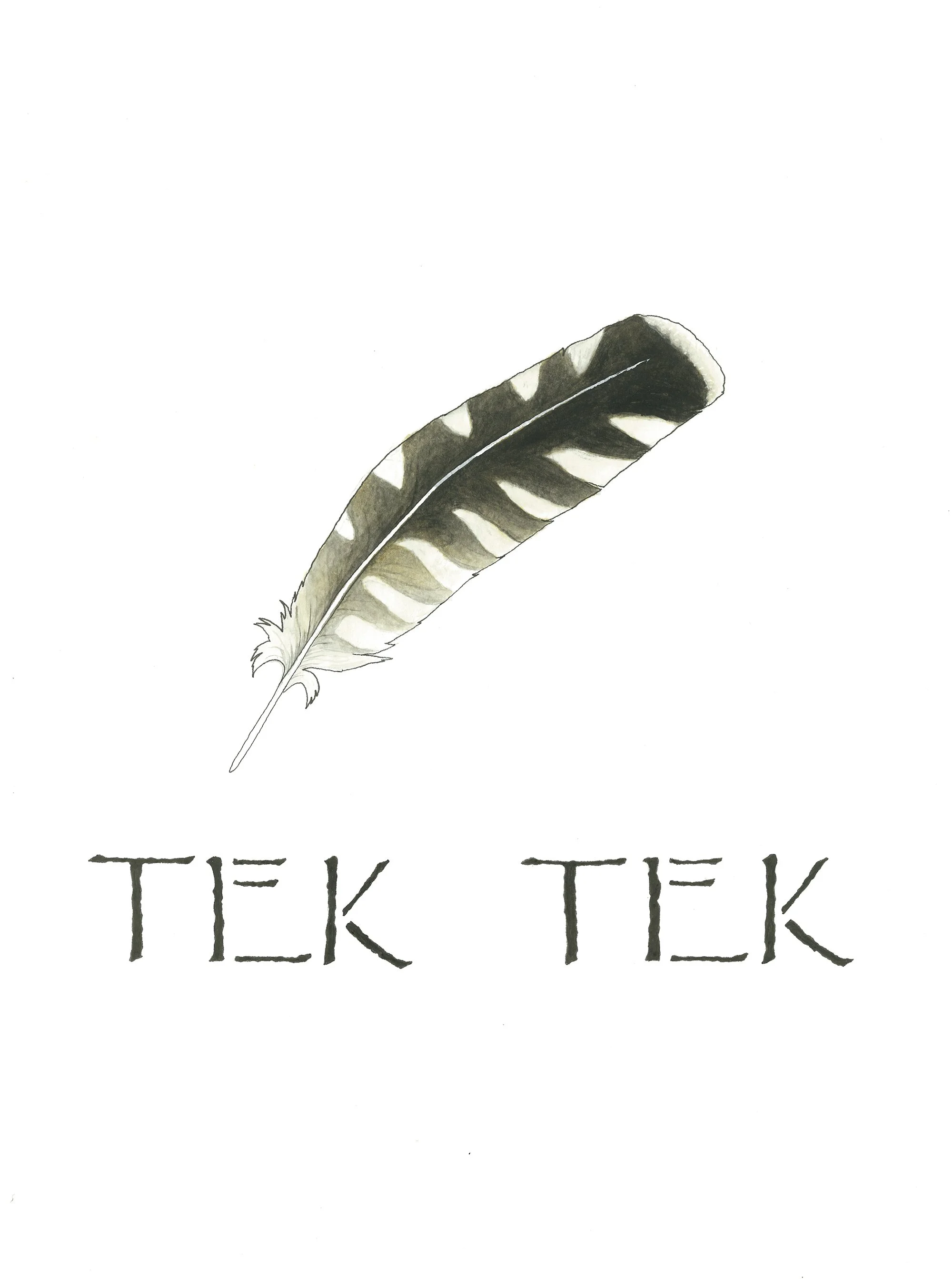
Look Around Series by Teighlor Renee Anderson. Watercolor, Ink ___________________________________________ In history books native people are often referred to in past-tense, though they are still here. Look around. Notice the impact of colonization. Notice the people, plants and animals around you. The Nisenan lived amongst many beings that endured the hardships that came during the Gold Rush, and they themselves did as well. The local language was nearly lost, though here you see plants and animals that persevered, as the resilient Nisenan people of nisem k'auwak' did, with the name they’ve known long before settlers walked this land.
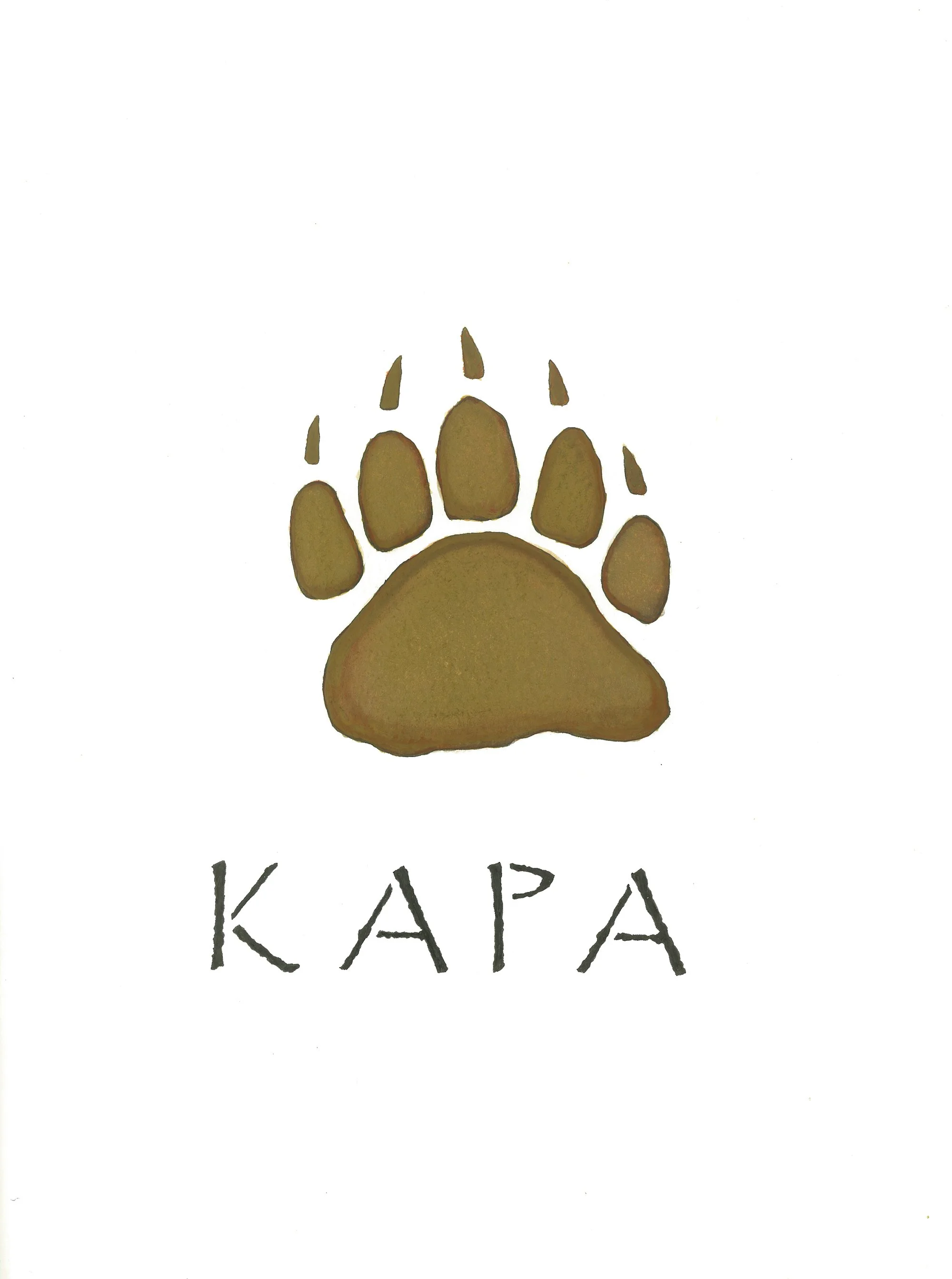
Look Around Series by Teighlor Renee Anderson. Watercolor, Ink ___________________________________________ In history books native people are often referred to in past-tense, though they are still here. Look around. Notice the impact of colonization. Notice the people, plants and animals around you. The Nisenan lived amongst many beings that endured the hardships that came during the Gold Rush, and they themselves did as well. The local language was nearly lost, though here you see plants and animals that persevered, as the resilient Nisenan people of nisem k'auwak' did, with the name they’ve known long before settlers walked this land.
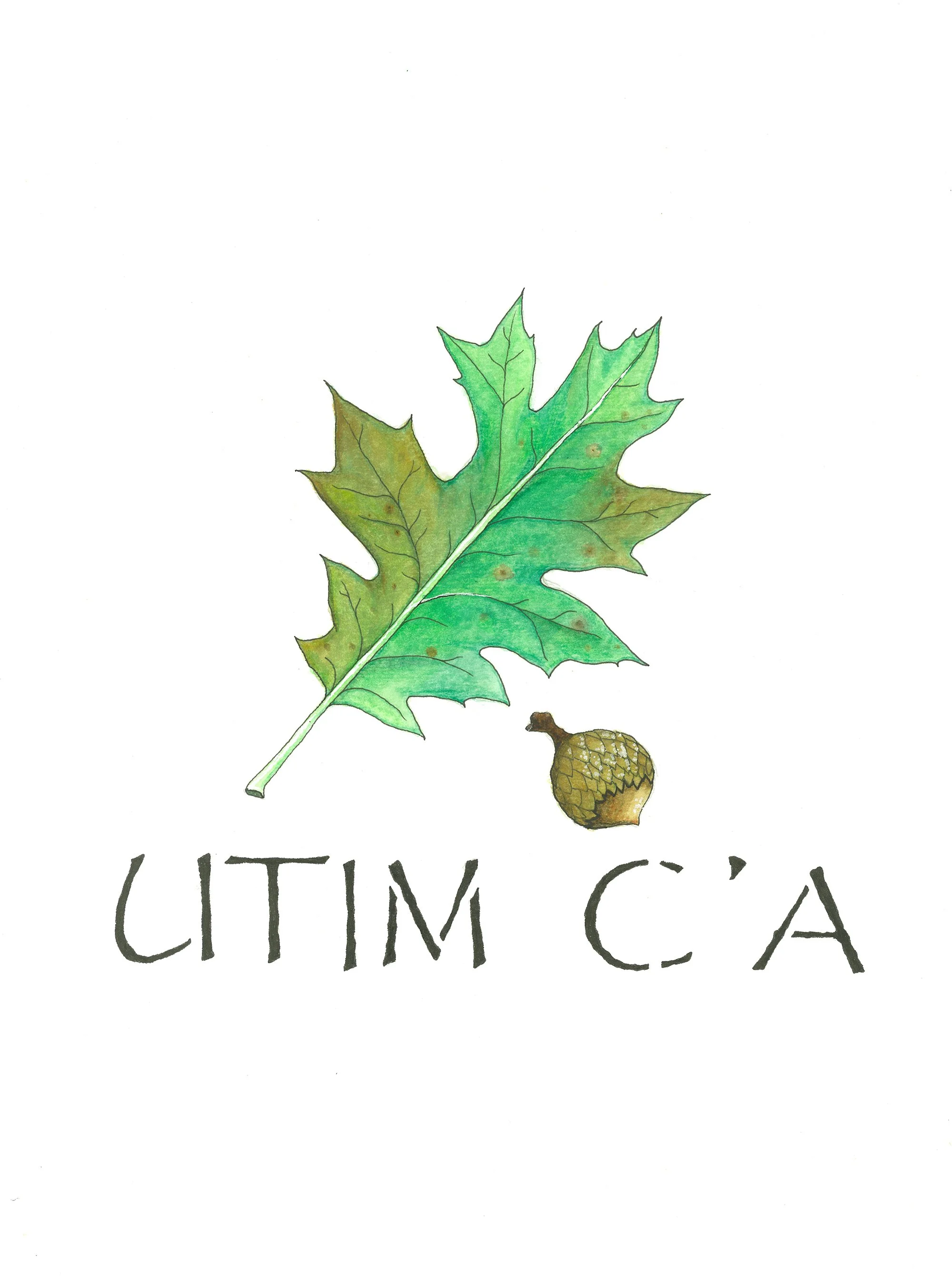
Look Around Series by Teighlor Renee Anderson. Watercolor, Ink ___________________________________________ In history books native people are often referred to in past-tense, though they are still here. Look around. Notice the impact of colonization. Notice the people, plants and animals around you. The Nisenan lived amongst many beings that endured the hardships that came during the Gold Rush, and they themselves did as well. The local language was nearly lost, though here you see plants and animals that persevered, as the resilient Nisenan people of nisem k'auwak' did, with the name they’ve known long before settlers walked this land.
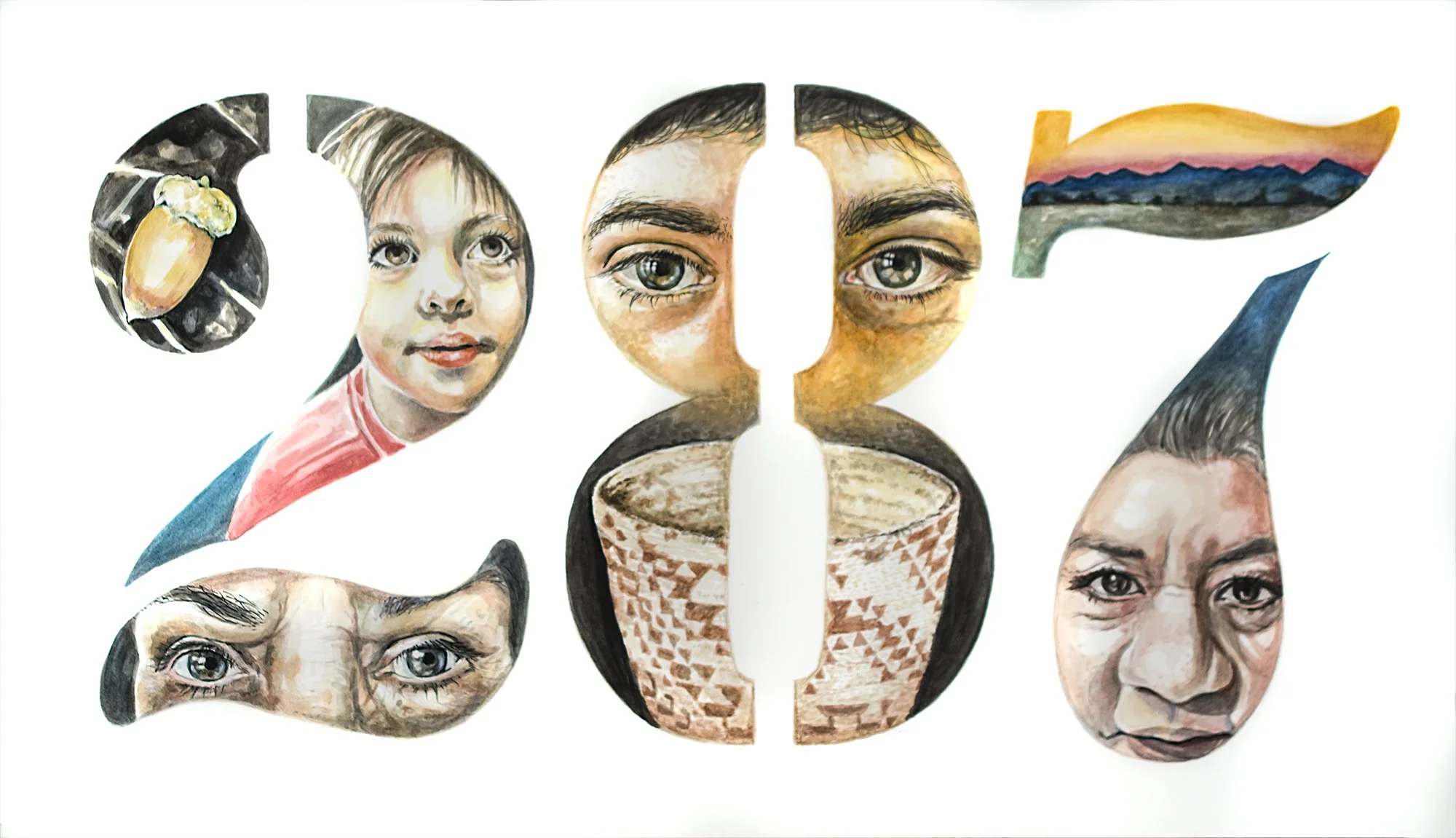
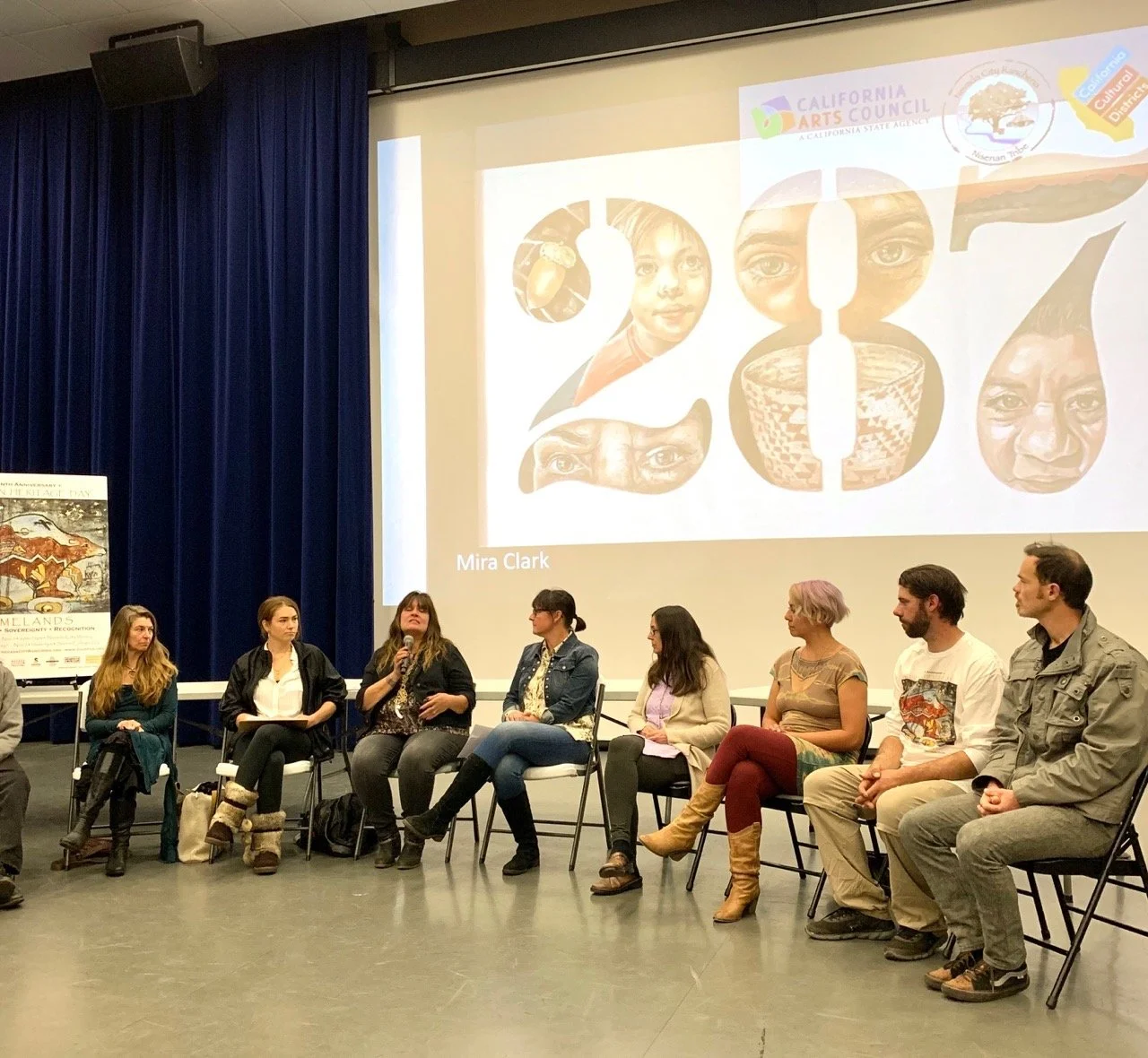
Home | Recognition by Mira Clark Existinspired.com. Watercolor and Pen. Collaboration with Nevada City Rancheria Spokesperson and Tribal Council Member Shelly Covert ___________________________________________ The number 287 is the Royce number corresponding with the 1851 California Indian Treaty negotiated between the Nisenan leaders and Federal agents representing the United States. This Treaty known as the “Camp Union Treaty” was negotiated at the confluence of the Bear and Yuba Rivers. The treaty would have provided a section of land located between Penn Valley and Rough and Ready. Tragically the treaties were never ratified by congress and were hidden away out of sight until found in 1904. This piece features the faces of living Tribal Members, as well as, items and places symbolic to home and recognition for the Nisenan people. This image represents the continued erasure, and broken promises that plague not only the Nisenan people, but Indigenous people all over the world.
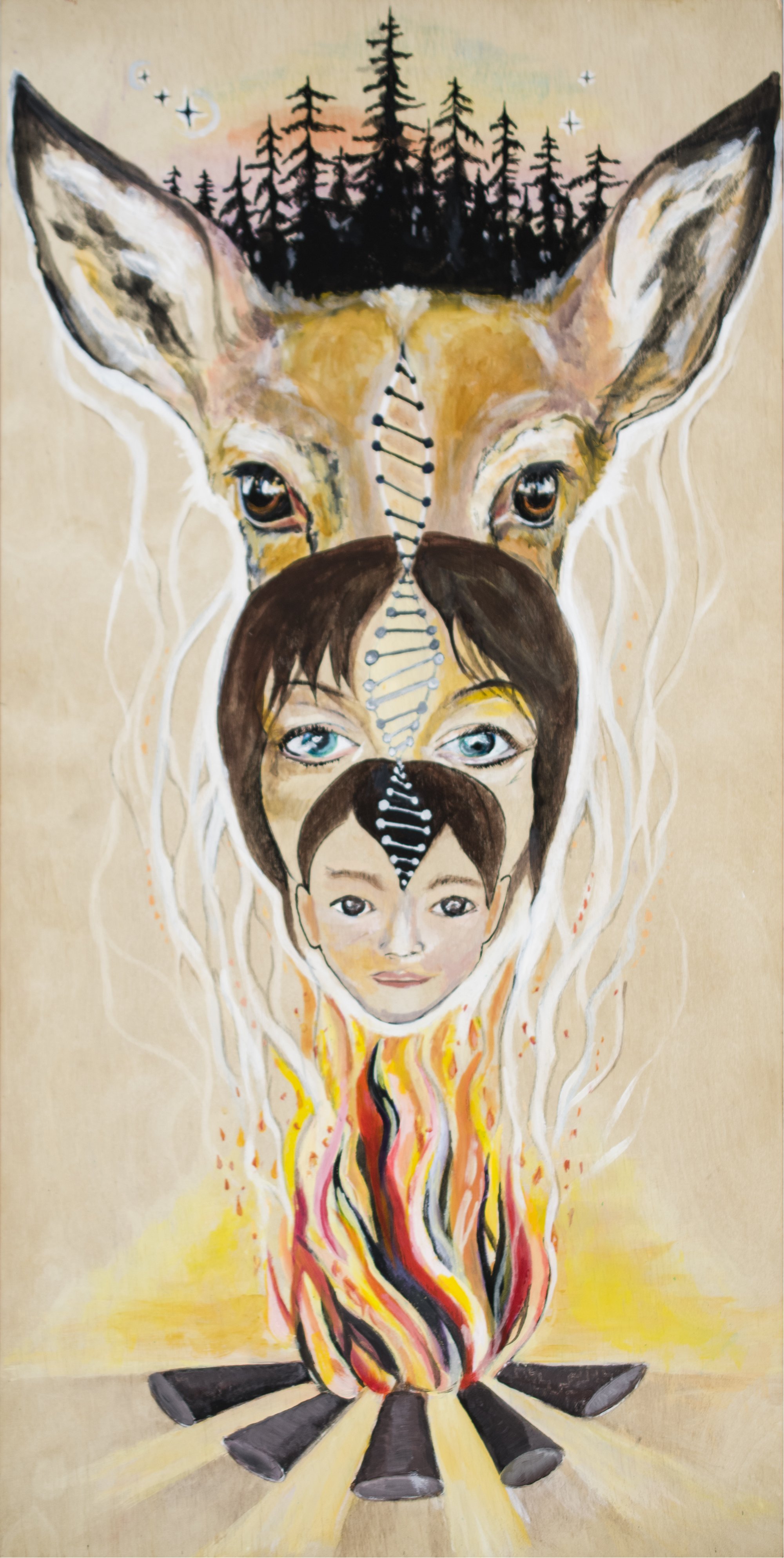
I Heard Their Stories By Jessa Hurst. Acrylic on Wood. Collaboration with Nevada City Rancheria Tribal Member Lorena Rose Davis ___________________________________________ In our interview, Lorena spoke about how so many of her Ancestors’ stories were never passed along, not written down, and lost as her elders past away. She believes that memories can be passed through our genetics and feels hopeful that if her and her remaining relatives pray in ceremony, their ancestors will come and help them remember. Lorena wrote this poem about a young man praying to a sacred fire and being joined by his ancestors, who remind him of the stories of his lineage. In this picture Lorena's grandson, Eddie, is praying to a sacred fire. His grandma, stands behind him in support and above her a deer from the land watches over them. This art piece is a vision of the remembering of stories that Lorena hopes for.
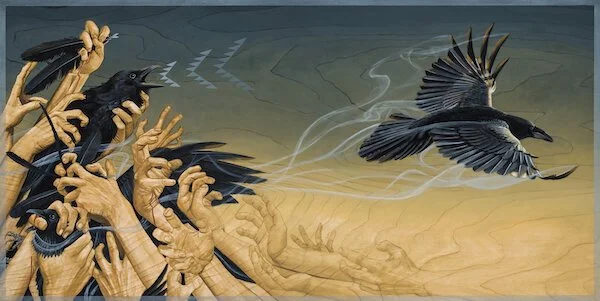
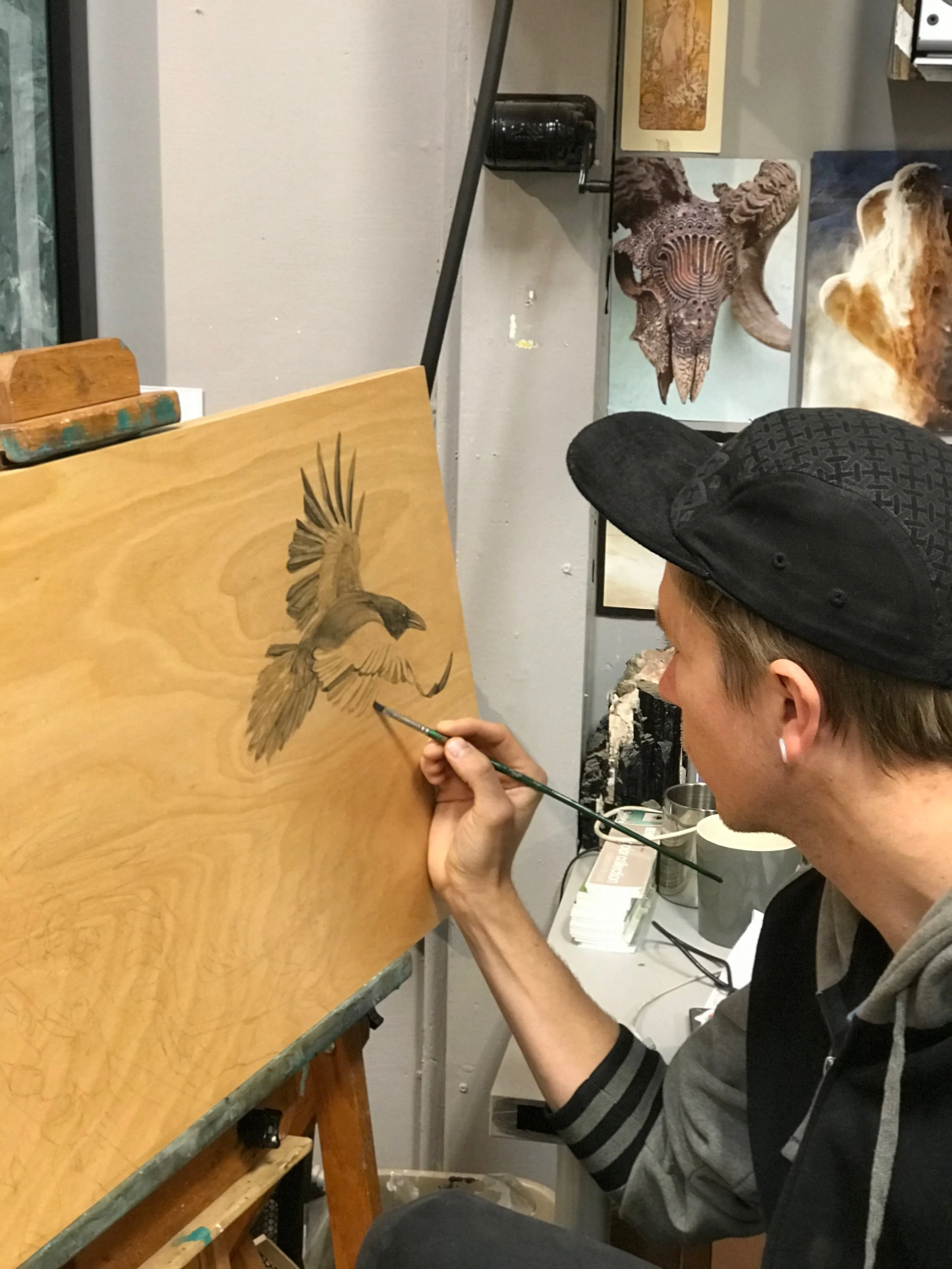
Remembering and Ravens by Miles Toland milestoland.com. Acrylic on Birch. Collaboration with Nevada City Rancheria Spokesperson and Tribal Council Member Shelly Covert ___________________________________________ The ravens in the painting symbolize the Nisenan who were tragically mistreated, displaced, and murdered during the greed and entitlement of the Gold Rush. Similarly, the ravens represent the animal kingdom that is currently being exploited, over hunted, under represented, and displaced by human lifestyle to the point of extinction. These stories are parallel and are still being written by our hands. How do we nurture the ravens who have broken free? How do we release the ones still captive? Moreover, this painting also speaks to the recent trip that Shelly Covert took to the Kunstkamera Museum in Saint Petersburg to visit a sacred Raven’s cloak and other artifacts that were taken by Russian explorers in the mid 1800’s. “Ravens are an important part of the old Nisenan stories. They struggle and adapt to the modern world as best they can and reflect to me the Tribe's struggle to survive in modern day America. Ravens mate for life and are family oriented. They are strong and smart and beautiful. Their memories are outstanding. I am honored to have had a couple of Ravens as friends in my life and understand why their feathers were so important in Traditional Feather Regalia. My obsession for this amazing being leads me back to my Nisenan roots and one day I will have my own Raven Feather Regalia to accompany me in dance and ceremony.” –Shelly Covert
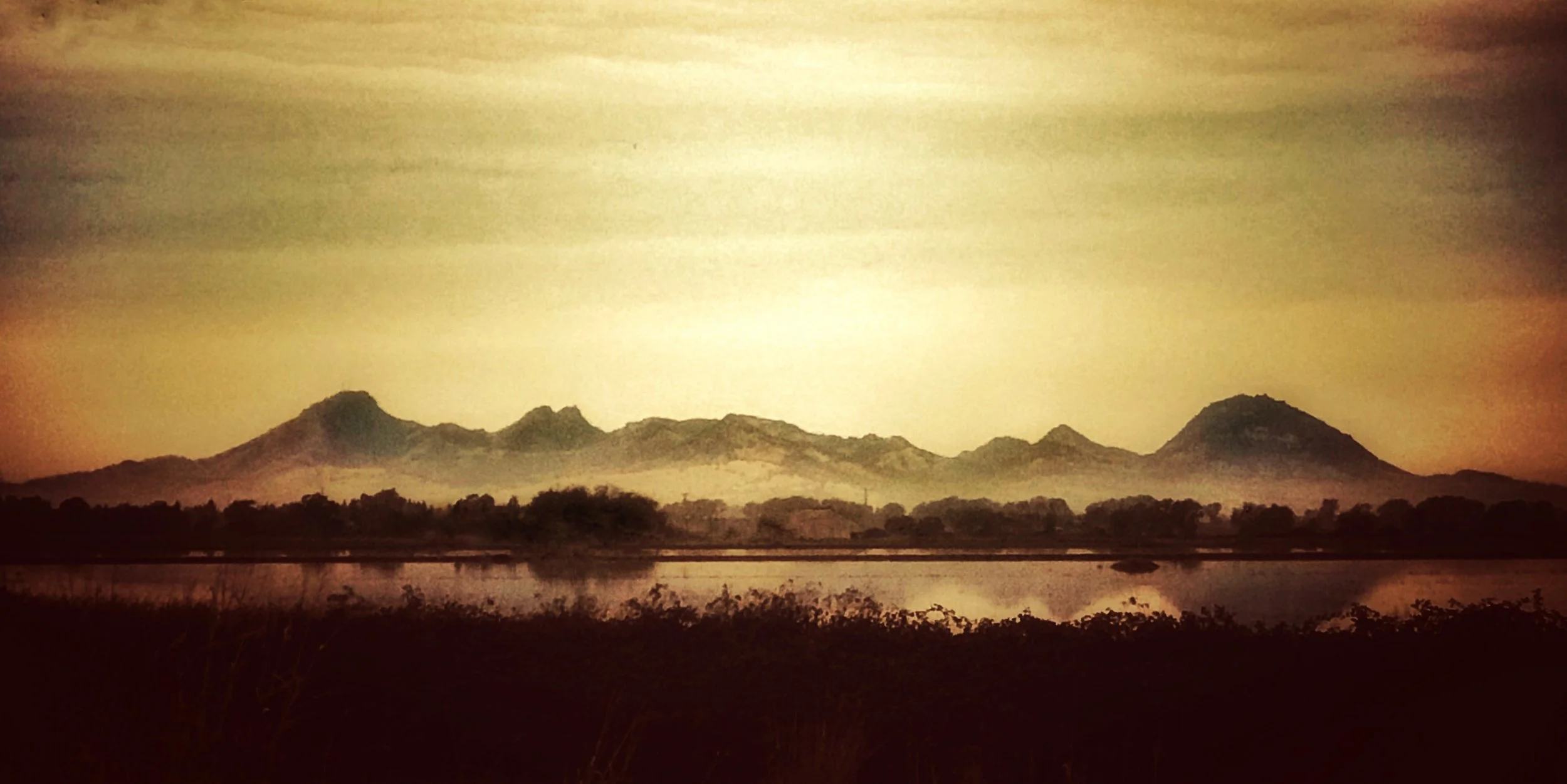
Sacred Mountain – ‘estom yanim by Lori Lachman lorilachman.smugmug.com . Photo Transfer. Collaboration with Nevada City Rancheria Spokesperson and Tribal Council Member Shelly Covert ___________________________________________ “It’s not polite to call it that.” A quote from Nevada City Rancheria Tribal Leader Dutch Rose. “This Mountain is the place of all life, and where we go when we die. Then we ascend to the Milky Way,” said Shelly Covert, Dutch’s granddaughter. This is the place of beginning. This is where we go when we die. This is the gateway to the Milky Way. The Mountain is central in their creation stories and afterlife.
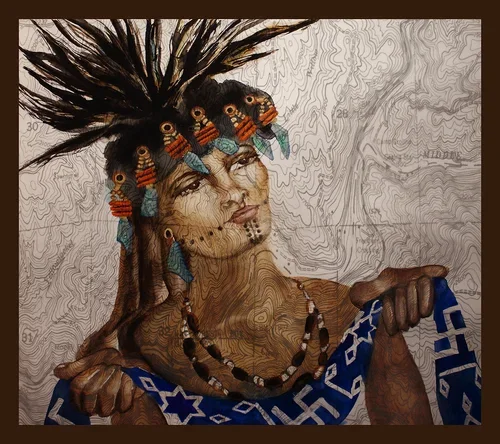
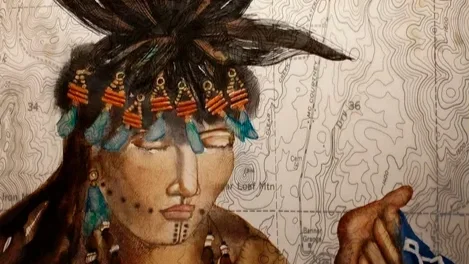
Guardians of the Dance by Jenny Hale. Watercolor and digital collage on translucent scrim material LED backlit. Collaboration between Nevada City Rancheria Nisenan Tribal Spokesperson Shelly Covert and local artist Jenny Hale as part of CHIRP’s Visibility through Art Initiative. ___________________________________________ Series of four images: “Guardians of the Dance” 2019 public art installation in downtown Nevada City. Nisenan female dancers in full dance regalia, layered over a topo map of their ancient Nisenan Homelands. Their headdresses are flicker feathers, bone, and abalone, and they hold a beaded dance belt. Their tattoos are passed on from countless Matriarchal Ancestors.
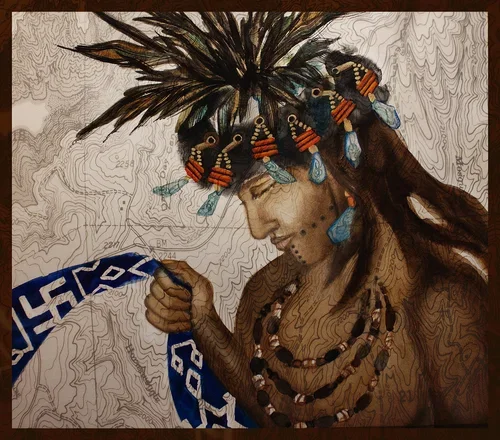
Guardians of the Dance by Jenny Hale. Watercolor and digital collage on translucent scrim material LED backlit. Collaboration between Nevada City Rancheria Nisenan Tribal Spokesperson Shelly Covert and local artist Jenny Hale as part of CHIRP’s Visibility through Art Initiative. ___________________________________________ Series of four images: “Guardians of the Dance” 2019 public art installation in downtown Nevada City. Nisenan female dancers in full dance regalia, layered over a topo map of their ancient Nisenan Homelands. Their headdresses are flicker feathers, bone, and abalone, and they hold a beaded dance belt. Their tattoos are passed on from countless Matriarchal Ancestors.
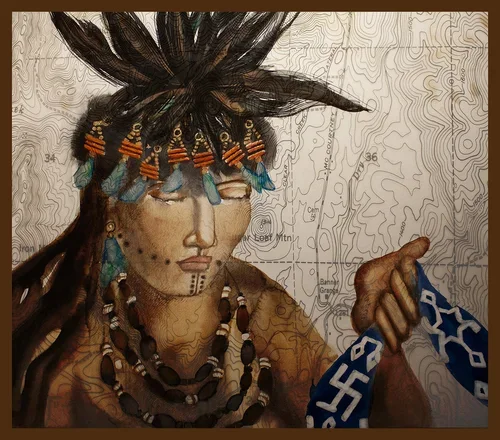
Guardians of the Dance by Jenny Hale. Watercolor and digital collage on translucent scrim material LED backlit. Collaboration between Nevada City Rancheria Nisenan Tribal Spokesperson Shelly Covert and local artist Jenny Hale as part of CHIRP’s Visibility through Art Initiative. ___________________________________________ Series of four images: “Guardians of the Dance” 2019 public art installation in downtown Nevada City. Nisenan female dancers in full dance regalia, layered over a topo map of their ancient Nisenan Homelands. Their headdresses are flicker feathers, bone, and abalone, and they hold a beaded dance belt. Their tattoos are passed on from countless Matriarchal Ancestors.
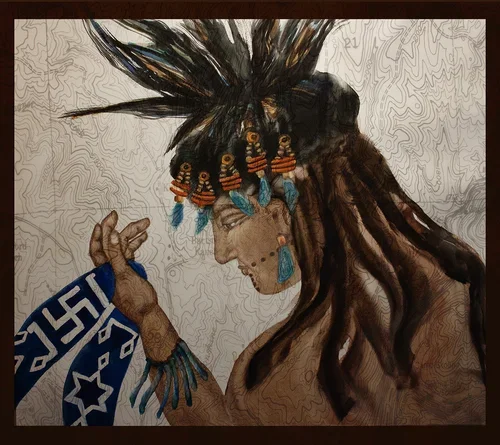
Guardians of the Dance by Jenny Hale. Watercolor and digital collage on translucent scrim material LED backlit. Collaboration between Nevada City Rancheria Nisenan Tribal Spokesperson Shelly Covert and local artist Jenny Hale as part of CHIRP’s Visibility through Art Initiative. ___________________________________________ Series of four images: “Guardians of the Dance” 2019 public art installation in downtown Nevada City. Nisenan female dancers in full dance regalia, layered over a topo map of their ancient Nisenan Homelands. Their headdresses are flicker feathers, bone, and abalone, and they hold a beaded dance belt. Their tattoos are passed on from countless Matriarchal Ancestors.
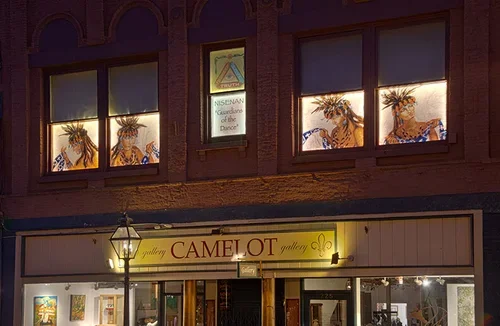
Guardians of the Dance by Jenny Hale. Watercolor and digital collage on translucent scrim material LED backlit. Collaboration between Nevada City Rancheria Nisenan Tribal Spokesperson Shelly Covert and local artist Jenny Hale as part of CHIRP’s Visibility through Art Initiative. ___________________________________________ Series of four images: “Guardians of the Dance” 2019 public art installation in downtown Nevada City. Nisenan female dancers in full dance regalia, layered over a topo map of their ancient Nisenan Homelands. Their headdresses are flicker feathers, bone, and abalone, and they hold a beaded dance belt. Their tattoos are passed on from countless Matriarchal Ancestors.
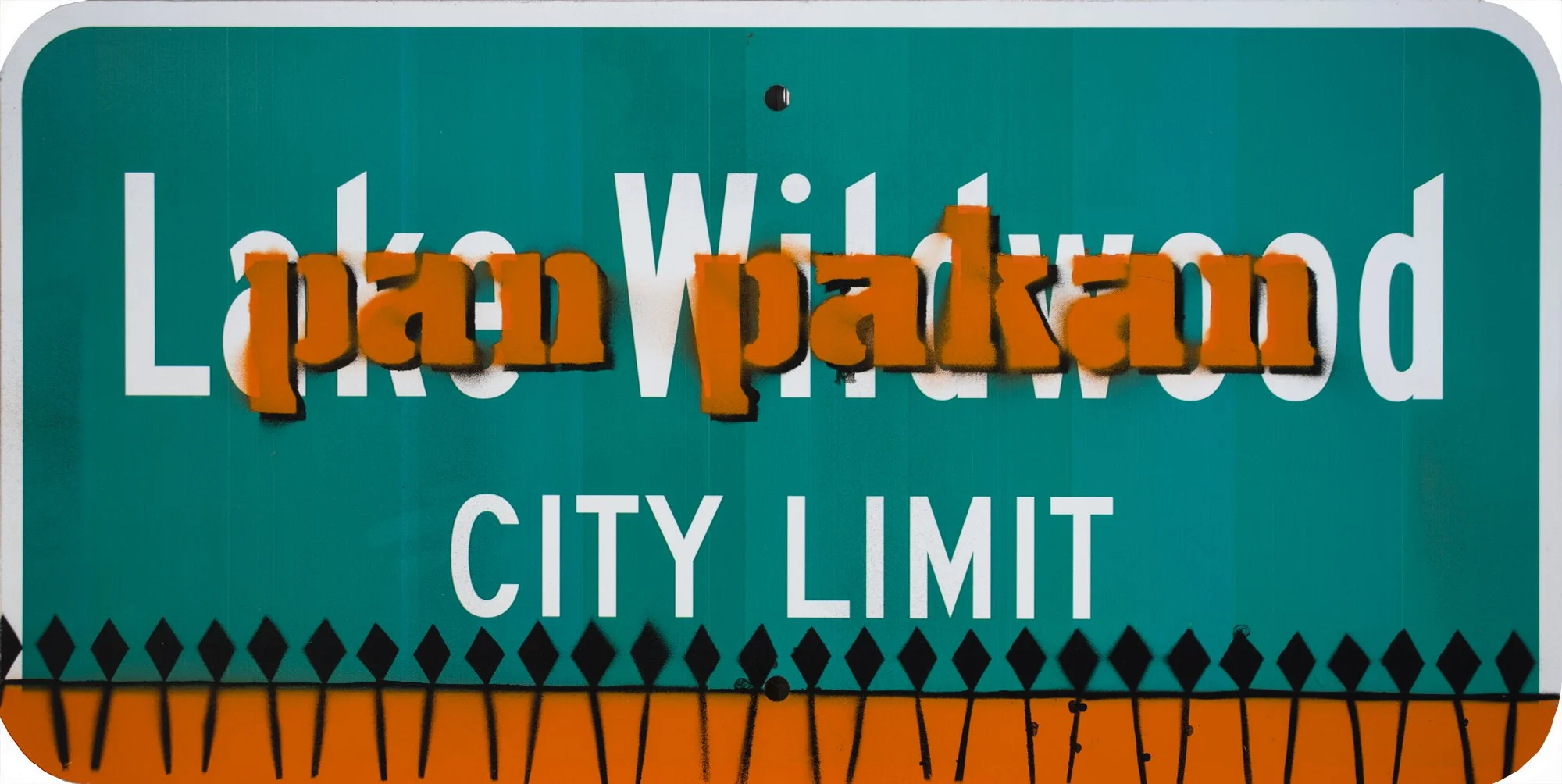
True Names by Robert “Bo” Blain. Lawfully acquired aluminum street signs and spray paint. ___________________________________________ The disruption of indigenous languages as part of a broader infiltration of Indigenous culture has been a strategy of empire building societies for ages. If a people lose their language they also lose the stories, memories, spirits, and connections to the land held within their original words and expressions. For the Nisenan the process of forced forgetting was done via various coercive means which forced them to assimilate to the point eventually trying to hide their indigenous identities to avoid discrimination and violence. Another strategy used to erase Nisenan language was the forced placement of Nisenan children into boarding schools where they were further severed from their words, traditions, and place. “Kill the Indian, save the man,” was the moto. A remembering is taking place within the remaining Nisenan who have begun the challenging task of taking back their original language. This graffiti was created to support this Nisenan remembering process and in the spirit of reclaiming the true names, and with them the stories of the original people, of the lands on which we live. pan pakan ( pahn-paw-kawn ) Is the true name for the place now occupied by the municipal incorporation called LAKE WILDWOOD.
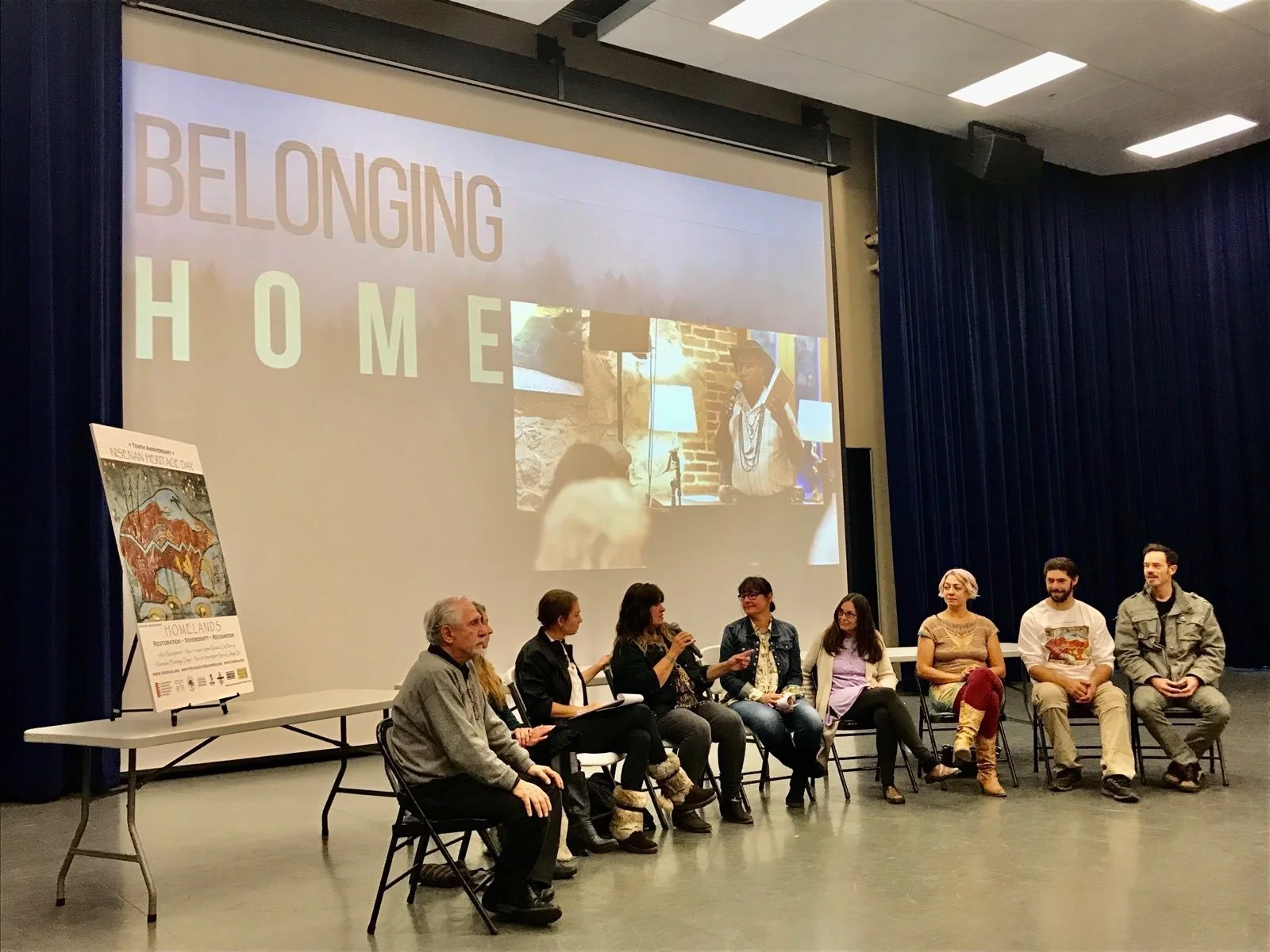
NISENAN HERITAGE DAY 2019
OPENING ART RECEPTION
& EXHIBITION PROCESS
Archival Note
This exhibition was presented before the opening of
'UBA SEO: Nisenan Arts & Culture gallery in 2021.
During the early years of Visibility Through Art, annual exhibitions were held in conjunction with Nisenan Heritage Day and took place at community venues throughout Nevada City.
These exhibitions helped establish the foundation for what would become the gallery and ongoing Visibility Through Art program.
Today, ‘UBA SEO serves as the permanent home for Visibility Through Art exhibitions while preserving the history of the program's earlier projects.