
INVISIBLE NO MORE
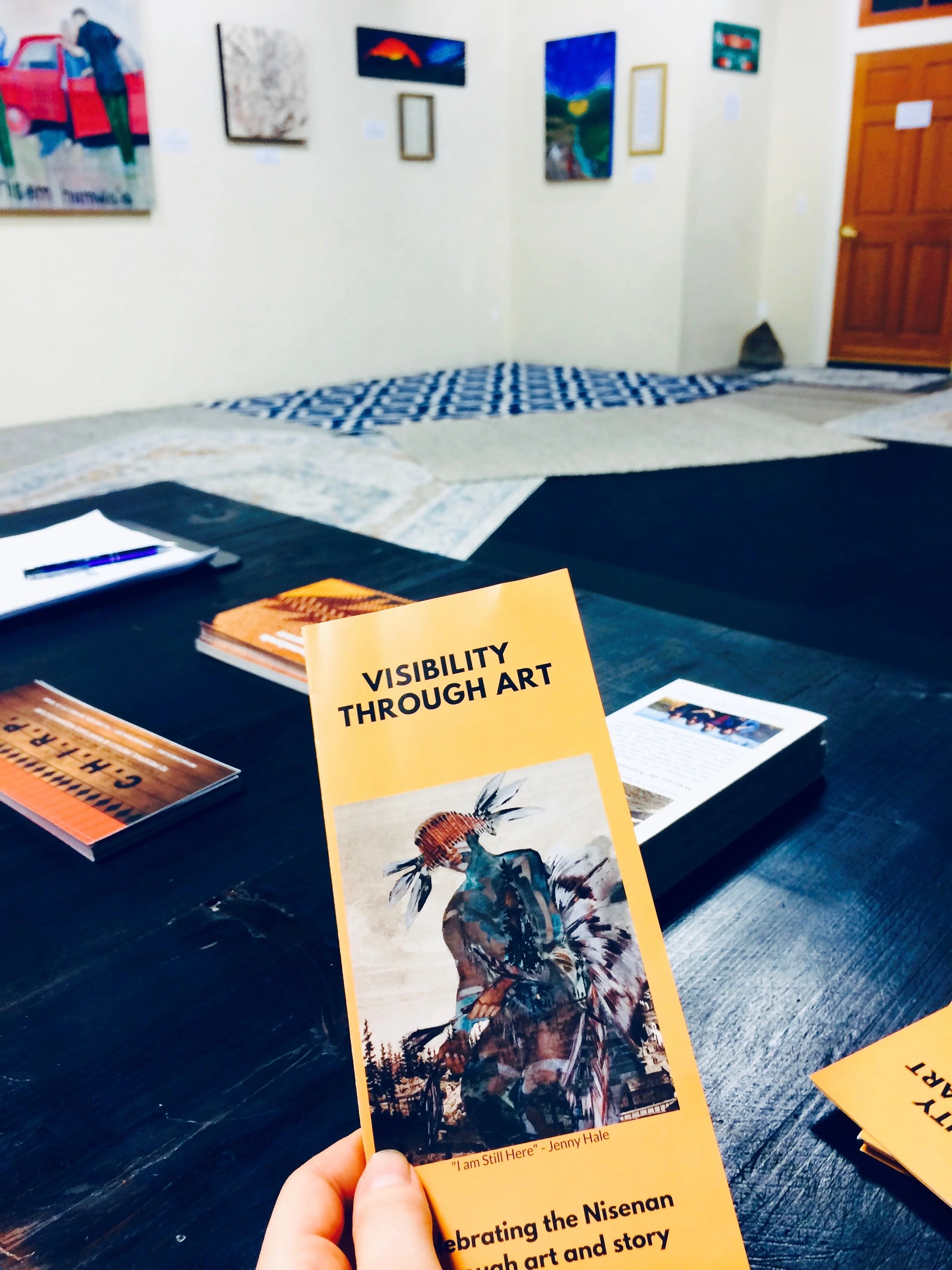
Visibility Through Art 2018
INVISIBLE NO MORE
Visibility Through Art 2018
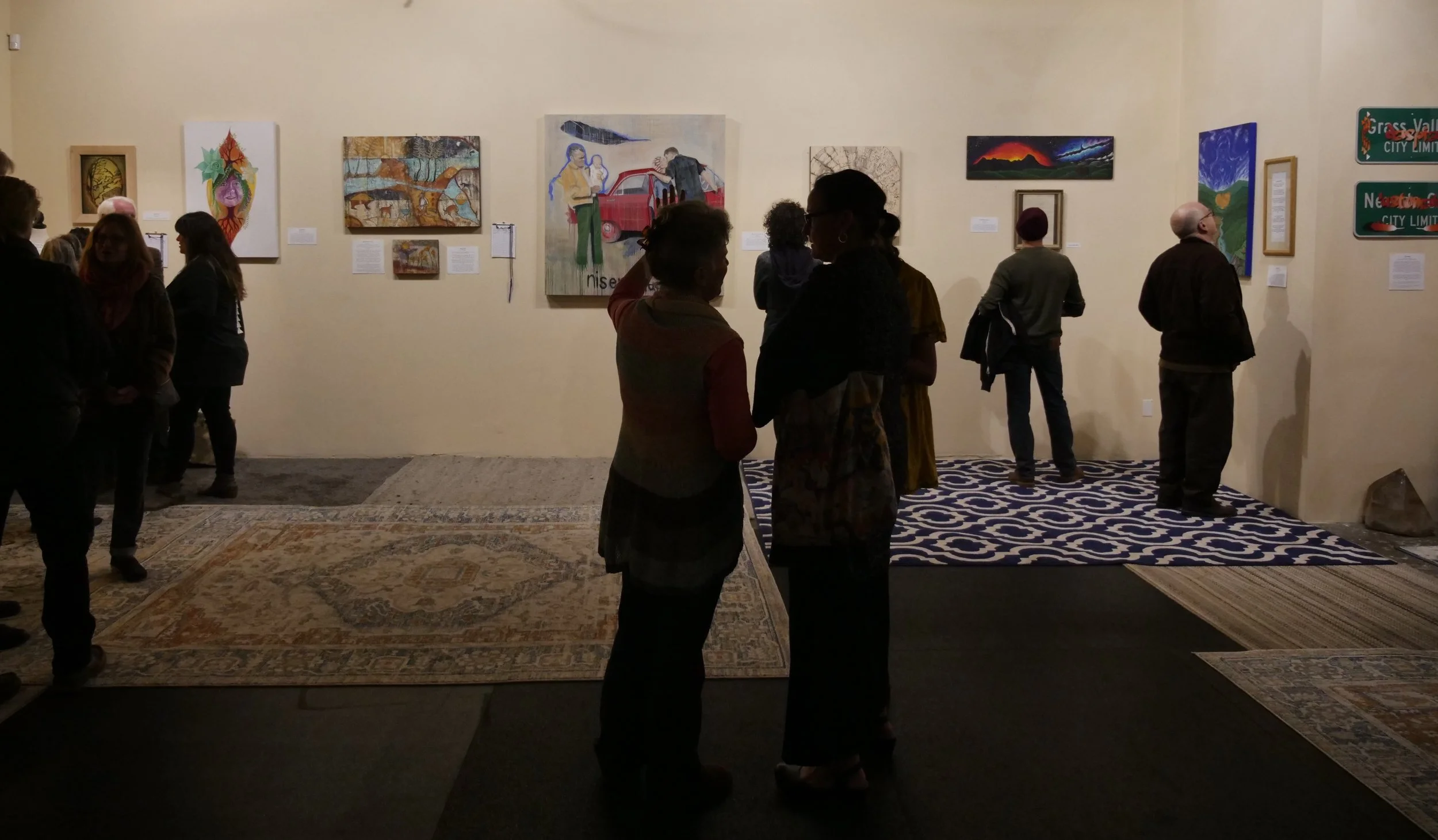
Building on the relationships established during its inaugural year, Visibility Through Art returned in 2018 as an integral part of Nisenan Heritage Day 2018, continuing to expand the day’s mission through visibility, education, and community dialogue.
Through continued relationship-building and creative exchange, participating local artists created works that invited visitors to reflect on the enduring presence of the Nisenan People and their deep connection to their Ancestral Homelands, engage thoughtfully with difficult and often overlooked and erased histories, and foster new relationships grounded in respect and reciprocity.
The continued success of the 2018 exhibition affirmed the importance of creating spaces where art could serve as a bridge between communities. These formative years laid the groundwork for the programs continued evolution, ultimately leading to a model that increasingly centered Nisenan artists while continuing to welcome the participation of local artists as collaborators and allies.
Nisenan Visibility and the Power of Public Art
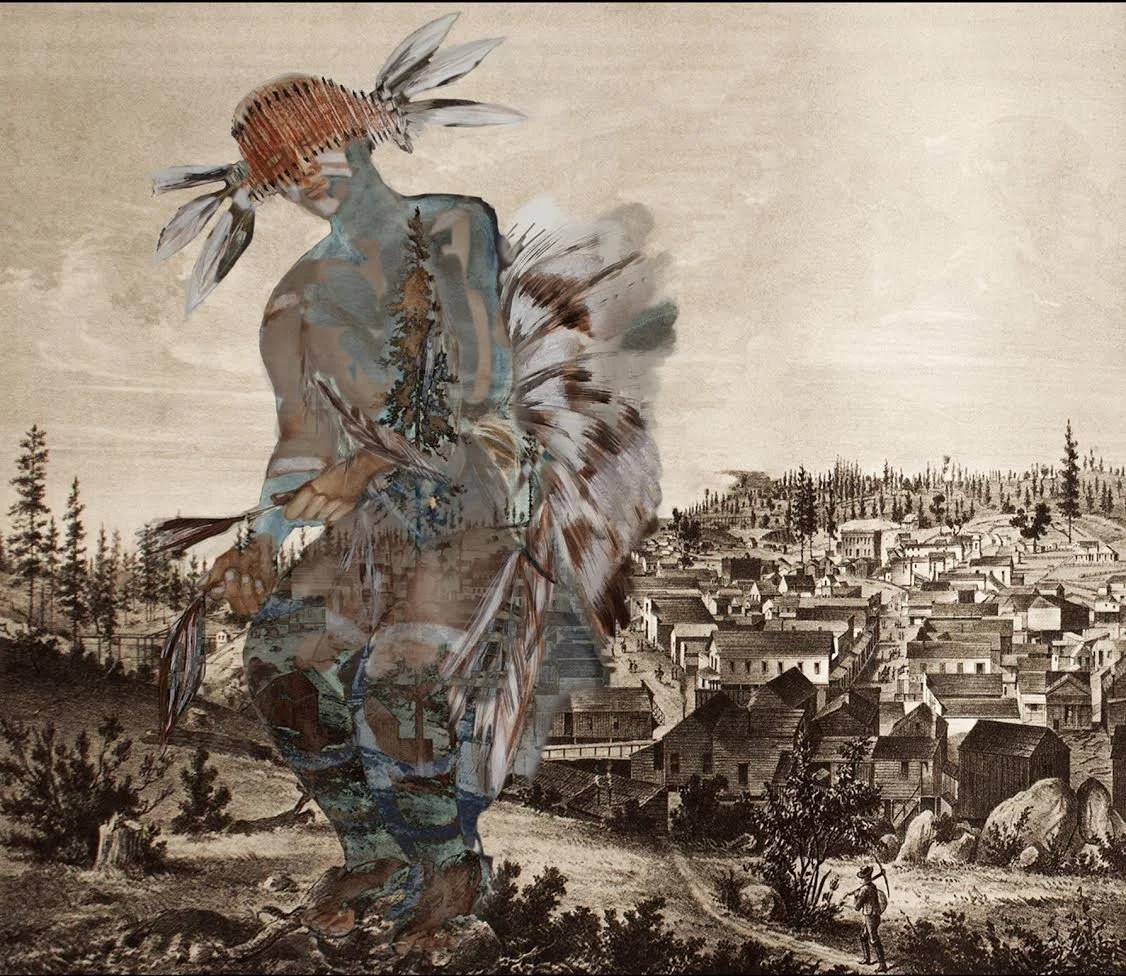
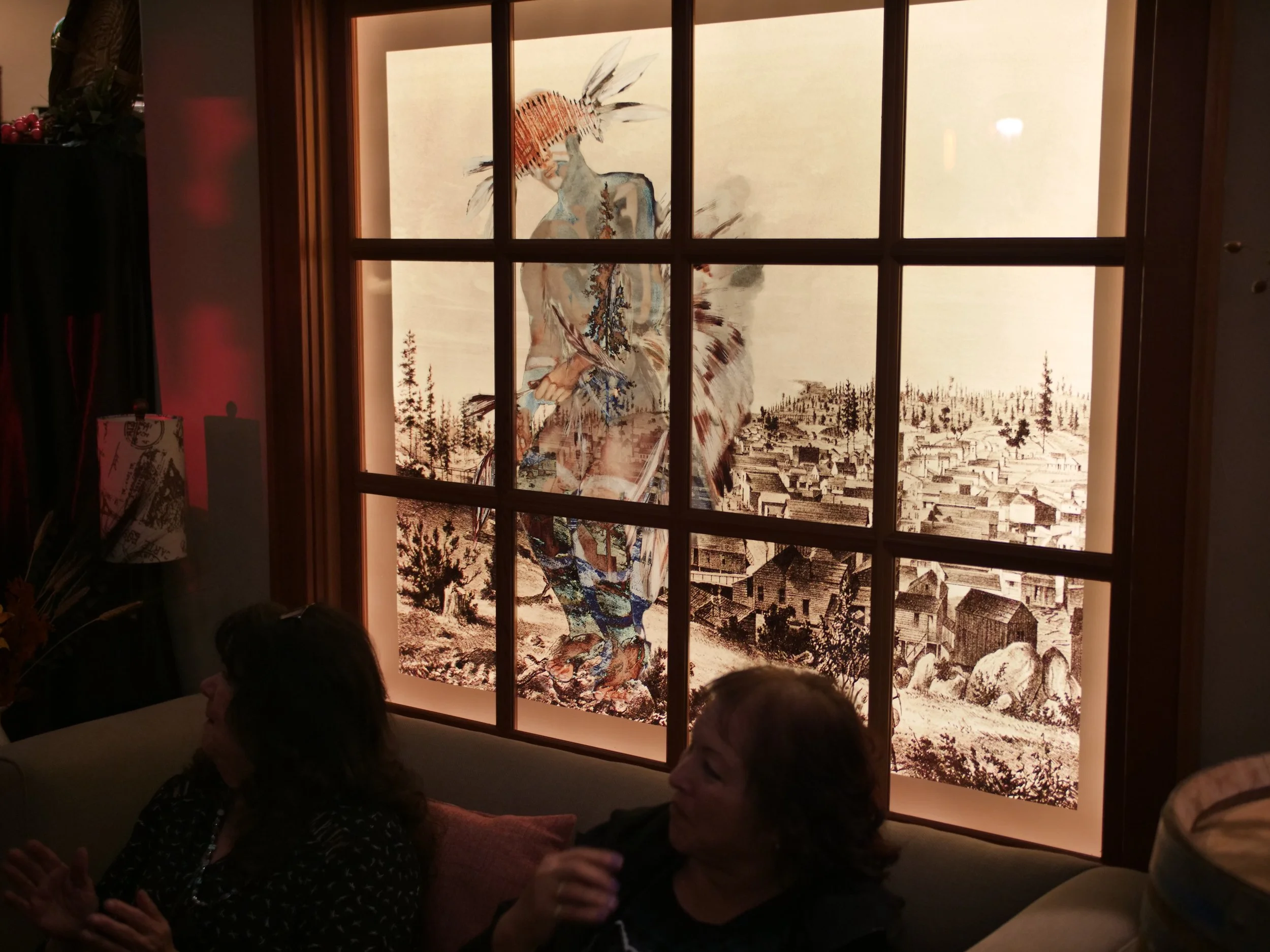
In 2018, the artist group included Jenny Hale and her piece “I am Still Here” featuring a Nisenan dancer superimposed over an image of 1864 Nevada City.
After the Nisenan Heritage Day opening art reception, the piece was displayed publicly during Victorian Christmas and Wild and Scenic Film Festival in the window of Asylum Down. Jenny saw the opportunity to raise visibility for the Tribe by creating more public art; and with the help of local business owner and friend, Eileen Jorgenson, they set out to help make it happen.
Covert and Hale partnered closely to create a dynamic work that was authentic and reflective of Shelly’s deep desire to show the community the beauty of Nisenan Culture. Hale’s work with “light” led to the creation of large, backlit pieces that are especially lovely at night.
When asked to talk about the process Shelly said,
“Jenny felt like my paintbrush. She took our many conversations and translated them onto paper. My dance belt is featured in the piece “Guardians of the Dance” that was displayed at the Oustomah Lodge (Oddfellows Hall) and my image was used as the model. But when the faces were done, I could see my daughter, my aunts and my mom reflecting back at me. It was a true collaboration.”
There may have been a bit of “cosmic alignment” having the art displayed in the lodge named after the original Nisenan town name ‘ustomah which sits under today’s modern-day town of Nevada City.
Visibility Through Art & Cultural-Sensitivity
The pair continuously navigated the sensitive and real topics of cultural appropriation, privilege and erasure.
“Giving a non-native artist permission to paint something of such cultural importance was a constant struggle and is not to be seen as a “pass” for others to do the same.
A Native artist recently asked me how my consent for this project might affect her and other Native artists who fight to keep cultural content in their own hands. And, while I don’t have an easy answer, I do see the importance of making it clear; this was a very special collaboration and it would not have worked without the Tribal Council having final say to the details of the pieces. The collaboration with Jenny Hale was absolutely crucial for the beauty of the work. She was open every step of the way to my many critiques, ideas and worries.
In the end, the artworks absolutely further CHIRP’s mission: to preserve, protect and perpetuate Nisenan culture. Visibility of the Nevada City Rancheria Nisenan is paramount to getting our Federal Recognition back. And, what better way to accomplish this than through the arts.”
Thanks to Jenny, Eileen and Oustomah Lodge in Nevada City, as well as the Nevada City Chamber of Commerce, Peggy Petersen of Asylum Down, and GoFundMe sponsors who assisted with the costs of installation.
EXHIBITING
Participating Artists: Chloe Young, Tracy Parker, Jarod Kane, Mira Clark, Ayssa Walz, Jennifer Rugge, Bishop Randall, Nikila Badua, Victoria Moran, Bo Blain, Rama Cryer, Teighlor Renee, Ruth Chase, Jenny Hale, Jessa Hurst, Gavrila Nikhila, Lori Lachman, Andy Cerrona
Mother Earth
Our great gift is the Spirit Father and our Mother Earth
Virginia Covert
Nevada City Rancheria Vice Chair
You provided us with shelter and fed us from your seeds
You nurtured us from infants, filling every need
You wanted us to grow and thrive, was it the overall plan
For us to be the gardeners, the keepers of your lands?
You knew we’d need sound bodies, good reasoning and health
But in those years of nurturing, did you forget about yourself
In those years of trial did you stray from the original plan
Or did you start to love us, as only a mother can?
You gave of yourself so freely, then we demanded even more
When you tried to wane the flow, we found ways to make it pour
We thought ourselves above all other living things
And in a world that no one owned, we crowned ourselves the Kings.
We continue to plunder your resources but no longer for our needs
Now the plundering that is done is for our insatiable greed
One ages quickly under stress and you’re old before your time
But like so many spoiled kids, we refuse to see the signs.
My prayer is to restore your clean rivers, forests and lakes
And reestablish our brotherhood with the Raven. The Wolf. And the Snake
Mother, we finally know now that our future is in your hands
A lesson hard learned, we are not the Kings, but the keepers of your land.
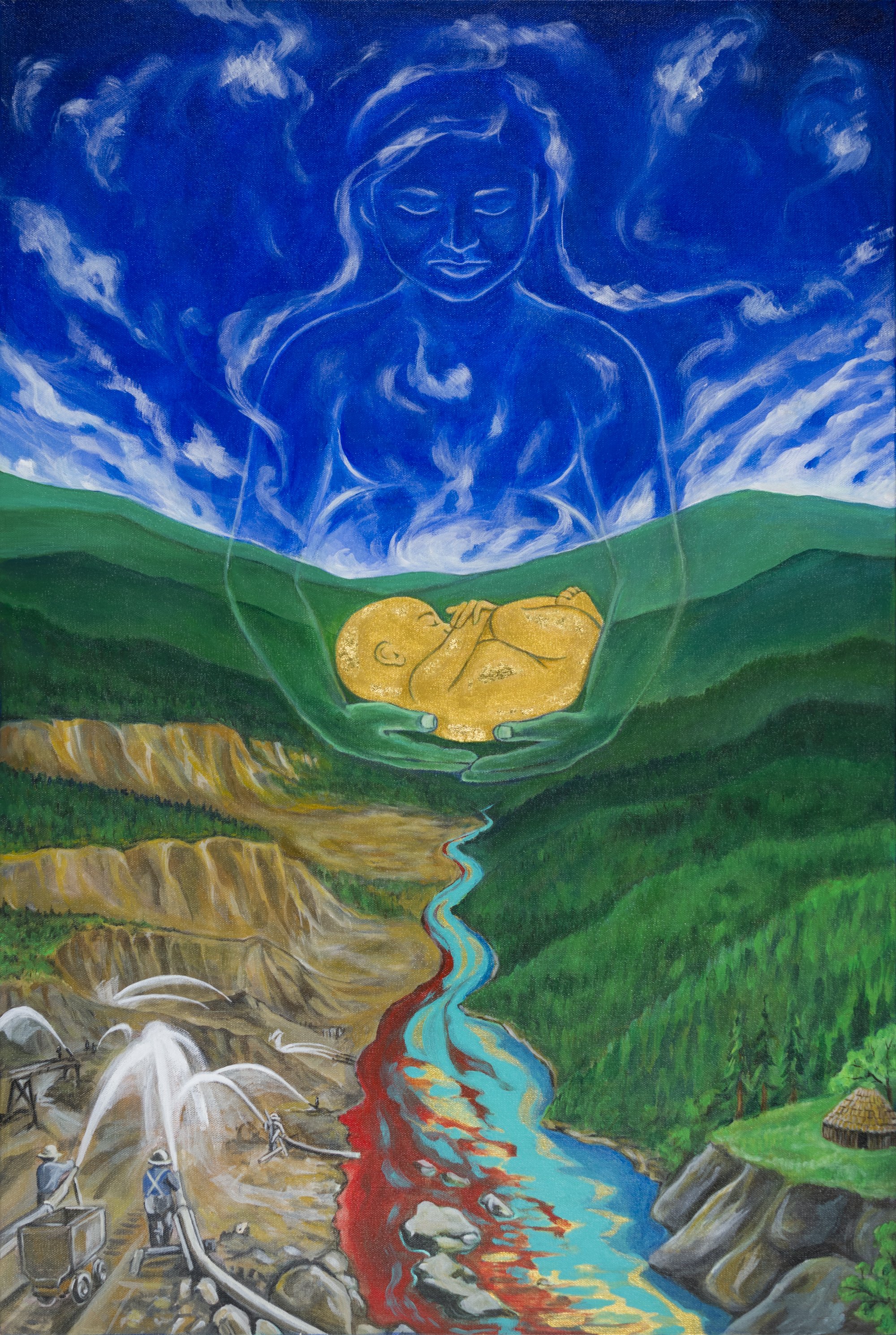
Mother Earth by Mira Clark
in collaboration with NCR Nisenan Tribal Vice Chair Ginger Covert
Gallery of Artworks
I Still Live Here by Jenny Hale jennyhaledesign.com . Original watercolor, printed digital collage, LED lights ___________________________________________ Through a window in time, a Nisenan dancer turns his back on a village that has displaced his own. Before Nevada City, the Nisenan lived at the same bend of Deer Creek in a village called ‘ustomah. His essence will forever live in the natural world of the Northern Sierra Foothills, and miraculously, his descendants still walk here. The dancer is superimposed over an engraving of Nevada City in 1851. In 1848 there were 7,000 indigenous people in Nevada County. By 1852 that number was reduced to 3,226, due to murder, disease, loss of hunting grounds, and relocation. Confronting the destruction of the Nisenan, is a small first step in acknowledging the humanity, and value of the people who came before. Today there are 144 descendants of the Nevada City Rancheria Nisenan.
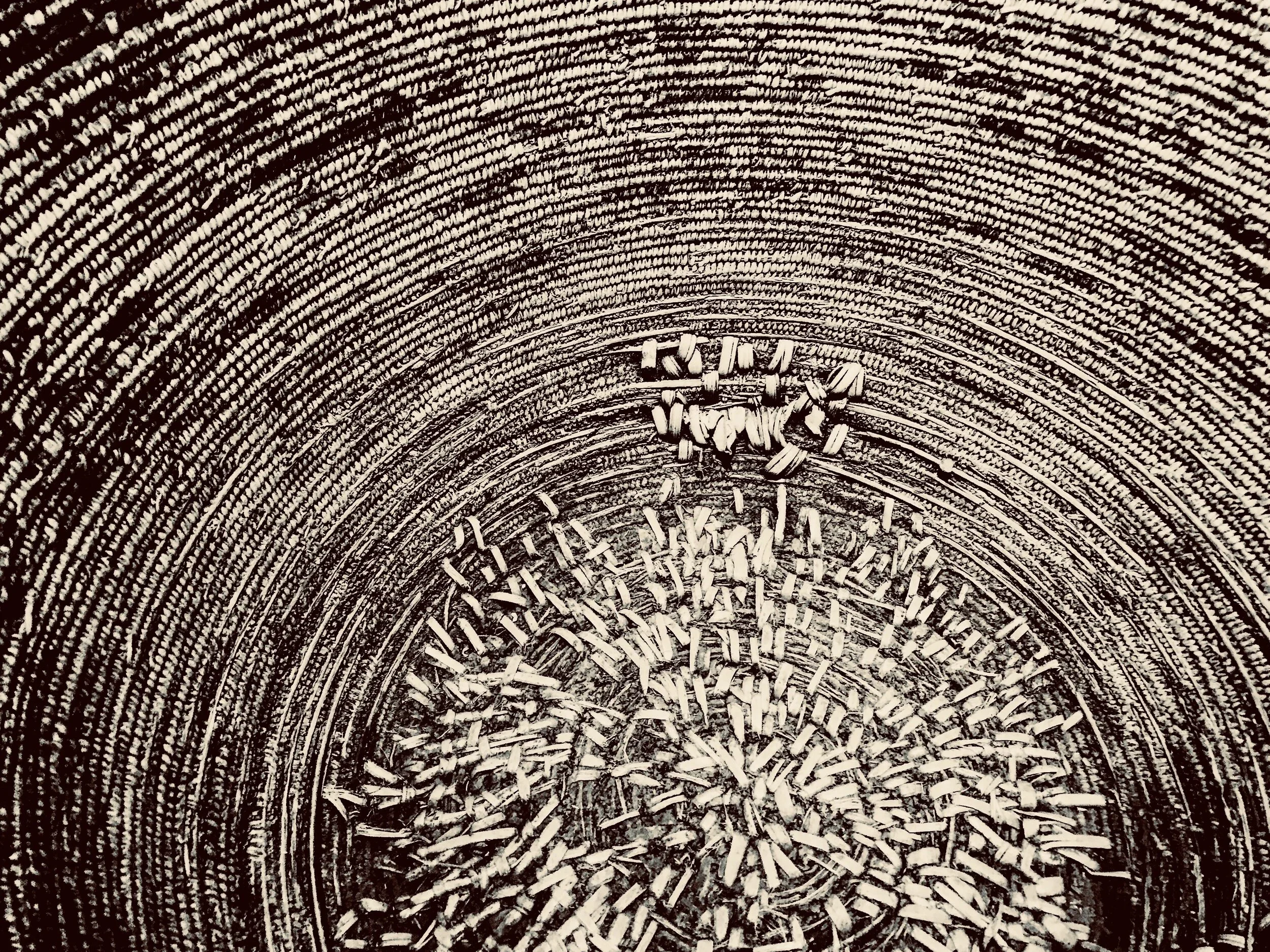
Basket by Lori Lachman. Photographs on Wood ___________________________________________ Heavy acorn mush strains the bottoms of baskets, this is a close up of Nisenan repair on one such basket.
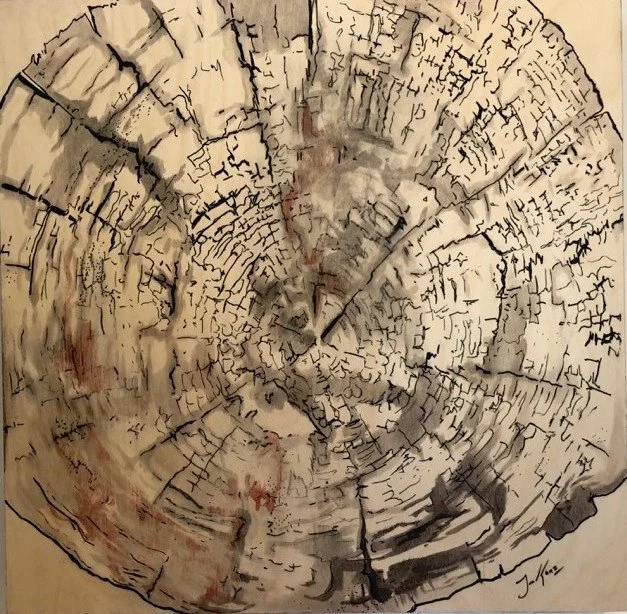
Identity by Jarod Kane. Acrylic on Wood Panel ___________________________________________ This piece is about identity, maintaining, and finding. I hope that it will help to maintain the culture and history of a community and land. I view this image as a fingerprint of the land and find that it shows both nature and human presence.
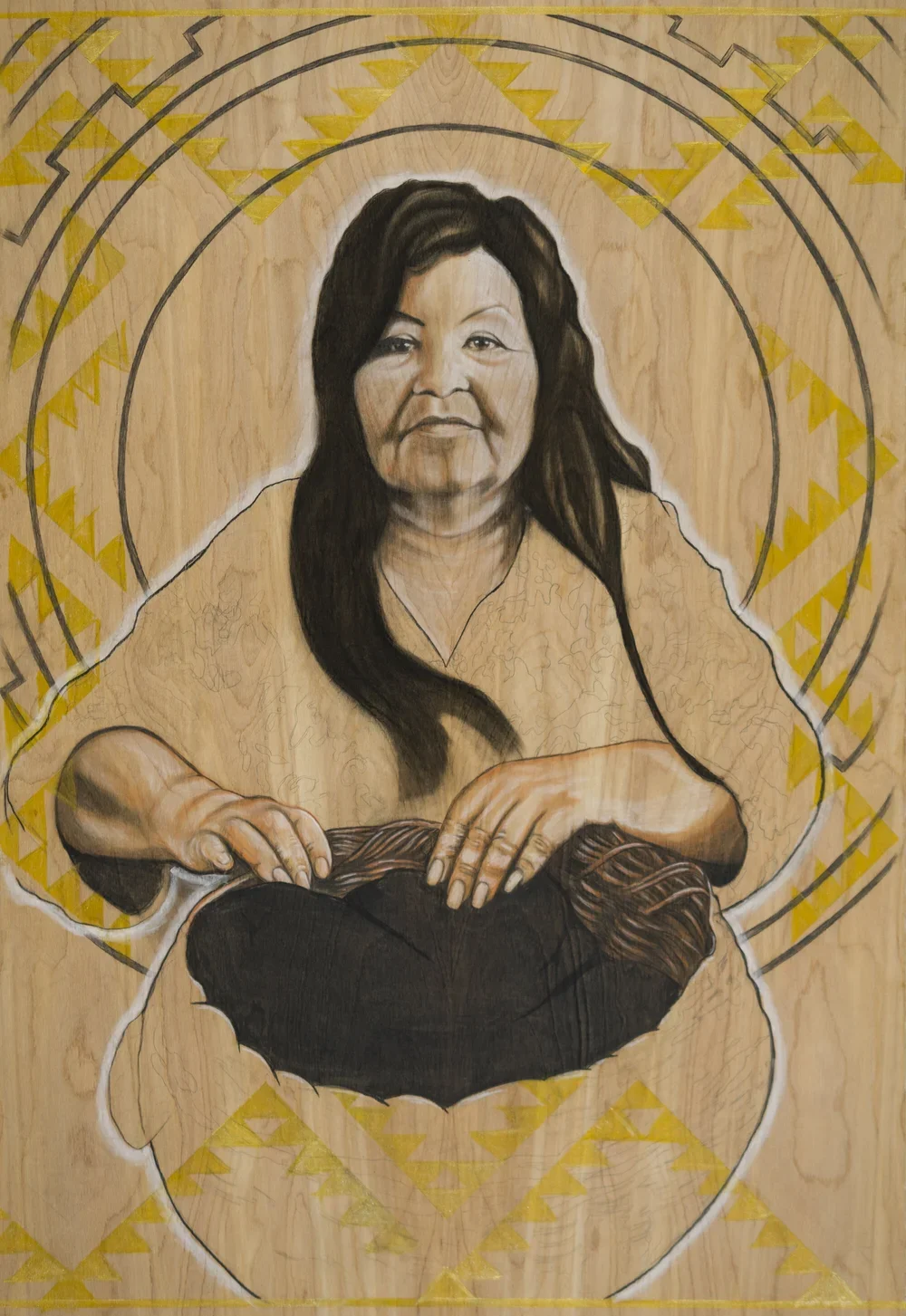
“BABE” - NISENAN/KONKOW BASKET WEAVER by Nikila Badua www.mamawisdom1.com Multimedia on wood. Ink and Graphite mixed with pigments sourced from local materials - rocks from the Yuba River and charcoal from burned oak ___________________________________________ Bear and Yuba River watersheds are the homeland of our Honored Elder, Helen “Babe” Rose Echols. Babe lives in Dobbins, California, and at nearly 80 years of age, is one of the Tribe’s last basket weavers. Konkow on her mother’s side, her father, Dan Rose, was Nisenan, and a very important medicine man in the family. Babe is known for her beautiful, large open-weave baskets made from redbud. The Nisenan honor their baskets as living beings, said to each have its own spirit. Though basket weavings are some of the oldest recorded textiles found in the world’s history, carbon dated back to 12,000 years, it is difficult to preserve them, as their natural materials wear out with age, and return to the earth in a living-dying cycle of life. It is also said that these baskets should not necessarily be preserved behind glass, as they are living beings that should be utilized. But for all practical reasons of protecting this endangered way of life, you can find some of the last local traditional Nisenan baskets displayed in Nevada City’s Firehouse Museum, which Tribal members still come to visit and sing to them to honor their spirits.
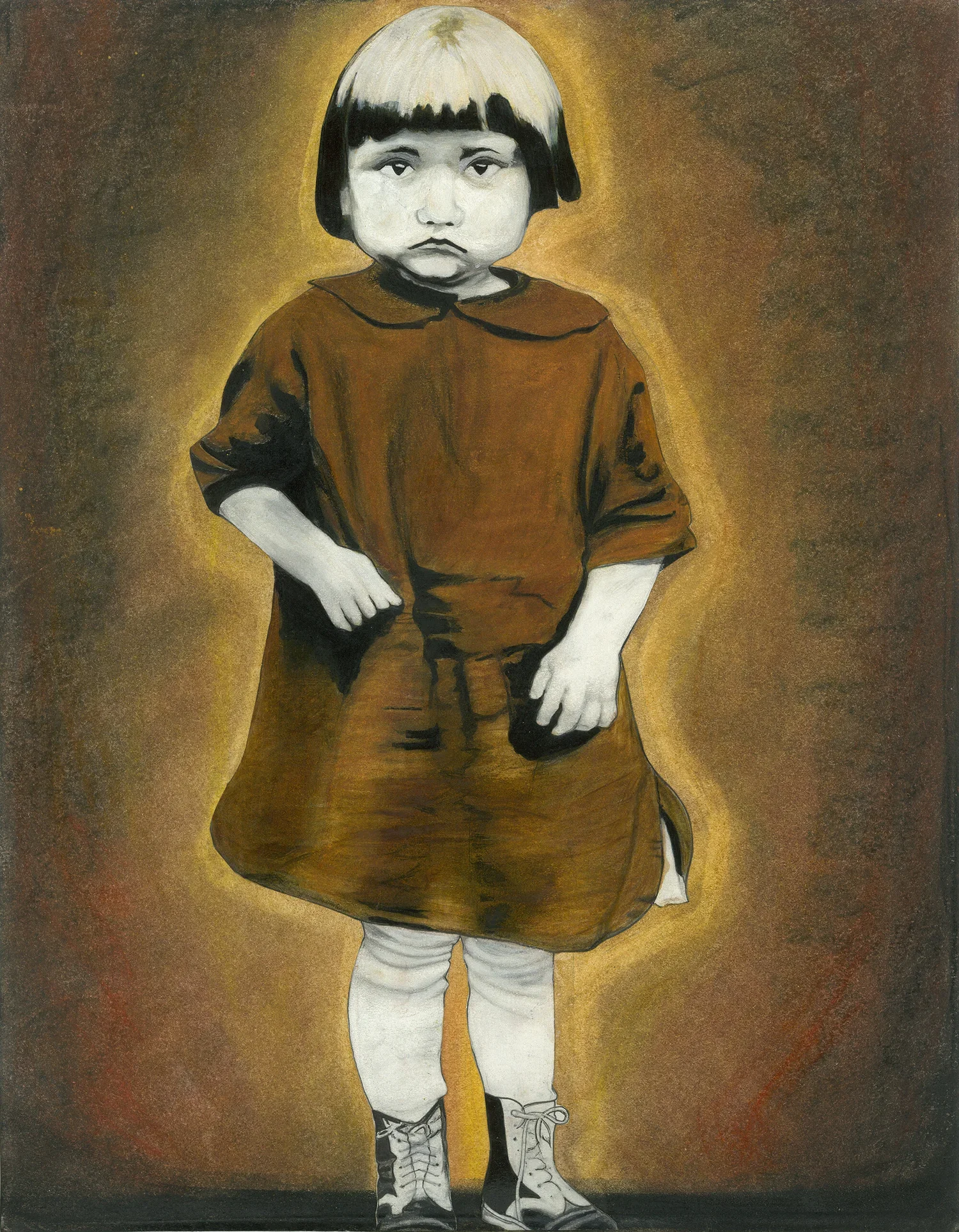
Carmel 1921-2014 by Alyssa Walz. Pencil, Ink & Pastel ___________________________________________ Carmel was born in Jackson California, her mother Mandy died from tuberculosis when Carmel was only 2 years old. She was then raised by a Southern Nisenan, Miwuk, and African American woman decent she called Auntie. Auntie raised Carmel on the Auburn Rancheria where they took care of Captain Jim Dick and Koto Jane Lewis. Carmel left Auburn Rancheria at 18 years old to marry Frances “Dutch” Rose and had 6 daughters, she was a midwife, healer, language keeper, and matriarch of our family until her passing in 2014. She left her songs to her descendants before she died and they will continue on.
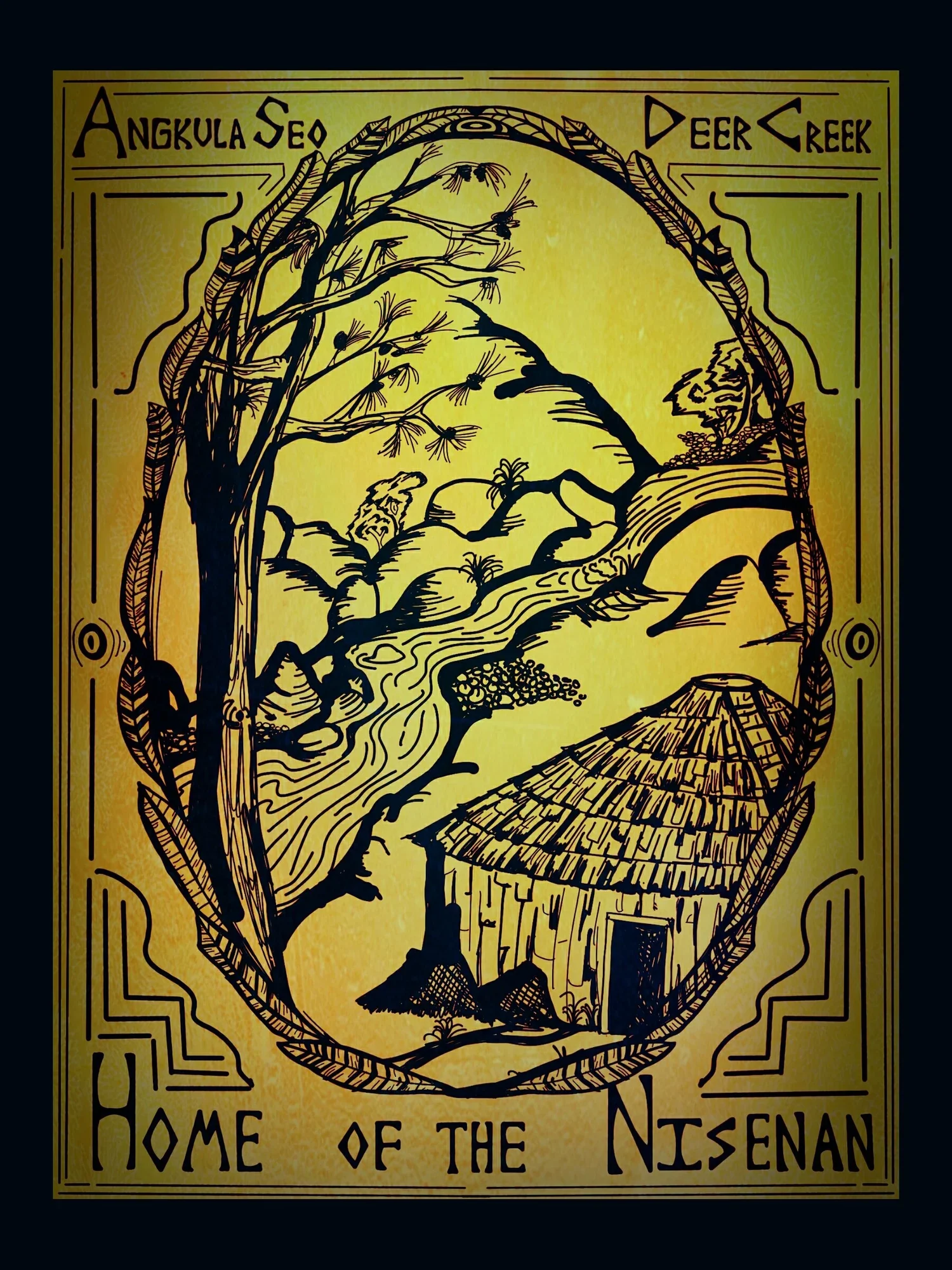
Angkula Seo by Andrew Cerrona. Digital Sketching ___________________________________________ The intention behind this piece is to help reclaim a name and space for the Nisenan.
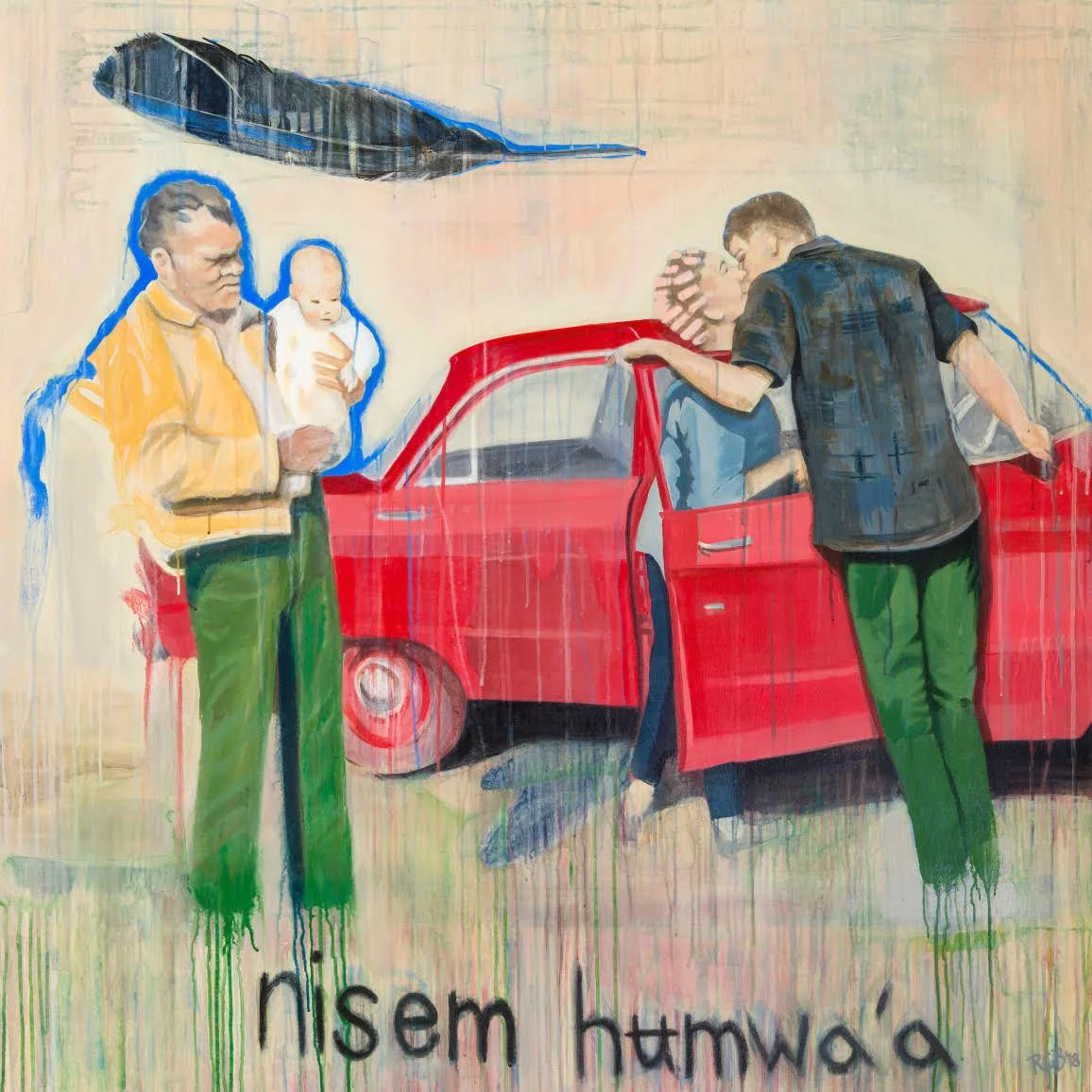
Where Do We Go From Here By Ruth Chase RuthChase.com. Acrylic on Canvas ___________________________________________ “Where Do We Go From Here" expresses the significance of the Nisenan to our community. How the American dream has played a roll in their development as a tribe externally and internally. ‘nisem humwa’a’ is Nisenan for : My family is from my heart or, my heart is drawn to my family (exact translation is difficult). An interpretation of a photo from 1967: Shelly Covert being held by Grandpa Ralph, her mother Ginger (Virginia) Lee Rose-Covert and her father. Created for Belonging, an arts initiative through Nevada County Arts Council and California Arts Council Grant Artist in Communities
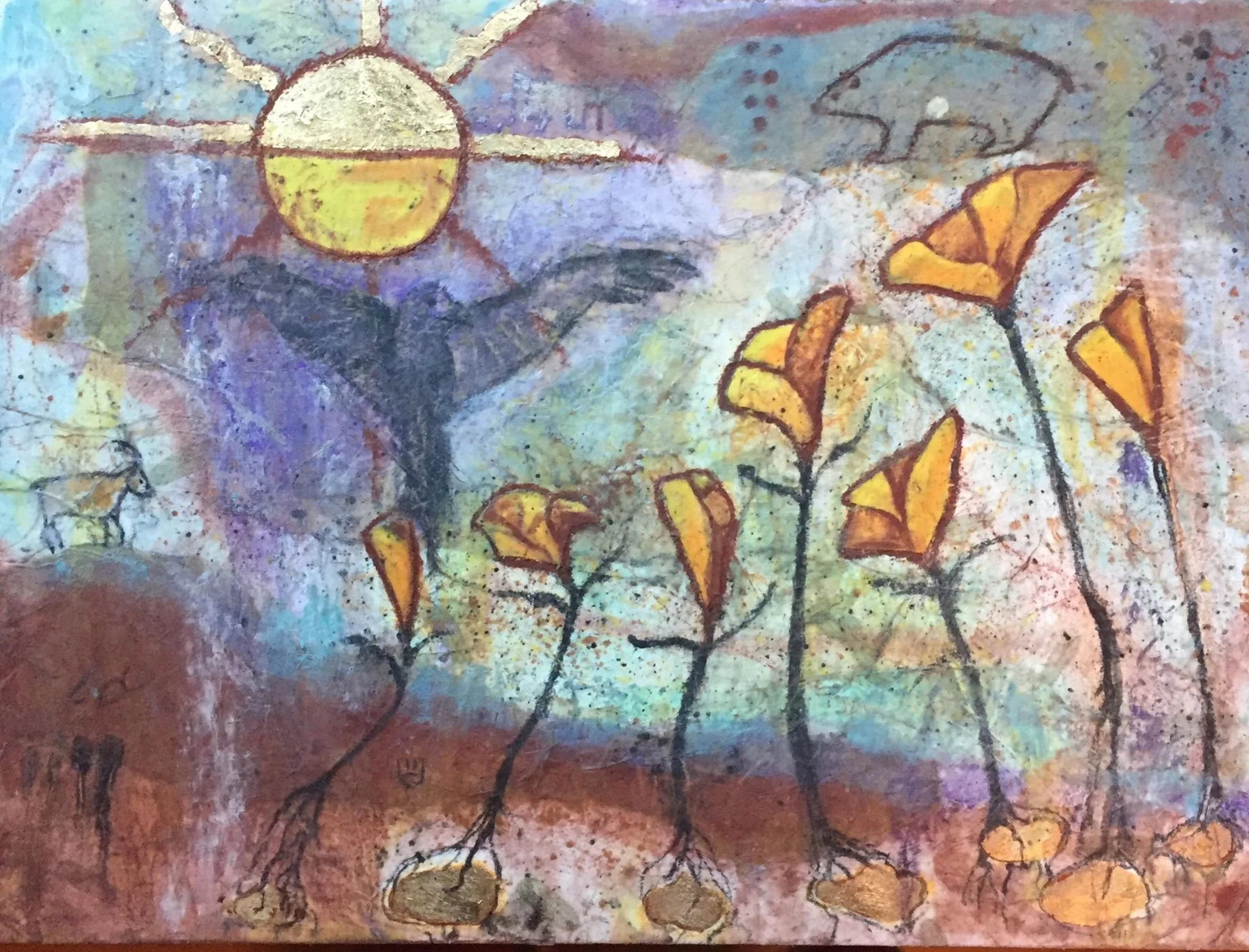
Story of Gold by Jennifer Rugge. Mixed media using natural mineral paints with cold wax on wood canvas. ___________________________________________ (Retold from S. Bray’s version) From Richard Johnson’s book, ‘History of Us, Nisenan Tribe of the Nevada City Rancheria.’ Hahatweenah, a young maiden, is to marry a young chieftain who lives in another tribe closeby. She dreams of the day they will be together. Soon she receives a message that her love has been kidnapped by an unfriendly tribe. The young chieftain is carried off and is offered to the Great Spirit as a sacrifice by his captors. Deeply saddened, she remains true and devoted to her lost Love. She gathers the tiny seeds of the golden poppy during the spring. She travels the hills and valleys scattering the seeds she has saved, planting them along her way as an expression of her love. The poppies multiply and fill the land with golden views of orange and yellow. The Great Spirit observes her devotion and consistency to spread more beauty. Therefore, the Great Spirit sends the roots of the poppy seeds to go down into the depths of the earth to unite with rock. Here under the clothes of the land rock forms into gold, gold that shimmers in the light as do the poppies. Through the winter winds and storms, the seeds are strewn further and further, covering more hillsides and valleys until the countryside is a vast garden of glistening golden poppies…and underground rests the treasures of the golden metal. California poppies - the true essence of gold.
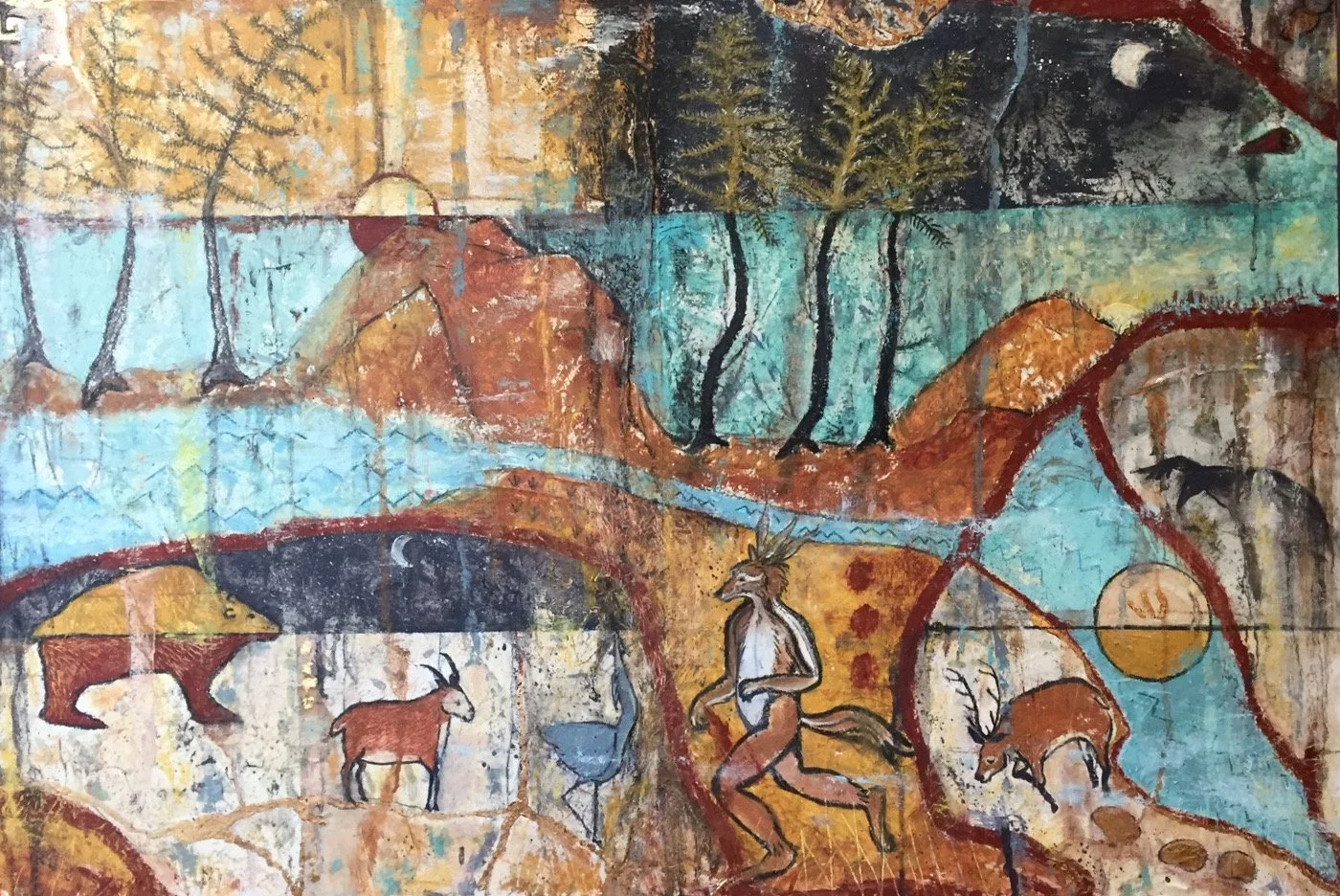
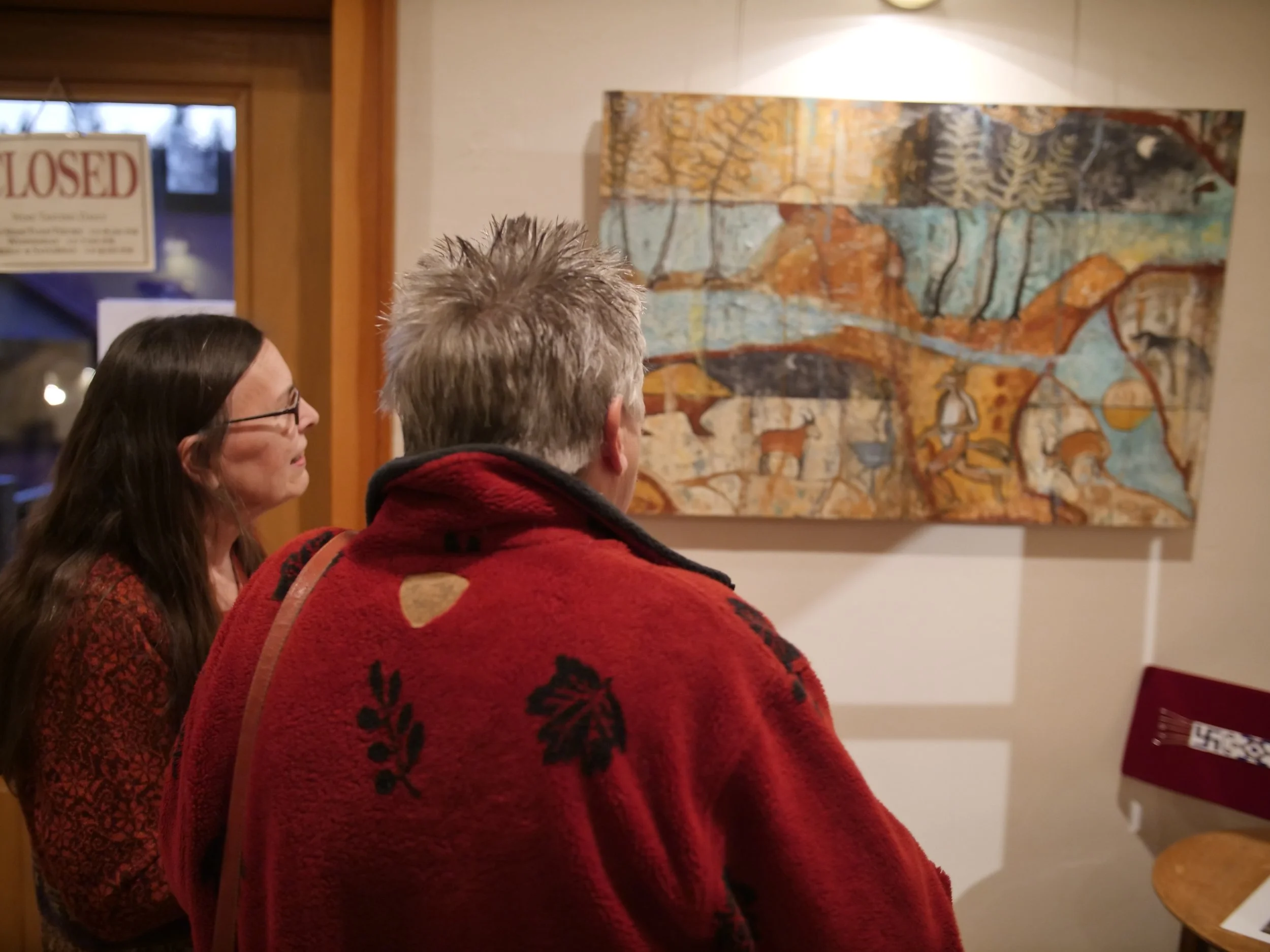
Stories from the Nisenan By Jennifer Rugge. Mixed media using natural mineral paints with cold wax on wood canvas. *Read the painting from the right top to the left, follow the river down and once again read from the right (bottom) to the left. ___________________________________________ "The Gray Pines" The wind picks up and changes directions as the sun descends to rest behind the Earth and her mountains. The gray trees rustle their needles. They stretch their branches and creak their trunks. Then it happens! The trees come alive to begin their dance! The moon rises. The graceful movements of the gray pine trees look black against the darkened sky. The moonlight glistens over the needles bathing them in yellow and white as they flitter and twinkle. The trees sway, jump and dip, moving to the rhythms of the wind as it swirls around them. "What great joy to dance all night long." Day breaks creeping along the ridge, over the gurgling river waters to warm the Earth. The wind subsides. The gray trees return to the stillness of stiffened trunks and arching branches, frozen into positions at Dawn…until once again the dark night frees them into the delight of dance. Shh! These are the gray pines that come alive to dance at night. "Creation" The Great Creator is born first. Shining brightly, Coyote-Man is brought into being out of the clay by Creator. Next rises the Earth. Soon the mountains are reaching for the skies. Then springs bubble to the surface forming into rivers. The animals appear. Coyote helps creation be. He talks to Creator, speaking about what he thinks ought now to be done with all the things created. **The stories in the painting and this writing are inspired from the stories shared in the book by Richard B. Johnson, The History of Us, Nisenan Tribe of the Nevada City Rancheria.
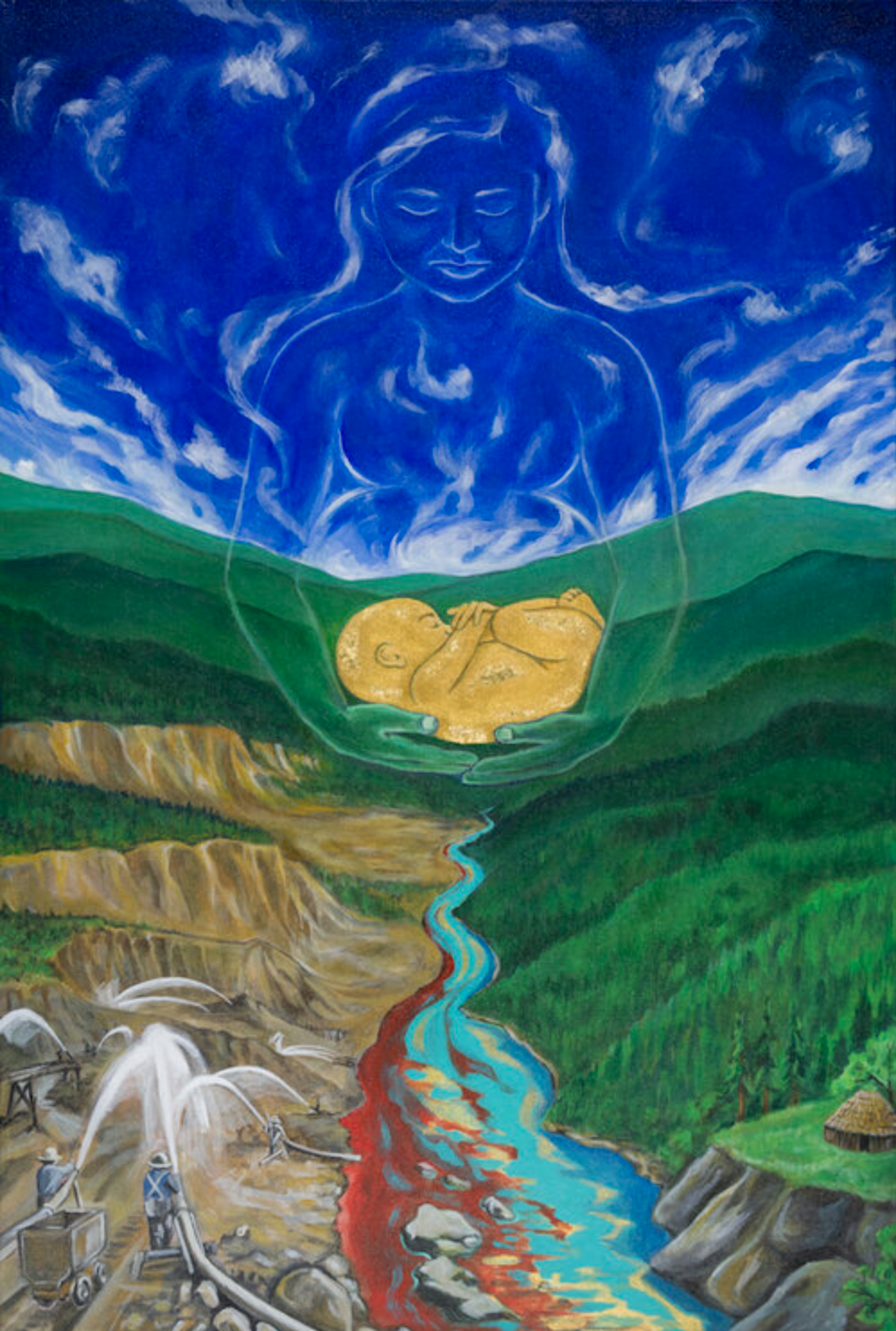
Mother Earth by Mira Clark. Acrylic and Gold Leaf on Canvas. ___________________________________________ This piece was inspired in part by Ginger Covert’s poem with the same title. The image of the Earth as a living being and nurturing mother served as a cultural constraint restricting the actions of human beings in many cultures for millennia. The Nisenan are one such culture. One does not readily slay a mother, digging into her for gold or mutilate her body. The Gold Rush of the 1850’s was devastating to the environment and the Nisenan, reflecting a very different perspective of the Earth’s value. Commercial mining required a specific belief system in regards to the Earth to carry out destructive acts against the environment and other living beings. This painting captures the violation of mining and this clash of beliefs. The Gold baby in this painting represents the precious metal that is like the unborn child of the Mother Earth.
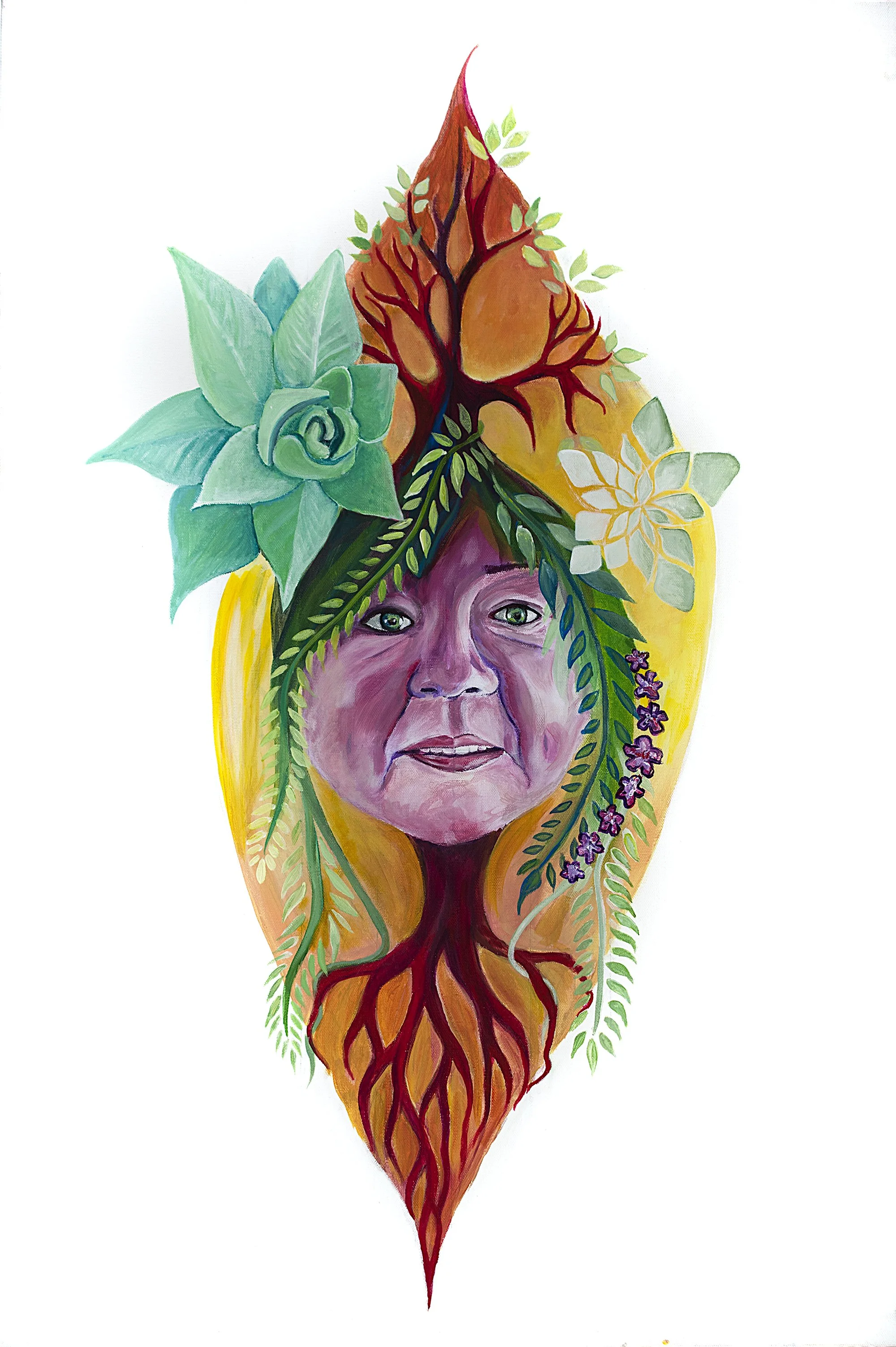
Plant Medicine by Jessa Hurst. Acrylic on Canvas. ___________________________________________ Before this area became known for its abundance of Gold, it was known for being rich in other valuable resources such as medicinal plants. The Nisenan people cared for these medicinal plants, harvested them, and traded them to neighboring tribes. The plant keepers, where important members of the tribe. The knowledge of these healing plants was cherished and this wisdom was passed down from generation to generation. When colonizers came to this area, the Nisenan people were not able to tend to the plants as they once did and the wisdom of this resource was greatly diluted. A few members of the tribe remain who still carry this plant wisdom. In this painting Lorena Rose Davis, one of the remaining plant wisdom holders, is depicted, surrounded by several of the local medicinal plants.
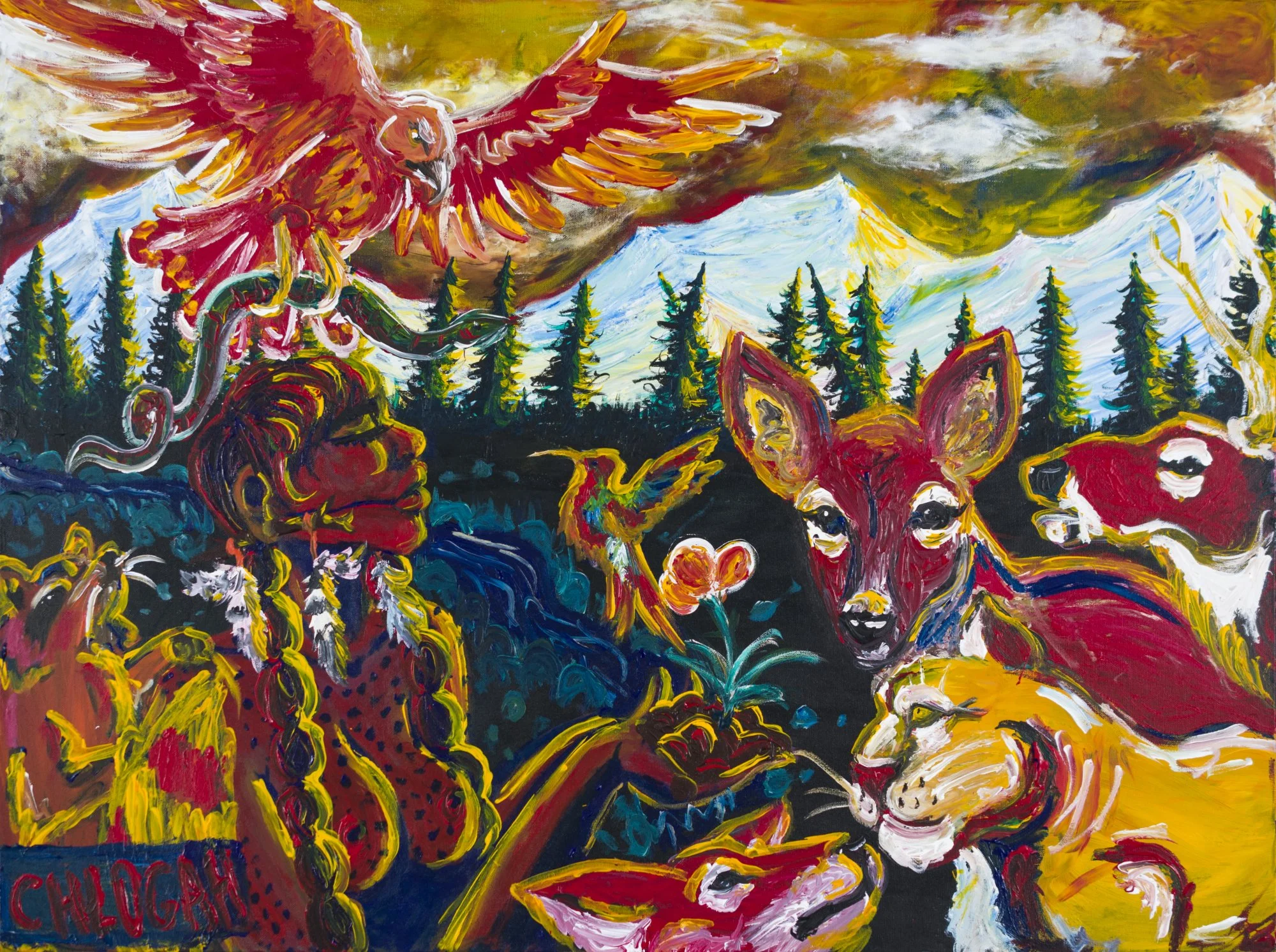
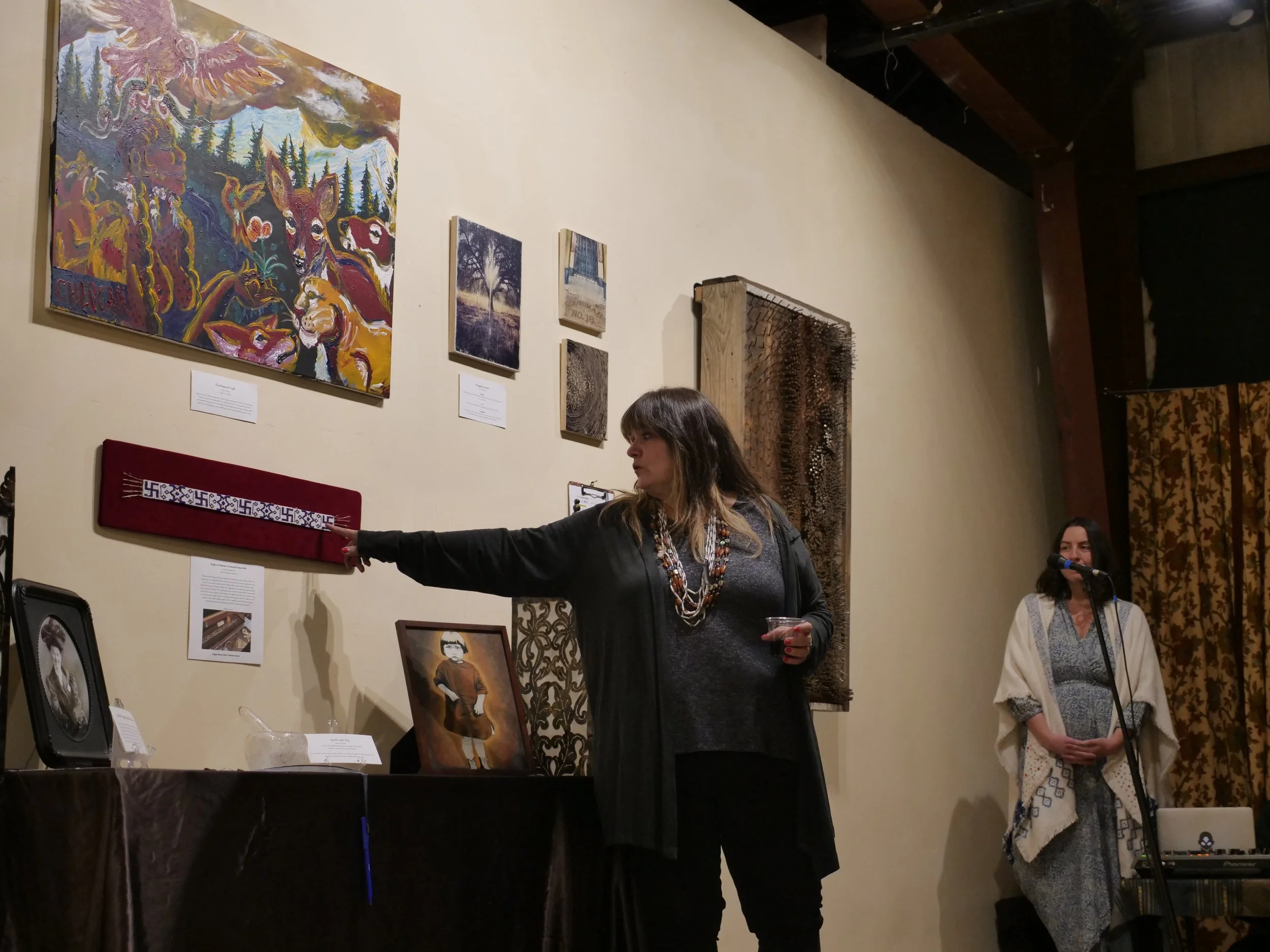
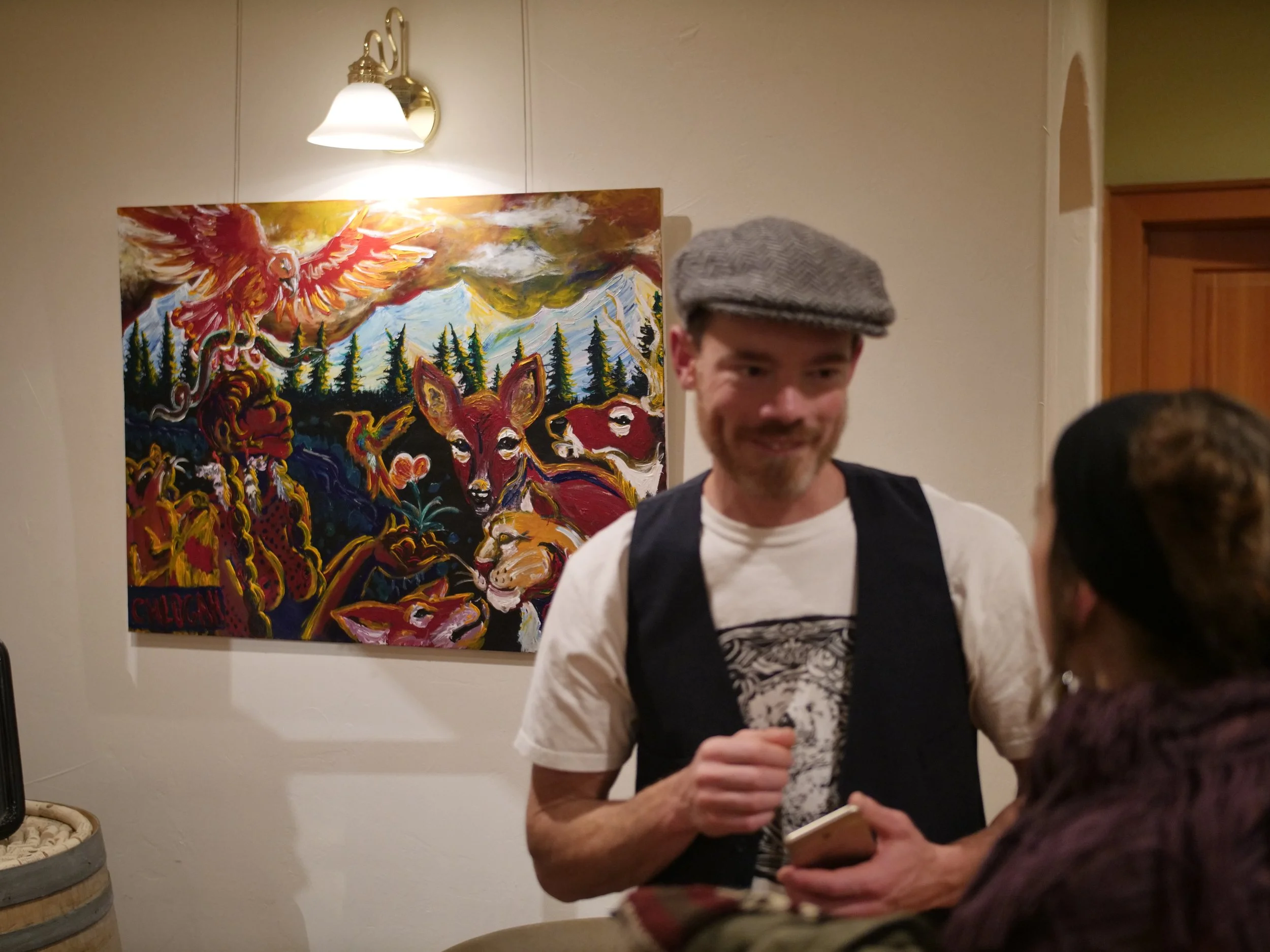
The Woman of Truth By Chloe Young. Acrylic on Canvas. ___________________________________________ My piece is of a Nisenan woman surrounded by the animal spirits of the local area as she stands strong in the woods with the sunset without fear. The mountains are of the Sierras with the grassy tree-covered hills of Grass Valley/Nevada City area below it with gold flakes freely flying around resembling freedom from the gold mining of the area.
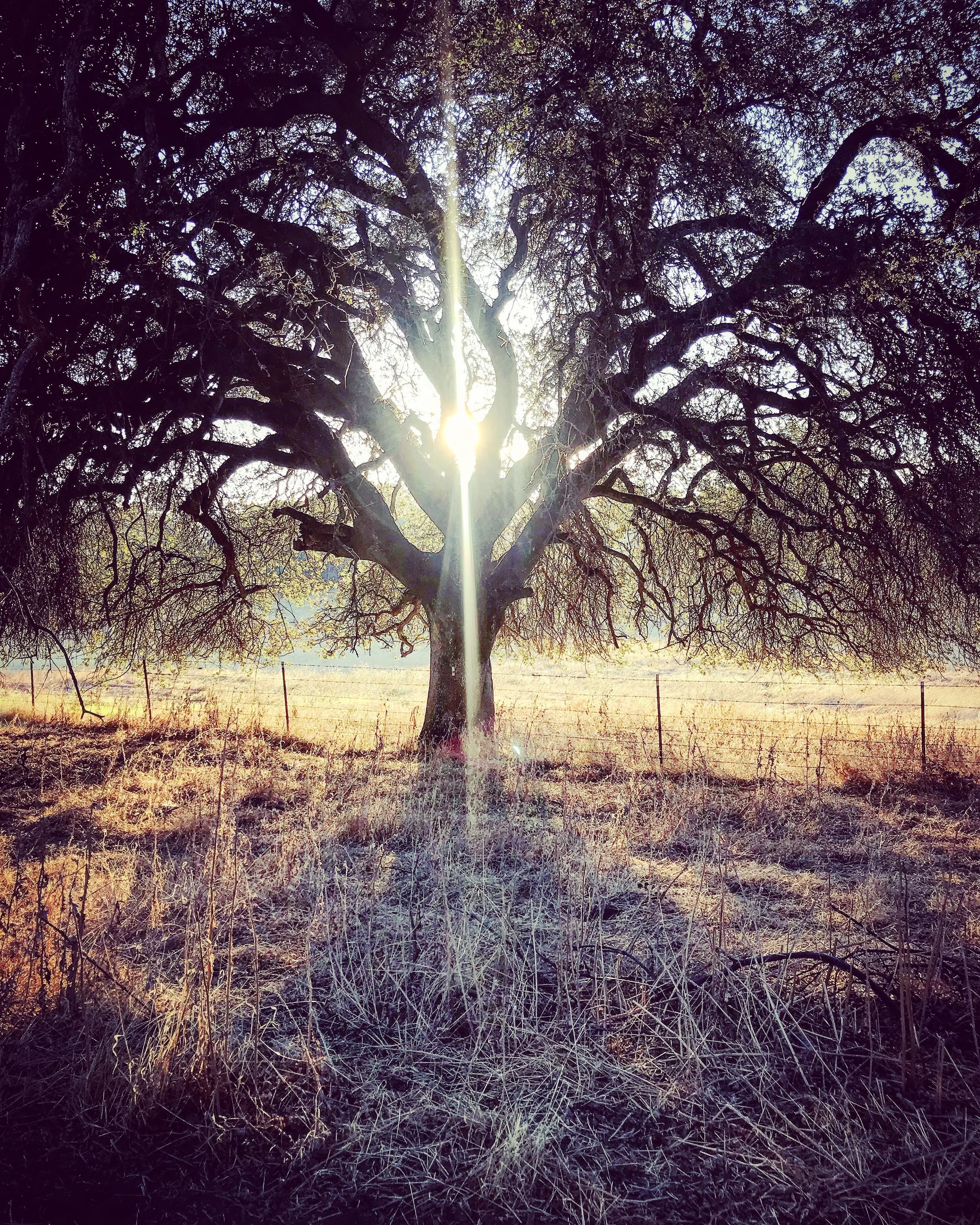
Tree By Lori Lachman. Photographs on Wood ___________________________________________ The fence cannot stop the tree from growing and the spirts from moving.
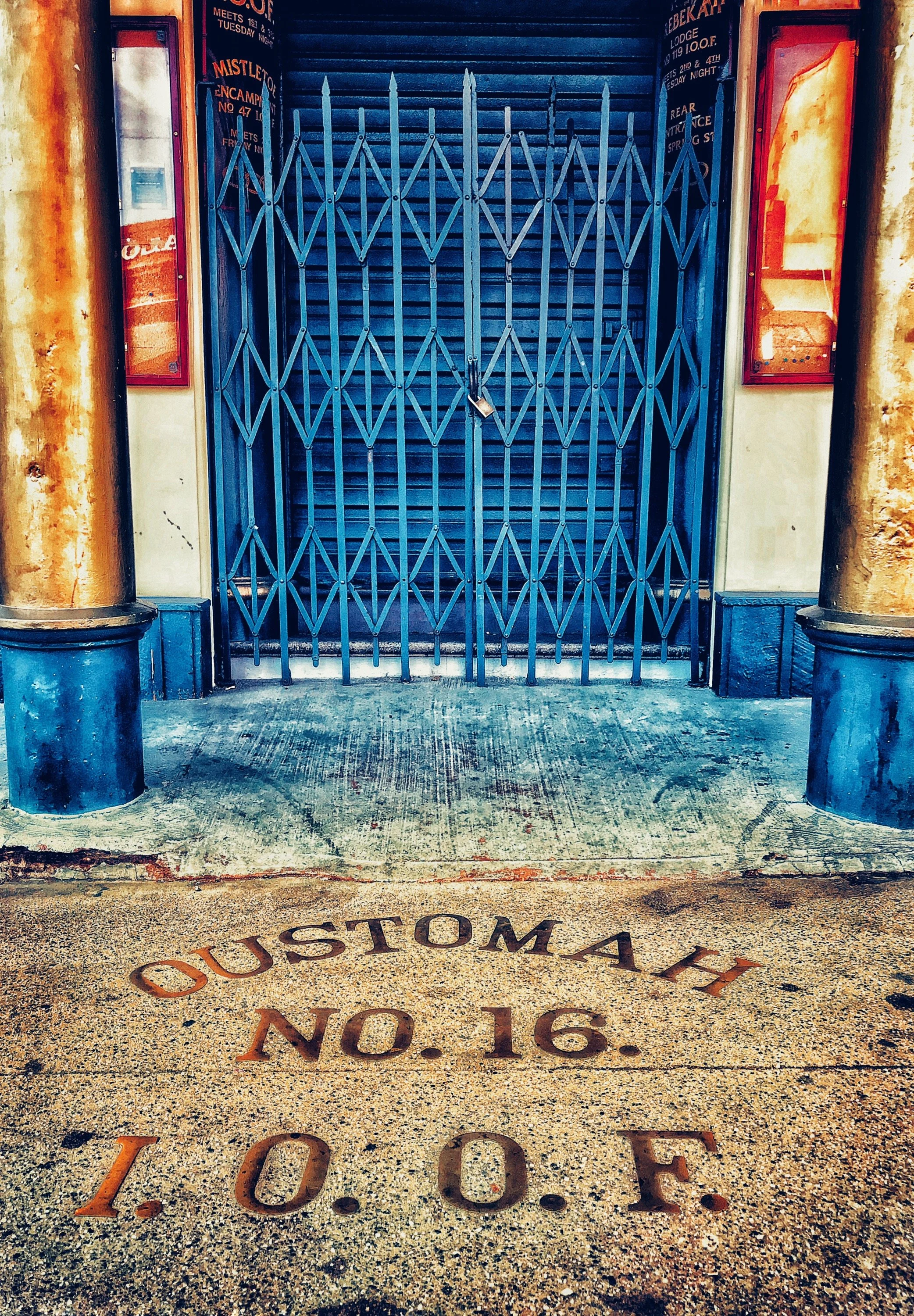
“Oustomah” 'ustomah by Lori Lachman. Photographs on Wood ___________________________________________ The original name of the Nisenan town that lies beneath Nevada City, ever emblazed in our sidewalk, thanks ironically to the Oddfellows in the early 1800s.
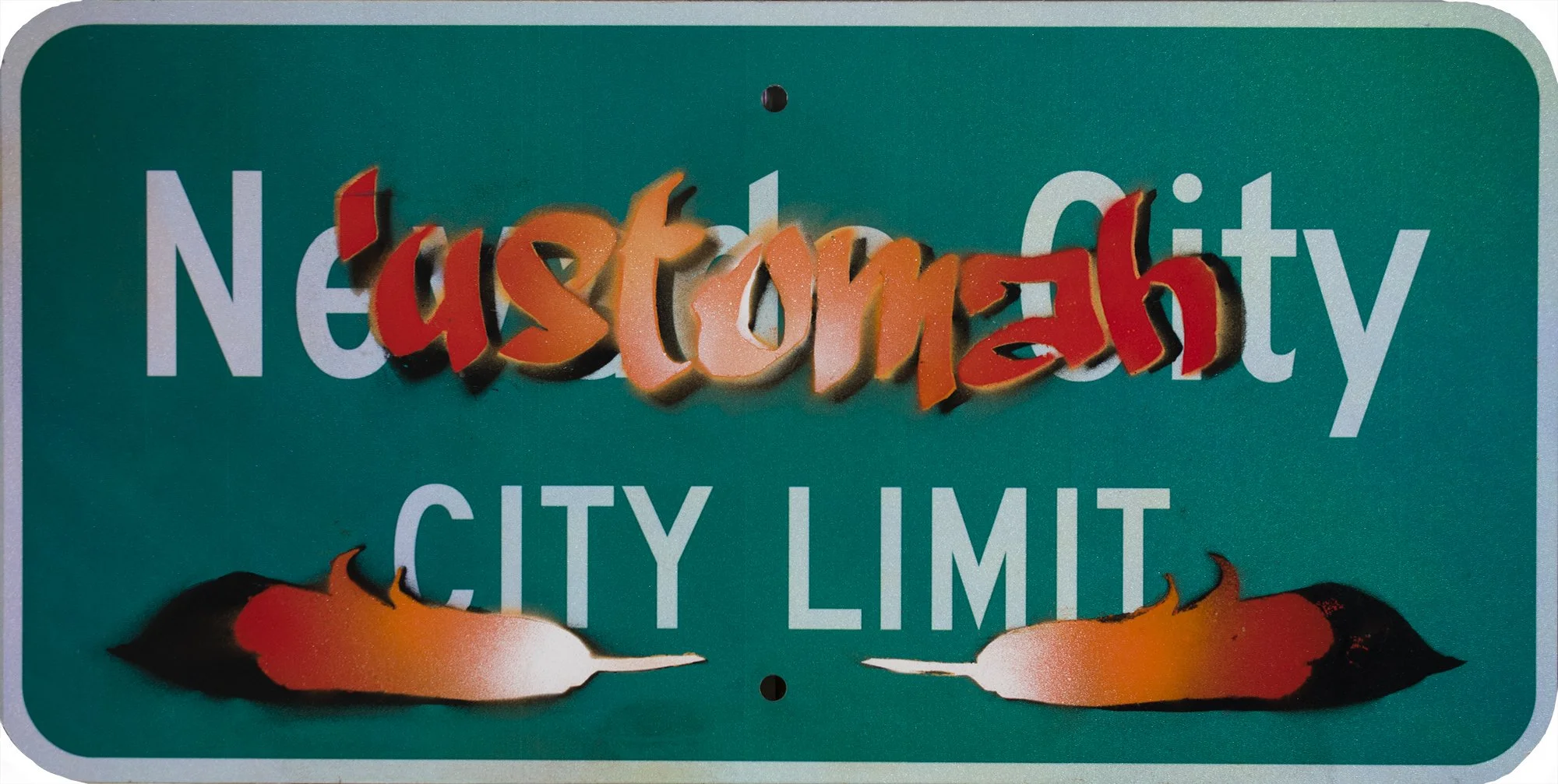
True Names by Robert “Bo” Blain. Lawfully acquired aluminum street signs and spray paint. ___________________________________________ The disruption of indigenous languages as part of a broader infiltration of indigenous culture has been a strategy of empire building societies for ages. If a people lose their language they also lose the stories, memories, spirits, and connections to the land held within their original words and expressions. For the Nisenan the process of forced forgetting was done via various coercive means which forced them to assimilate to the point eventually trying to hide their indigenous identities to avoid discrimination and violence. Another strategy used to erase Nisenan language was the forced placement of Nisenan children into boarding schools where they were further severed from their words, traditions, and place. A remembering is taking place within the remaining Nisenan who have begun the challenging task of reincarnating their original language. This graffiti was created to support this Nisenan remembering process and in the spirit of reclaiming the true names, and with them the stories of the original people, of the lands on which we live. ‘ustomah (oo-sto-maa)– Is the true name for the place now occupied by the municipal incorporation called NEVADA CITY. daspah (da-sp-aah)– Is the true name for the place now occupied by the municipal incorporation called GRASS VALLEY.
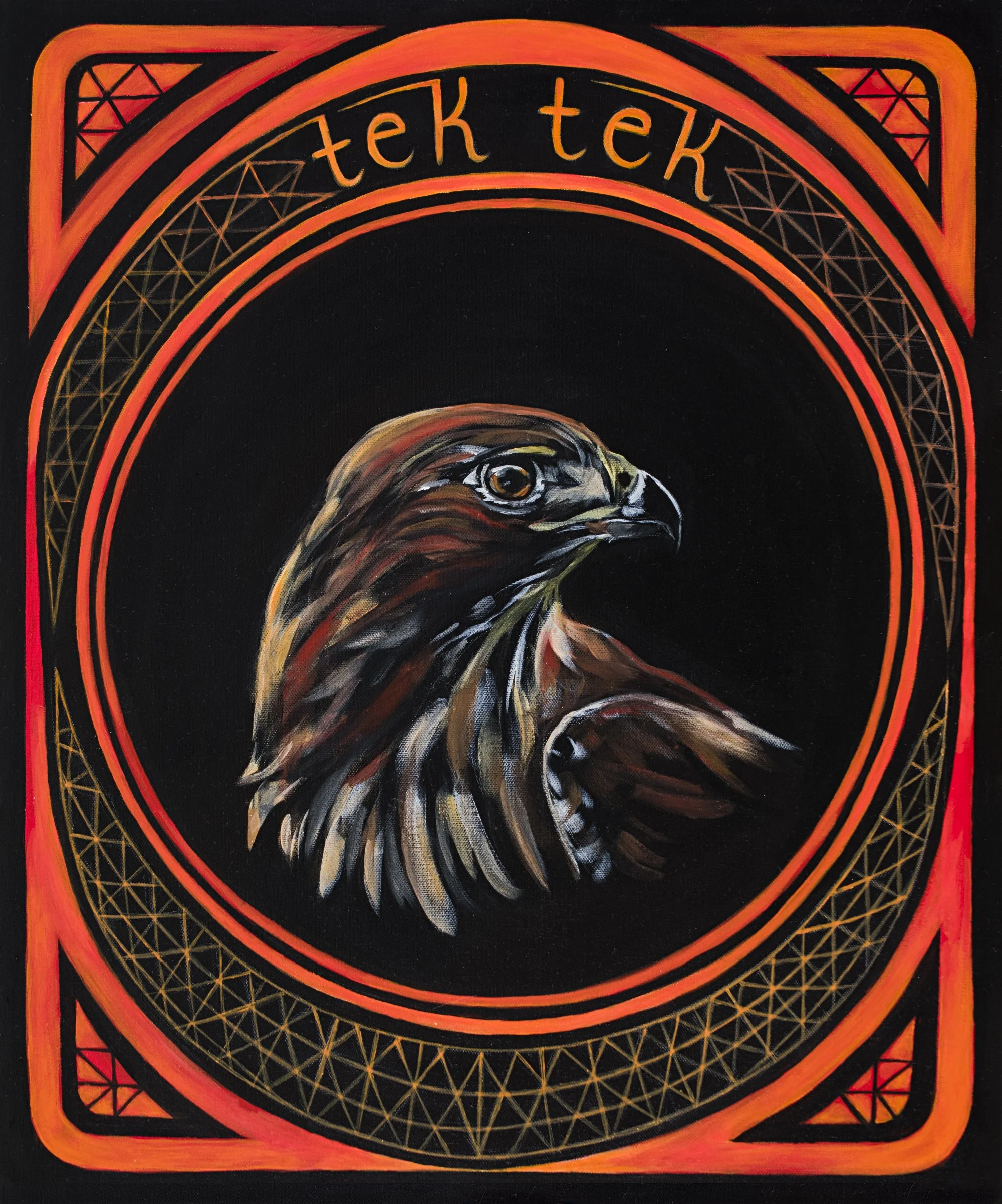
Tek Tek by Mira Clark existinspired.com . ___________________________________________ “Language is power. Language is the main conduit for culture, our languages connect us to our people, our landscapes, and to each other. We were told the Nisenan Language, ‘was an extinct language,’ but our Elders were still speaking, singing, and telling stories. We have worked to have the language reclassified as a ‘sleeping language,’ we are reclaiming our connections and participating in our culture. ‘Tek Tek’ is the Nisenan word for a red tailed hawk. Tek Tek watches everything and sees this happening and stands witness to the revival of our past, history and culture.” -Shelly Covert
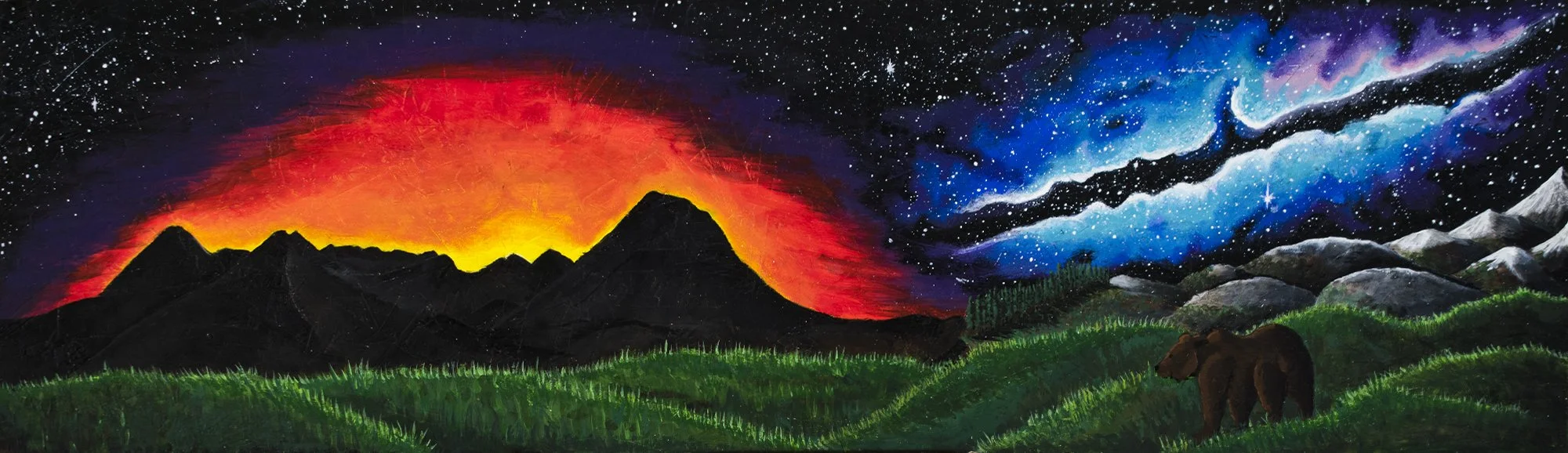
Estom Yanim Yamanan by Rama Cryer. Acrylic on Plywood. ___________________________________________ Honor the land. Remember the time before the settlers, when the Nisenan were the guardians of the earth. A time when the elk & antelope would roam in herds so vast, they would blacken the hills. When the great condors soared above, and the stars in the sky shone so bright, a clear map to navigate by. Remember the time when the Jom Kapa (grizzly bear) ruled the hills. When mother ‘uba (Yuba) was rich with salmon and ran, uncontrolled, down from the foothills to the feet of the sacred ancestral home, Estom Yanim.
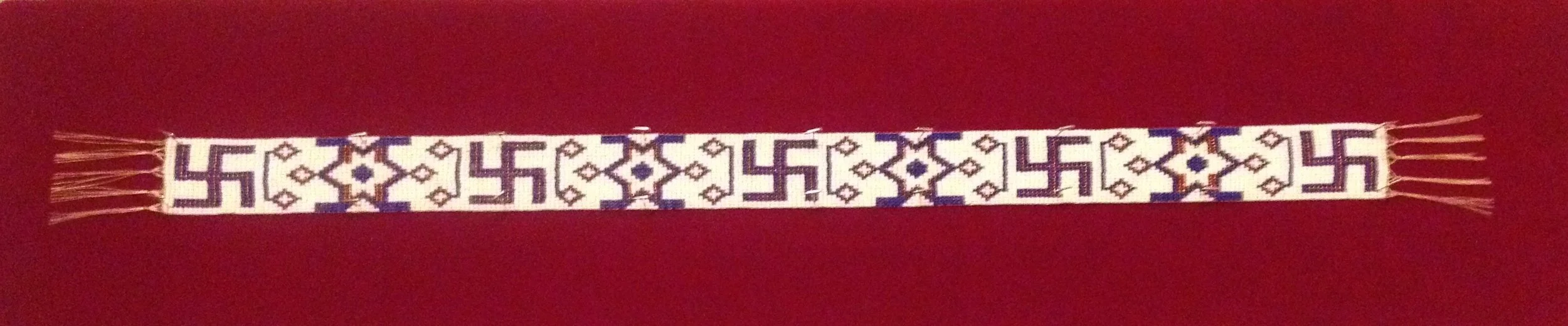
Replica of Nisenan Ceremonial Dance Belt by Victoria Moran. Made with beads and loom. ___________________________________________ “This is a beautifully crafted reproduction of a Nisenan ceremonial dance belt. The original piece is displayed at the Firehouse No.1 Museum in Nevada City where it is on loan from a Nevada City Rancheria Tribal member as part of the Nevada County Historical Society’s Nisenan Exhibit. The original piece is in extremely fragile condition and cannot be handled. The original piece was created in the late-1800’s and was well used until it was put away for safekeeping. The pattern is of the four directions and is an ancient power symbol used across the planet by many cultures for millennia. The ancient Hindu and Buddhist symbol of the “Swastika” used by the Nazi party, is possibly the world’s most famous example of cultural appropriation.” -Shelly Covert
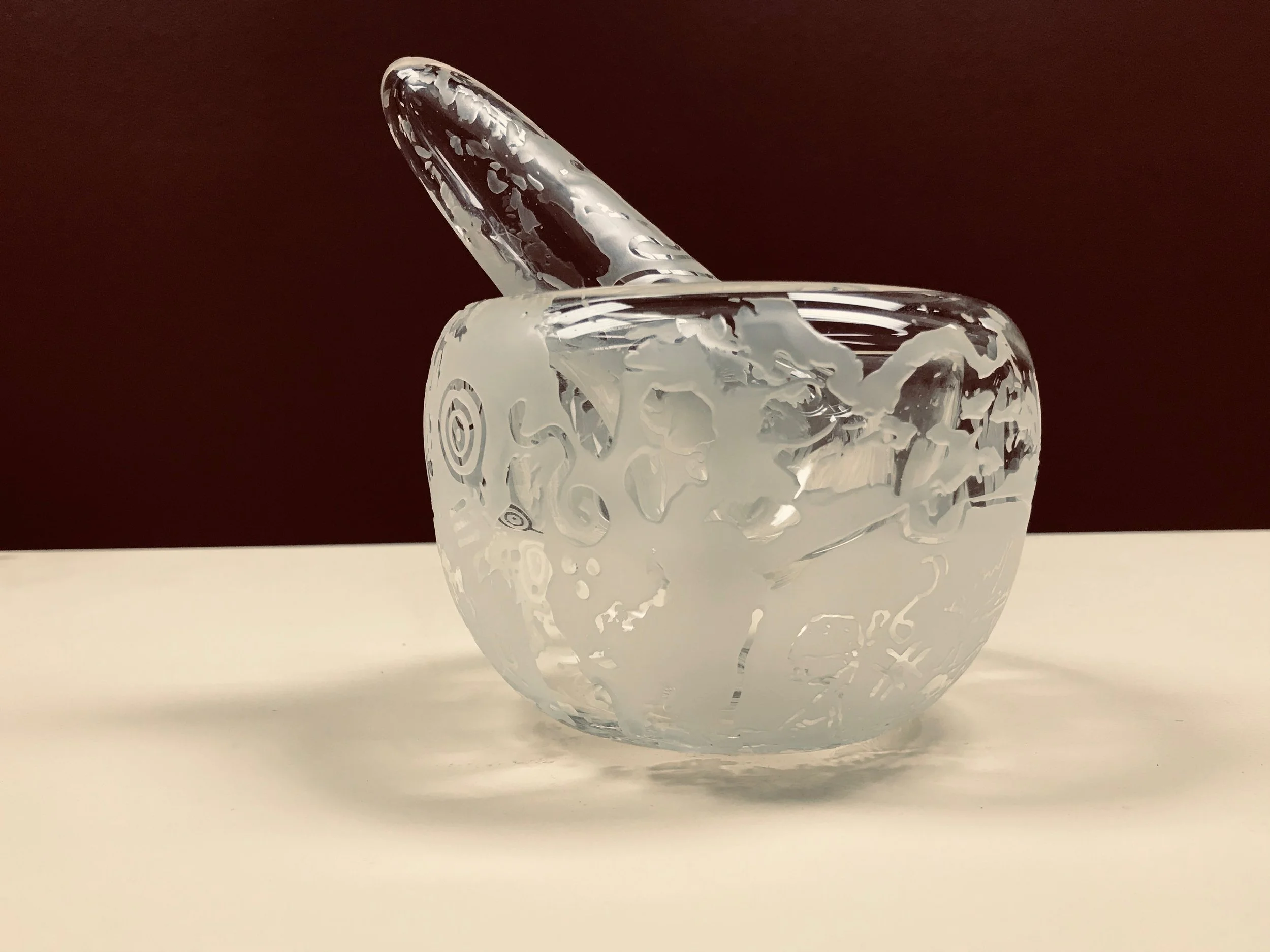
'eyi nik • pulu • baj (Grinding Stone) by Bishop Randall. Lampworked, sand carved glass ___________________________________________ First, there were the First People and the First People changed into trees, plants, rocks, rain, hail, and animals. And then Animals made Our People.
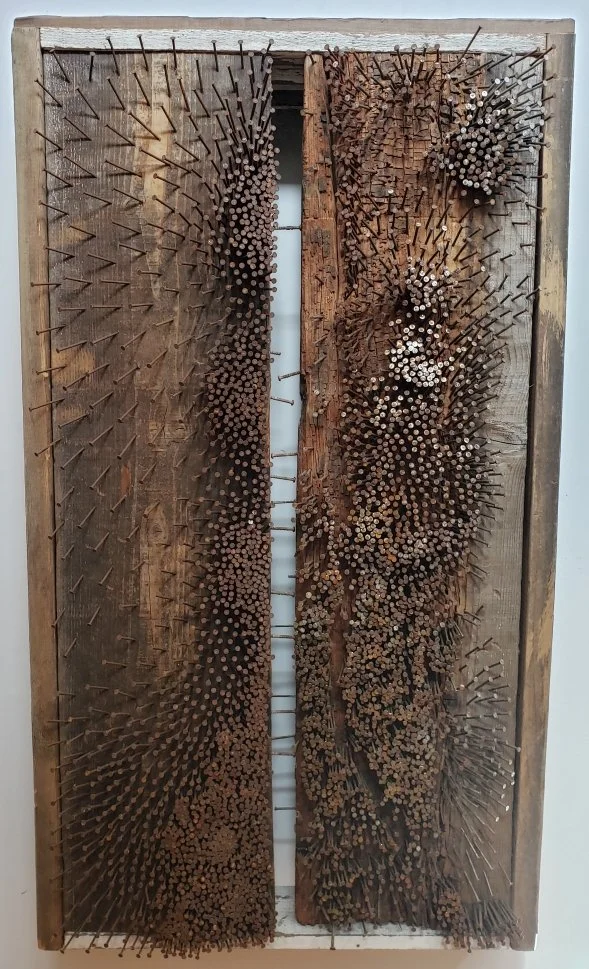
Oppression & The Return to Innocence by Tracy Parker. Found wood and nails. ___________________________________________ This piece explores at the cellular and mythic levels the energetic depiction of oppression, loss of innocence, taking of land, the crystallized energy found in the cellular memory of abuse, lying deep within the invisible underworld of remembering- A mapping of soul fracture and pain body afflicted by the unconscious masculine, onto the feminine, onto the indigenous lands of Nisenan and within the wombs and bellies of the Nisenan women, men, and children. Currently the Nevada City Rancheria Nisenan people, 144 remaining today, do not have a Ceremonial Round House for healing on land, collective prayer, and for practicing their ancestral ways of releasing the dead back to the source, the Milky Way, by way of fire. The intention of this piece is to activate awareness, resources and the funding necessary to construct a Ceremonial Round House for the Nisenan people.
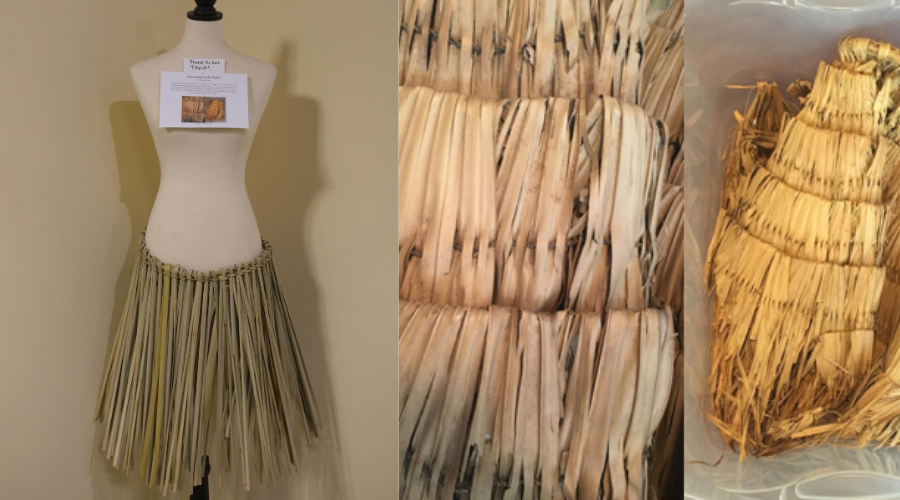
Nisenan Inspired Skirt Replica by Teighlor Renee. Local Cattail. The replica on left, Original on right. ___________________________________________ This Nisenan skirt is an inspired replica made by artist Teighlor Renee. Skirts were used both ceremonially and as everyday wear by the Nisenan. However, this is not an exact replica and is made from local cattail where the originals were made from Tule. Also, this skirt would be one that was for everyday use and not ceremonial.
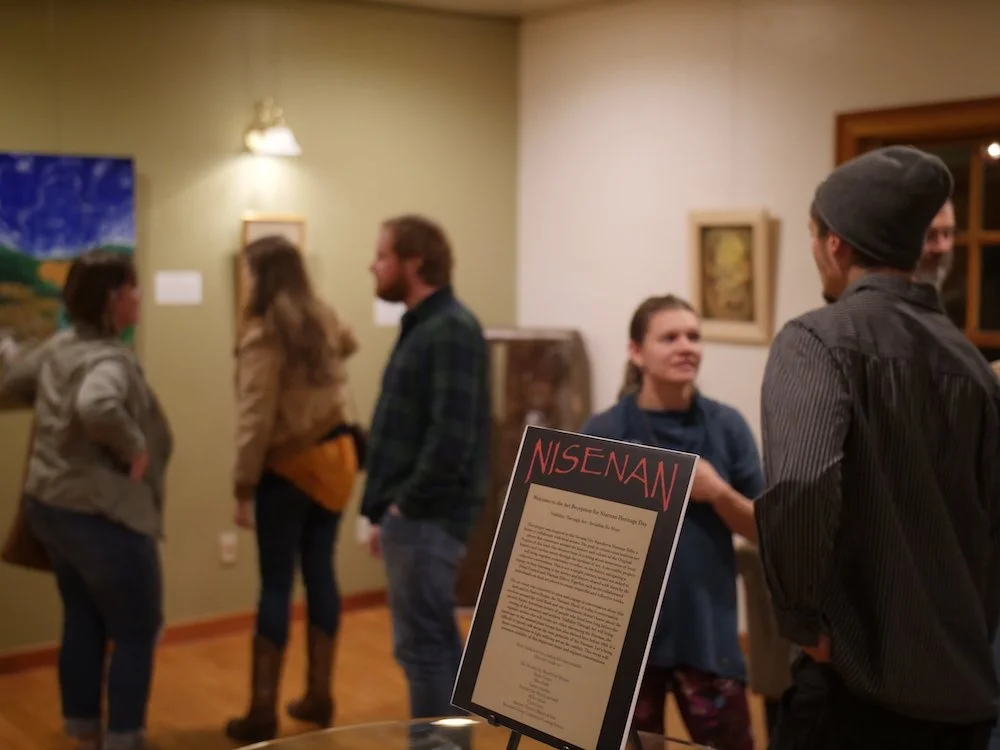
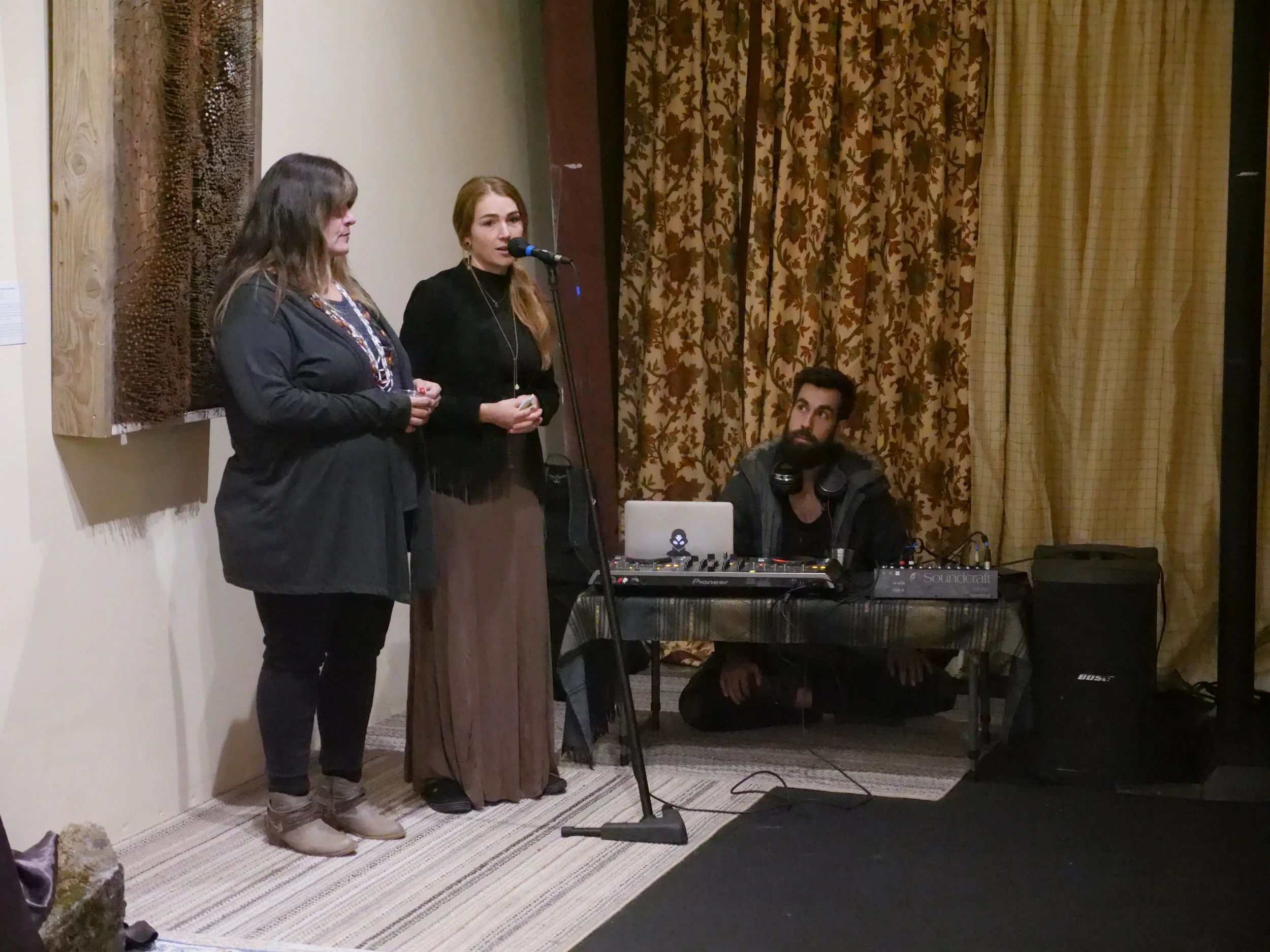
NISENAN HERITAGE DAY 2018
OPENING ART RECEPTION
Archival Note
This exhibition was presented before the opening of the 'Uba Seo: Nisenan Arts & Culture gallery in 2021.
During the early years of Visibility Through Art, annual exhibitions were held in conjunction with Nisenan Heritage Day and took place at community venues throughout Nevada City.
These exhibitions helped establish the foundation for what would become the gallery and ongoing Visibility Through Art program.
Today, ‘UBA SEO serves as the permanent home for Visibility Through Art exhibitions while preserving the history of the program's earlier projects.